Gong Call Recording: Features, Setup & Pricing Guide [2026]
Complete guide to Gong. Explore key features like AI transcription & coaching metrics, see real pricing, and learn how to set up recording for Zoom & Teams.

![Gong Call Recording: Features, Setup & Pricing Guide [2026]](https://cdn.sanity.io/images/gb4upfg4/staging/e05645811cdeb8777e6e2f700416170082be7479-1536x864.jpg?w=1080&h=608&fit=crop&auto=format&q=75)
What is Gong Call Recording?
Gong Call Recording is more than a simple recording tool—it's a revenue intelligence platform that automatically captures, transcribes, and analyzes your sales conversations across web conferencing platforms (Zoom, Teams, Meet) and phone systems.
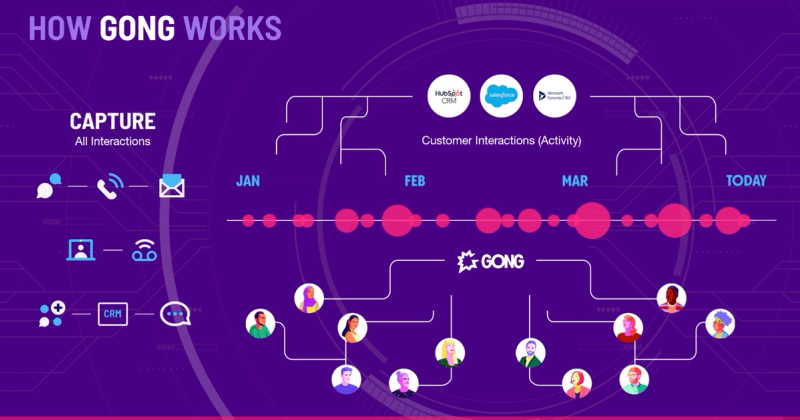
Here's how it works behind the scenes:
The 4-Step Process
- Calendar Sync – Gong connects to your Google Workspace or Office 365 calendar to detect upcoming meetings
- Capture – Calls are recorded using either native integration (seamless, no bot visible) or by adding a Gong bot as a virtual participant
- Storage – Recordings are encrypted and stored on AWS servers (default 7-year retention)
- AI Analysis – Gong's AI transcribes conversations, identifies key moments, tracks talk ratios, and flags topics like competitor mentions or objections
One standout insight: Gong's data shows that top-performing reps maintain a 43:57 talk-to-listen ratio—meaning they speak 43% of the time and let prospects talk 57%. This isn't just tracking calls; it's using data to reveal what actually drives deals forward.
Unlike basic recording tools, Gong captures video, phone calls, and even email threads to give you complete visibility into the buyer journey.
What are the Benefits of Gong Call Recording?
Gong Call Recording provides numerous advantages:
- Personalized Coaching: Offers tailored coaching insights based on each rep's performance, helping them refine their techniques.
- Total Visibility: Captures every detail of a call, giving leaders a comprehensive view of interactions with customers.
- Market Insights: Analyzes trends and competitor mentions to identify emerging market opportunities.
- Company-Wide Sharing: Enables team-wide sharing of winning strategies to improve overall performance.
- Faster Onboarding: Shortens the onboarding process by giving new hires access to top-performing call recordings.
Understanding the benefits is one thing—but here's what Gong actually does under the hood that separates it from basic recording tools.
What are Gong's Recording Key Features?
Gong isn't just recording calls and storing them in a library. The real value is in what happens after the call ends—how it turns raw audio into actionable intelligence.
AI Transcription & Search
Gong transcribes calls in near real-time (usually within 5-10 minutes) with accuracy that handles industry jargon, accents, and crosstalk better than most competitors. But transcription is table stakes. What matters is search.
You can search for keywords across your entire call history—every mention of "budget," "competitor," or "legal review"—and Gong will pull up specific moments from hundreds of recordings. No more guessing which call had that important objection. One search, every instance, timestamped.
Coaching Metrics & Scorecards
This is where Gong gets interesting for managers. After every call, Gong calculates metrics that reveal how reps are performing:
- Talk-to-Listen Ratio – Top performers hit 43:57 (they talk 43% of the time, prospects talk 57%)
- Longest Monologue – How long your rep talks without letting the prospect respond (red flag if it's over 2 minutes)
- Patience Score – How long the rep waits before jumping in after the prospect stops talking (best reps wait 3-4 seconds)
- Questions Asked – How many discovery questions the rep asked vs. how many features they pitched
You can build custom scorecards based on your sales methodology (MEDDIC, BANT, SPIN, SPICED) and automatically grade every call. Instead of saying "you need to ask better questions," you can show a rep that their question count dropped from 12 to 4 over the past month.
Deal Intelligence

Gong doesn't just analyze individual calls—it looks at deal patterns across your entire pipeline.
If a deal goes silent (no calls or emails for 10+ days), Gong flags it as "at-risk." If a late-stage opportunity has never mentioned legal or procurement, Gong surfaces that gap. If a competitor name keeps appearing but your reps aren't addressing it, you'll see that trend before it kills deals.
This is the shift from sales call recording to revenue intelligence—using data to predict outcomes, not just review what happened.
Call Spotlight & Smart Trackers
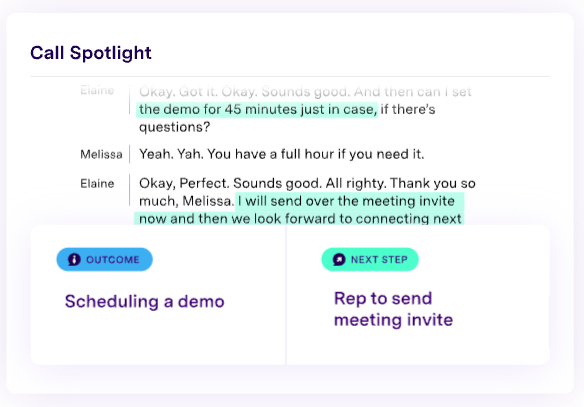
Nobody has time to watch 50-minute discovery calls. Gong's Call Spotlight feature highlights key moments—pricing discussions, objections, next steps, competitor mentions—so you can jump directly to what matters.
Smart Trackers let you monitor specific topics across all calls. Want to know every time a prospect mentions "budget concerns"? Set up a tracker. Gong will scan every call and compile a list of those moments, complete with timestamps and context. This is how product teams gather feature requests at scale and how sales leaders spot emerging objections before they become deal-killers.
Video Portability
Gong lets you download recordings as MP4 files or share snippets externally (if your admin enables it). This is useful for:
- Creating training clips from top-performing calls
- Sharing demo recordings with prospects who missed the live session
- Building a library of objection-handling examples for onboarding
One note: download permissions are controlled at the admin level, so you might need to request access if you don't see the option.
Gong Pricing & Real Implementation Costs
Gong doesn't publish pricing on its website, and there's a reason: the total cost of ownership is a lot higher than most teams expect.
Gong Pricing Calculator: Estimate Your First-Year Cost
Trying to budget for Gong before entering a sales call? This calculator gives you a rough estimate based on your team size and expected usage.
Gong Pricing Calculator
Estimate your investment in Gong's revenue intelligence platform
Number of Users: 10 Starter Tier 5 100 250 500 Annual User License Cost Based on volume pricing $16,000 Estimated Annual Platform Fee Minimum estimate $5,000 One-Time Onboarding Fee Average implementation cost $7,500 Total Estimated First-Year Cost $28,500 Effective Cost Per User Per Month (Year 1) $238Switch to Claap and Save Claap Annual Cost $8,000 Your Annual Savings with Claap $20,500 72% less expensive Based on $800/user/year • No platform fees • Simple onboarding
For more information, check out our article about Gong's pricing.
The Cost Structure
Gong charges in two parts:
- Platform Fee: $5,000 - $50,000 annually (scales with team size and feature tier)
- User Licenses: $1,200 - $1,600 per user per year
For a 20-person sales team, expect to pay roughly $30,000 - $35,000 in the first year for licenses alone. Add the platform fee, and you're looking at a minimum annual commitment of $35k-$85k.
The "Hidden" Costs
Beyond the sticker price, Gong requires:
- Implementation fees: $15,000+ for onboarding, CRM integration, and training
- Mandatory professional services: You can't just sign up and start using it—Gong assigns a customer success manager who walks you through a 6-8 week setup process
- The 3-year contract lock: Many customers on G2 report being locked into multi-year contracts with steep penalties for early termination
Implementation Timeline (Be Realistic)
Gong's sales materials promise fast setup, but real customers report a different experience:
- Week 1-2: Calendar sync and basic recording setup
- Week 3-4: CRM API integration (this is where delays happen)
- Week 5-6: Custom trackers, scorecards, and coaching templates
- Week 7-8: Team training and adoption push
If your CRM has custom fields or non-standard workflows, add another 2-4 weeks. This isn't Gong's fault—it's the reality of enterprise software. But if you need something running quickly, know that Gong is built for scale, not speed.
Who Should Use Gong Call Recording?
Gong Call Recording is suitable for:
- Sales Representatives: To review their own performance and learn from the team's top reps.
- Sales Managers: To identify training opportunities and monitor rep adherence to best practices.
- Market Analysts: To analyze market trends and gain insights into competitors.
How Do I Use Gong Call Recording?
Setting up Gong to record calls depends on whether you want automatic recording for all scheduled meetings or manual recording for ad-hoc conversations.
Method A: Automatic Recording (Calendar Sync)
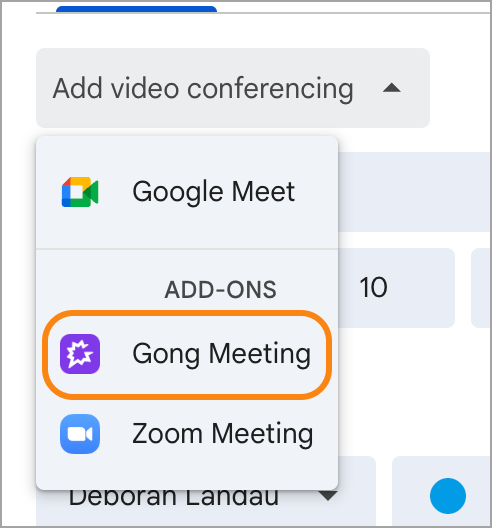
This is the standard approach for teams who want hands-off recording:
- Connect your calendar – Link your Google Workspace or Office 365 account in Gong's settings
- Schedule meetings 30+ minutes in advance – Gong's system needs time to prepare the recording
- Include an external email – At least one participant must have an email address outside your company domain (this triggers Gong's detection)
- Let Gong handle the rest – The platform automatically joins and records when the meeting starts
Method B: Manual Recording (The Assistant Email)
For unscheduled or last-minute calls:
- Invite assistant@gong.io to your meeting (or add it during the call)
- Gong's bot will join within 30-60 seconds
- Recording starts immediately and appears in your library 5-15 minutes after the call ends
Platform-Specific Setup
Zoom
- Native recording (preferred): Enable Gong in your Zoom admin settings under "App Marketplace" – no bot appears to participants
- Bot recording (fallback): Gong joins as "Gong Bot" if native integration isn't configured
- Common issue: The Zoom user who creates the meeting must match the Gong user, or auto-recording won't work
Microsoft Teams
- Gong joins as a guest participant (bot visible to everyone)
- Disable "waiting room" for external participants in your Teams settings, or the bot won't be able to join
- For Teams phone calls, you need a supported telephony provider (RingCentral, Aircall, etc.)
Phone/VoIP Systems
Gong integrates directly with providers like RingCentral, Aircall, Dialpad, and Outreach Kaia. Check Gong's integrations page to confirm your system is supported—standard desk phones won't work without VoIP.
Troubleshooting: Why Is Gong Not Recording?
If Gong isn't recording your calls, here's a step-by-step troubleshooting checklist:
The Pre-Recording Checklist
Before assuming there's a technical issue, verify these basics:
- Scheduled 30+ minutes in advance? – Gong needs lead time to prepare. Last-minute meetings may not trigger auto-recording.
- External email on the invite? – At least one participant must have an email outside your company domain (e.g., a customer or prospect).
- License match? – The Gong user who scheduled the meeting must be the same person logged into the web conferencing platform. If you create a Zoom meeting on behalf of someone else, recording won't work.
- Calendar sync active? – Check Gong's settings to confirm your calendar integration isn't expired or disconnected.
Platform-Specific Errors
Zoom Issues
- Problem: "Meeting host doesn't allow recording"Fix: Go to your Zoom admin settings → Recording → Enable "Local Recording" and "Cloud Recording" for all users
- Problem: Gong bot joins but doesn't recordFix: The meeting host must grant recording permission when the bot joins—check if the host is dismissing the prompt
Teams Issues
- Problem: Bot stuck in waiting roomFix: Disable the "waiting room" feature for external participants in your Teams admin center (Meetings → Meeting Settings → Participants)
- Problem: Recording missing for phone callsFix: Teams phone calls require a supported telephony provider—standard PSTN calls won't be captured
Processing Delays
Recordings don't appear instantly. Gong needs 5-15 minutes after a call ends to process, transcribe, and publish it to your library. If it's been longer than 20 minutes, contact your Gong admin.
Compliance, Consent & Security
Recording sales calls isn't just a technical decision—it's a legal one. Here's what you need to know to stay compliant and avoid nasty surprises.
Consent Features in Gong
Gong gives you three ways to notify participants that calls are being recorded:
- Audio Prompts – An automated voice announces "This call is being recorded" when someone joins
- Pre-Call Emails – Gong can send a notification to external participants before the meeting starts
- In-Meeting Banners – For Zoom and Teams, a visual indicator appears on-screen during recording
You can toggle these on or off in Gong's admin settings, but here's the catch: choosing "Enable" instead of "Enforce" leaves compliance up to individual reps. If they forget to announce recording, your company could be liable.
State Laws You Can't Ignore
Recording laws vary by state:
If you're calling someone in California from Texas, California's stricter law applies. Fail to notify them, and you're violating wiretapping statutes.
Data Governance & Storage
Gong stores all recordings on AWS servers with encryption at rest and in transit. By default, recordings are retained for 7 years—useful for compliance, but a data liability if not managed properly.
Key questions to ask your Gong admin:
- Who has access to recordings? (Reps? Managers? Entire company?)
- Are you purging recordings of candidates who don't get hired? (GDPR/CCPA requirement)
- Do you have a data retention policy that overrides Gong's 7-year default?
Real User Reviews: Pros vs. Cons
Gong has a 4.7/5 rating on G2, but those stars don't tell the full story. Here's a balanced look at what sales teams love—and what frustrates them.
What Users Love About Gong
Coaching Impact
Managers rave about the ability to review calls at scale. Instead of sitting through 10 hours of recordings, they can scan Gong's highlights and jump to key moments—objections, competitor mentions, pricing discussions. One VP of Sales on G2 said:
"We cut onboarding time in half because new reps can watch how our best performers handle tough questions."
Deal Intelligence
Gong's AI flags risks before deals slip away. If a champion goes silent, if legal hasn't been mentioned in a late-stage deal, or if a competitor name keeps popping up, Gong surfaces it. Revenue leaders say this visibility is the difference between hitting forecast and missing it.
Smart Trackers
You can set up custom trackers to monitor anything—pricing objections, feature requests, competitor names, compliance mentions. One RevOps director said:
"We track every time 'budget' comes up and whether the rep addressed it. That single insight changed how we coach."
What Frustrates Users
Contract Inflexibility
Multiple G2 reviews mention being locked into 3-year contracts with no early exit. One user wrote:
"We wanted to switch after year one because our team shrunk, but Gong held us to the original commitment. The cost per user doubled overnight."
Search Interface
Finding specific moments across hundreds of calls can be clunky. Gong's search relies on exact keywords—if a prospect says "expensive" instead of "price," you might miss it. Semantic search (understanding intent, not just words) is limited compared to newer tools.
Export Limitations
Several users report difficulty exporting data for custom reporting. One sales operations manager said:
"We wanted to pull call data into our BI tool, but Gong's API limits made it a multi-week project. For a platform that promises insights, getting data out feels harder than it should."
The Verdict
Gong is powerful for enterprise teams with long sales cycles who need deep analytics. But if you're a smaller team, move fast, or value flexibility, the implementation burden and contract lock-in might not be worth it.
Looking for a Gong Alternative for your sales team ?
Gong is powerful, but it comes with baggage: lengthy implementation timelines, rigid contracts, and a steep learning curve. If you want the same visibility without the complexity, Claap offers a smarter Gong's alternative.
Why Sales Teams Choose Claap Over Gong
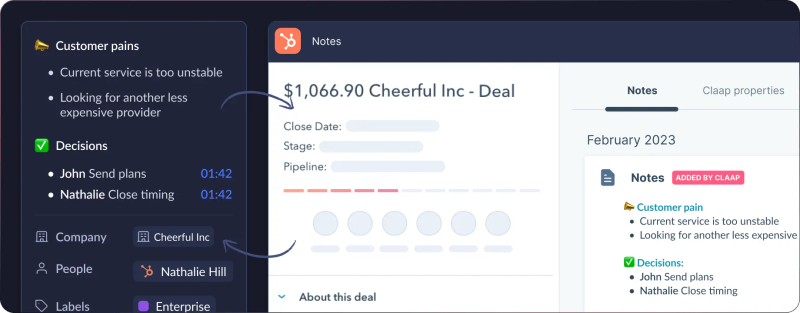
Sales Call Insights & Pipeline Reports
Claap automatically records your sales calls and generates notes that highlight key moments—objections, deal risks, competitive mentions, and next steps. Unlike Gong's dense interface, Claap surfaces insights in a clean, scannable format that helps you act faster.
Smart Meeting Templates & Smart Tables
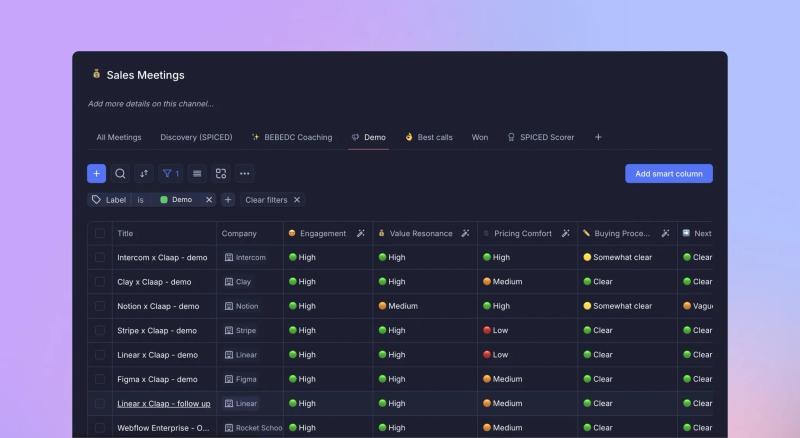
Customize summary templates for discovery calls, demos, or QBRs—Claap structures insights automatically so reps don't waste time formatting notes. The Smart Tables module lets you analyze dozens of calls at once to compare outcomes, spot patterns, and extract trends effortlessly.
Sales Coaching That Scales
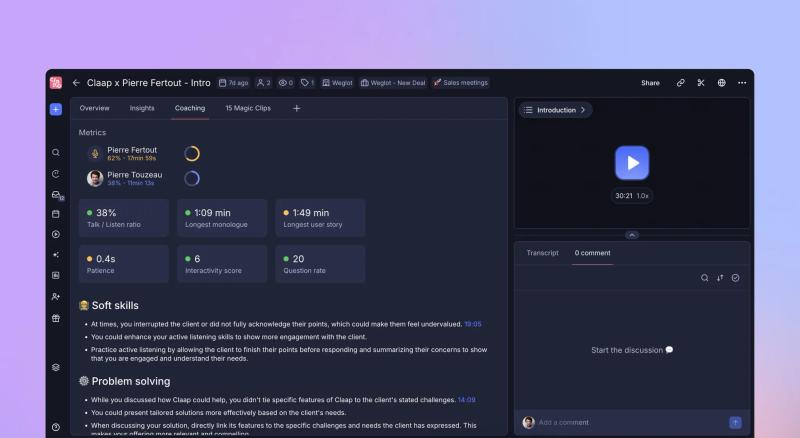
Claap's advanced coaching modules analyze talk ratios and conversation patterns to identify improvement opportunities. Managers can deliver targeted feedback based on real conversations, not gut feelings. New reps ramp faster with AI-powered scorecards that highlight what to improve after every call.
Seamless Integrations (Without the Headache)
Claap connects effortlessly with HubSpot, Salesforce, Attio, Notion, Slack, and Jira. No multi-week implementations or API wrangling—just plug it in and let Claap keep your CRM up to date automatically. For advanced workflows, use Claap's API or MCP to build custom automations.
Your AI Brain Assistant
This is where Claap gets interesting. You can ask your personal assistant things like:
- "Remind me what we discussed last time with customer X?"
- "Suggest an icebreaker for Y based on our last exchange"
- "Based on the last 3 months, make a scorecard of pros & cons of choosing us vs. competitor B"
Claap turns your meeting data into conversational answers—instantly.
Pricing That Makes Sense
Gong requires a platform fee ($5k-$50k) plus $1,200-$1,600 per user per year, with implementation costs often exceeding $15k. Claap starts at $32/user/month for the Pro plan (unlimited recordings, 1,000 minutes) or $60/user/month for Business (includes AI notes, CRM enrichment, deal insights, and coaching). No hidden fees. No 3-year lock-in.
Check out the latest breakdown of Gong's pricing; or read a detailed comparison of Gong and Claap to help you make an informed decision for your sales team's call and meeting recording needs.
Free Trial, No Credit Card Required
Start with Claap's free plan (10 videos, 300 minutes) and explore all core features. Want more power? Book a demo to unlock advanced capabilities.
Leading companies like Qonto, Revolut, 360Learning, and OpenClassrooms have already switched from Gong to Claap. Ready to see why?
FAQs
Is it Possible to Record My Gong Calls Automatically?
Yes, Gong can record your calls automatically by syncing with your web conferencing platform like Zoom or phone provider. Once configured, Gong will handle the recording and transcription, providing accurate and searchable call data for review and analysis.
Why is my Gong not recording Zoom calls?
The most common cause is a permission mismatch. If you schedule a Zoom meeting on behalf of someone else, you're technically the host—but if they log in with their credentials, Gong won't recognize the meeting as theirs. Fix: Make sure the Gong user who scheduled the meeting is the same person hosting it in Zoom. Also check that auto-recording is enabled in your Zoom admin settings (Settings → Recording → Cloud Recording).
How do I download a video from Gong?
Open the call recording in Gong, click the three-dot menu (⋮) in the top right corner, and select "Download." Gong exports the video as an MP4 file to your computer. Keep in mind: your admin controls download permissions, so if you don't see this option, you'll need to request access. Downloads include both video and audio—useful for creating training clips or sharing externally with prospects who weren't on the original call.
Can Gong record phone calls?
Yes, but only if you use a supported VoIP provider like RingCentral, Aircall, Dialpad, or Outreach Kaia. Gong integrates directly with these systems to capture calls. Standard desk phones or mobile carrier calls won't work—you need Voice over IP infrastructure.
Does Gong notify participants of recording?
It can, but it's optional. You can enable audio prompts ("This call is being recorded"), pre-call emails, or in-meeting banners in Gong's admin settings. However, compliance best practice is to enforce these notifications, not leave them optional. If you're calling someone in a two-party consent state like California, verbal or written notice is legally required.
How much does Gong cost per user?
Gong charges $1,200 - $1,600 per user per year, plus a platform fee of $5,000 - $50,000 annually (depending on team size and features). For a 20-person team, expect a total annual cost of $35,000 - $85,000. Implementation fees (typically $15,000+) and a 3-year contract commitment are also standard.
How do I record an unscheduled call in Gong?
Invite assistant@gong.io to the meeting—either when you schedule it or by adding the email during the call. Gong's bot will join within 30-60 seconds and start recording. The recording will appear in your library 5-15 minutes after the call ends.