

The 8 best sales call recording software in 2026, and how to record sales calls legally
The 8 best sales call recording software in 2026, compared on phone and video capture, bot-free recording, CRM logging, price and G2 ratings, plus consent rules and a rollout plan.

Prices, G2 ratings and features checked on 7 October 2026.
Summary
- The 8 best sales call recording software in 2026 are Gong, Modjo, Claap, Aircall, HubSpot Sales Hub, Avoma, Attention and Fathom. They fall into three families: conversation intelligence platforms, phone systems and CRMs that record their own calls, and meeting note-takers.
- Sales call recording software captures the calls reps have with buyers, transcribes them and files each one against the right contact and deal. The useful part is what happens after the recording: notes, CRM fields and coaching.
- Where the call happens decides the tool. Aircall and HubSpot record the calls placed through them. Gong, Modjo and Claap record video meetings and import calls from dialers. Fathom records video meetings only.
- A meeting bot is no longer the only way to record a video call. Modjo, Claap and Fathom can record from the rep's own computer, which helps when buyers refuse to let a bot into the meeting.
- Most conversation intelligence vendors do not publish prices. Gong, Modjo and Attention quote on request. Claap, Avoma, Aircall, HubSpot and Fathom publish per-seat prices.
- Recording a sales call is legal in most places if every participant is told, and in some places only if every participant agrees. About a dozen US states, including California and Florida, require all-party consent. In France, the CNIL requires that each person is informed at the start of the call and can object.
- The common failure is not recording too little, it is recordings nobody uses. Pick a tool that turns calls into CRM notes and fields automatically, and roll it out with a clear policy for reps and buyers.
Pipedrive's CRM Trends Report 2026, a survey of 1,000 US sales and marketing professionals, found that 38% spend most of their time logging calls, emails and meetings, while only 11% count closing deals among their most frequent weekly activities (Pipedrive, August 2026). Pipedrive sells a CRM, so read it as a vendor survey, but the gap it describes is the reason teams record sales calls: the call should log itself. This guide compares the 8 tools sales teams use to record calls in 2026, then covers the consent rules and a rollout plan. If you want to see how Claap records calls and fills HubSpot or Salesforce, see our sales call recording software page.
Sales call recording software at a glance
| Tool | Best for | Records | Entry price (per seat/month) | Free plan or trial | G2 rating |
|---|---|---|---|---|---|
| Gong | Enterprise revenue teams with 50+ reps and a RevOps team | Video meetings, Gong's dialer, dialer integrations, email | Not public. Est. $100–217 + platform fee | No | 4.7 (6,745) |
| Modjo | French and European mid-market teams that sell on the phone and on video | Video meetings without a bot, 8 dialers | Not public | Demo only | 4.7 (92) |
| Claap | Sales teams of 5–100 reps that want every call, phone and video, in the CRM at a published price | Video meetings with or without a bot, 4 dialers, in-person on mobile | $32 Pro, $60 Business (annual) | Free plan | 4.6 (480) |
| Aircall | Phone-first teams (SDRs, inside sales) that need a dialer that records | Phone calls placed through Aircall | $30 (annual, 3 seats min) | Free trial | 4.4 (1,627) |
| HubSpot Sales Hub | Small teams that call from inside HubSpot | Phone calls placed through HubSpot | $20 Starter (monthly); $90 Professional (annual) for conversation intelligence | Free CRM, recording from Starter | 4.4 (13,460) |
| Avoma | Small teams that want notes, scheduling and coaching in one tool | Video meetings, plus add-ons | $19 + $29 CI add-on (annual) | 14-day trial | 4.6 (1,365) |
| Attention | US teams that want call data to trigger CRM workflows | Video meetings | Not public | Demo | 4.6 (78) |
| Fathom | Individuals and small teams that want free recordings and notes | Video meetings, with or without a bot | Free. $15 Team (annual) | Free plan | 5.0 (7,064) |
"Est." is a third-party estimate (Vendr), not a list price. G2 ratings for Gong, Modjo, Claap, Avoma and Attention read on g2.com on 6 October 2026, Fathom on 5 October; Aircall and HubSpot Sales Hub as shown in G2 search results in October 2026.
What buyers told us about recording their calls
Claap records its own sales calls, so we can hear how buyers talk about the tools they record with today. Three patterns came back again and again in calls from October 2025 to October 2026.
Recording is split across tools. A go-to-market leader at a US accounting-services company described his stack: "Zoom is used just for recording of the meetings, and Gong is used for, let's say, analyzing of those [calls]." His plan was to consolidate.
Buyers do not always let a bot in. A RevOps lead at an AI scale-up whose prospects send the meeting link put it bluntly: "Forget about the bot. This will never happen. [...] It's the customer using Zoom, meaning that they will send us the link. And they will not let our bot enter the room."
Phone calls are the blind spot. A sales lead at an investment-research firm, already a Gong user for meetings, said: "One big challenge on cold calling is I can't keep track of or have a view on what the activity level of the associates are. Then even recording so we can coach them better."
Our own data shows why phone calls need their own setup. Across a year of recordings on Claap, 29% are calls imported from dialers, and 53% of those dialer calls end in under two minutes, against a median of 30 minutes for a recorded video meeting (method on our call recording page).
Method: recorded sales calls from Claap's and lemlist's workspaces, October 2025 to October 2026. Only the buyer's own words were quoted, checked against the call transcript, anonymized to the role. We removed filler words, marked cuts with [...] and translated some quotes from French.
How to choose sales call recording software
- List where your calls happen. Video calls on Zoom, Meet or Teams, phone calls from a dialer, calls from a mobile phone, meetings in a room. A tool that misses one of them leaves a hole in the deal history.
- Decide how the buyer learns the call is recorded. A visible bot tells everyone. Bot-free capture from the rep's computer needs the rep to say it. Check which modes each tool offers.
- Check what lands in the CRM. A link to a recording, a note on the contact and deal, or typed values in the fields your reports use? See how Claap logs calls in HubSpot and Salesforce.
- Check transcription in your languages. Run a real call in each language your team sells in.
- Check storage and access. Where recordings are hosted, how long they are kept, and who can open them.
- Price the whole contract. Seat price, minimum seats, platform fee, add-ons and the plan that unlocks CRM sync.
The 8 best sales call recording software in 2026
1. Gong
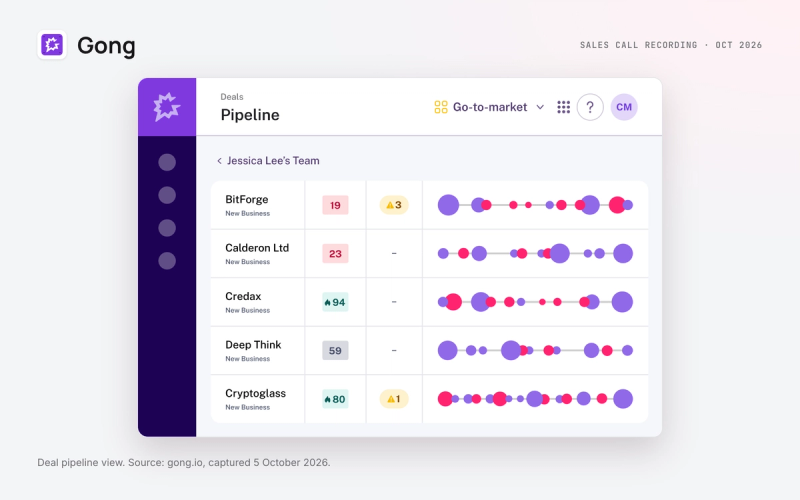
Best for: enterprise revenue teams with 50+ reps, a Salesforce-first stack and a RevOps team to run the platform.
Overview. Gong is the reference in revenue intelligence. It records web meetings, phone calls through its own dialer and dialer integrations, and emails, then uses them for deal boards, forecasting and coaching. Recording is the entry point to a much larger platform.
Top features
- Recording of web meetings, Gong Dialer calls and integrated dialers
- Trackers that flag topics, competitors and next steps across calls
- Deal boards and forecasting built on call and email activity
- 70+ transcription languages and an optional EU data center
Pricing. Not public. Gong says licenses are "priced per user" with "a platform fee based on the number of users supported" (gong.io/pricing). Vendr reports $1,200–2,600 per seat per year and a median contract of $55,359 per year (Vendr). See our Gong pricing guide and how Gong call recording works.
Pros
- The most complete platform in this list
- Phone, video and email in one place
- Mature forecasting
Cons
- Opaque pricing with a platform fee
- Too much platform if you only need recordings
What reviewers and buyers say. Gong is rated 4.7 on G2 from 6,745 reviews. A commercial operations lead at a US healthcare-training company, a current Gong user, told us: "A bunch of them, like, won't use Zoom. They'll only use Teams. We've literally been trying to connect Teams to Gong since November. And it still doesn't work."
→ Looking at other options? Read our Gong alternatives guide.
2. Modjo
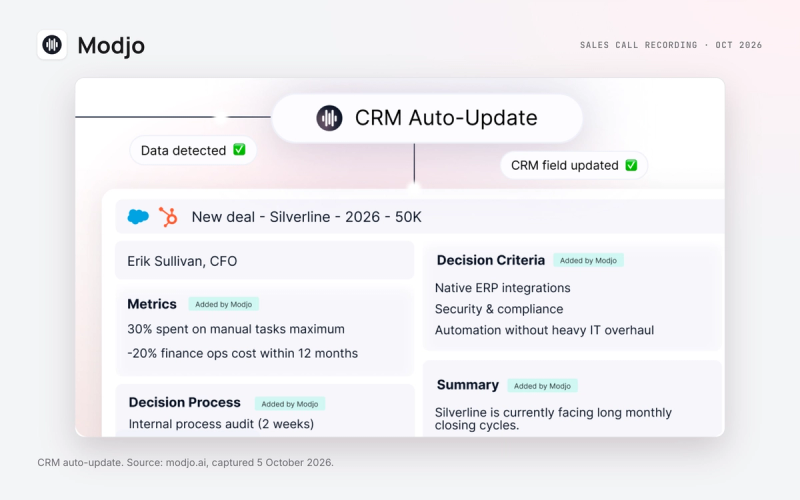
Best for: French and European mid-market teams that sell on the phone and on video and want an EU-hosted vendor.
Overview. Modjo is a Paris company founded in 2019. It records video calls without a meeting bot, imports calls from a long list of dialers, transcribes them in 100+ languages and runs ready-made agents on them. Data is hosted on AWS in Paris.
Top features
- Recording of Zoom, Teams and Meet calls without a bot
- Dialer integrations: Aircall, Ringover, CloudTalk, Diabolocom, Vocalcom, Zoom Phone, Onoff and Salesloft
- CRM sync with HubSpot, Salesforce and others
- SOC 2 Type II, EU hosting
Pricing. Not public. Modjo's pricing page says it is "optimal from 3 sales reps" and asks for a demo (modjo.ai).
Pros
- No bot in the meeting
- The widest dialer list in this guide
- EU hosting and a French-speaking team
Cons
- No public pricing
- Small review base on G2
What reviewers and buyers say. Modjo is rated 4.7 on G2 from 92 reviews. A sales lead at a Canadian real-estate company, a current Modjo user, told us what his team values: "What we like about Modjo is that we don't need a bot joining the Zoom call to record the calls." (translated from French)
→ Compare in detail: Claap vs Modjo
3. Claap
Best for: sales teams of 5 to 100 reps that want every call, phone and video, logged in the CRM at a published per-seat price.
Overview. Claap is a conversation intelligence platform by lemlist. It records video calls from the rep's computer without a bot, or with a visible bot, imports dialer calls from Aircall, Ringover, Allo and lemlist VoIP, and records meetings in a room with the mobile app. Each call is transcribed and logged as a note on the right HubSpot or Salesforce contact and deal, with typed values in the fields you map. Claap does not replace your dialer: phone calls reach Claap through the dialer integration.
Top features
- Bot-free recording from the desktop app or Chrome extension, or a visible bot
- Dialer calls matched to CRM contacts by phone number
- CRM auto-complete into HubSpot and Salesforce fields
- Call scoring and coaching on your own framework, and an MCP that lets Claude and other agents read and write the data
Pricing. Free Basic plan (10 recordings per user, 300 minutes in total, 3-month storage). Pro is $32 per seat per month billed annually and adds unlimited recordings, the dialer integrations, the Mac desktop app, 99+ languages and 2-year storage. Business is $60 per seat per month billed annually and adds the CRM integrations, CRM auto-complete and AI coaching. Prices on claap.io/pricing.
Pros
- Phone, video and in-person calls on the same record
- Published pricing, free plan, no platform fee
- SOC 2 Type II and GDPR
Cons
- CRM sync starts on the Business plan
- Only four dialers integrated today
- Smaller review base than Gong
What reviewers say. Claap is rated 4.6 on G2 from 480 reviews.
4. Aircall
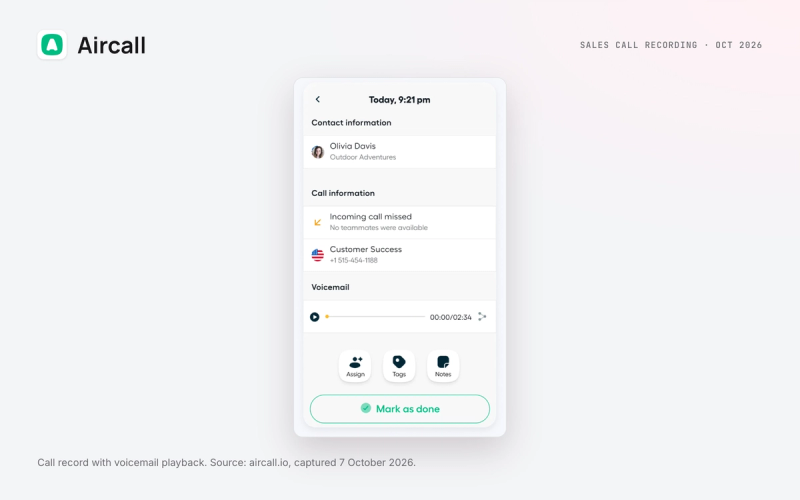
Best for: phone-first teams, such as SDRs and inside sales, that need a cloud phone system that records every call.
Overview. Aircall is a cloud phone system, not a meeting recorder. It records every inbound and outbound call placed through it, transcribes calls in 24 languages, and syncs recordings to Salesforce, HubSpot and 250+ apps. Its AI Assist adds summaries, key topics, sentiment and talk-to-listen ratio. European accounts are stored in Frankfurt.
Top features
- Automatic recording of every call, with pause and manual start
- Pre-call recording announcement for consent
- AI call summaries and conversation intelligence on Professional
- AI Assist Pro add-on for real-time coaching ($49 per seat per month)
Pricing. Essentials $30 and Professional $50 per license per month billed annually, with a 3-license minimum. Enterprise on quote, from 25 licenses (aircall.io/pricing).
Pros
- Recording built into the phone line
- Consent tools on the call itself
- EU data residency
Cons
- Records phone calls only, not video meetings
- Call summaries need Professional
What reviewers say. Aircall is rated 4.4 on G2 from 1,627 reviews (G2 search results, October 2026).
→ Already on Aircall? Claap imports Aircall calls next to your video calls: see dialer call recording.
5. HubSpot Sales Hub
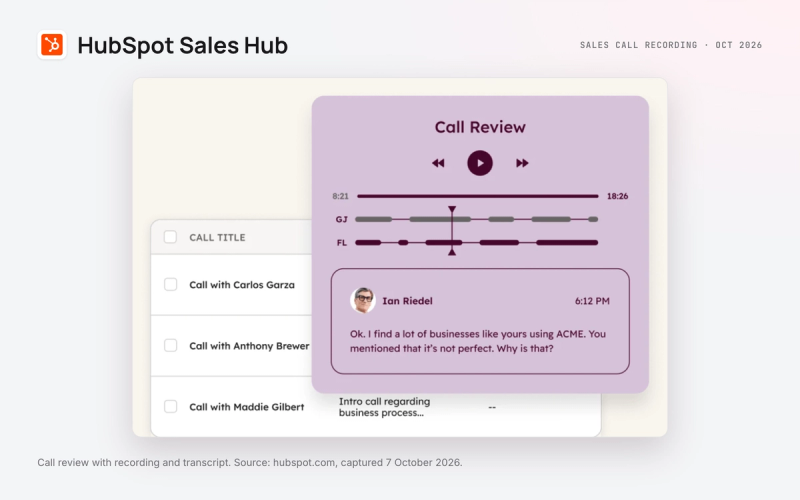
Best for: small teams that already work in HubSpot and call from inside it.
Overview. HubSpot records calls placed with its built-in calling tool and logs them to the CRM. HubSpot's own help center says: "Recording and transcription is turned on by default in your call settings" and "It's the responsibility of your users to obtain consent" (HubSpot). Conversation intelligence, the analysis of those recordings, is on Professional and Enterprise.
Top features
- Calling from the browser or the mobile app, logged to the contact
- Recording and transcription on by default
- AI call summaries and conversation intelligence on Professional
- 500 calling minutes on Starter, 3,000 on Professional
Pricing. Starter $20 per seat per month billed monthly. Professional $90 per seat per month billed annually ($100 monthly) plus a $1,500 onboarding fee. Enterprise from $150 per seat plus $3,500 onboarding (hubspot.com).
Pros
- No extra tool if you already live in HubSpot
- Calls logged automatically on the record
Cons
- Records only calls placed through HubSpot
- Conversation intelligence needs Professional and an onboarding fee
What reviewers say. HubSpot Sales Hub is rated 4.4 on G2 from 13,460 reviews, for the whole Sales Hub (G2 search results, October 2026).
→ Recording meetings and dialer calls into HubSpot? See HubSpot call recording with Claap.
6. Avoma
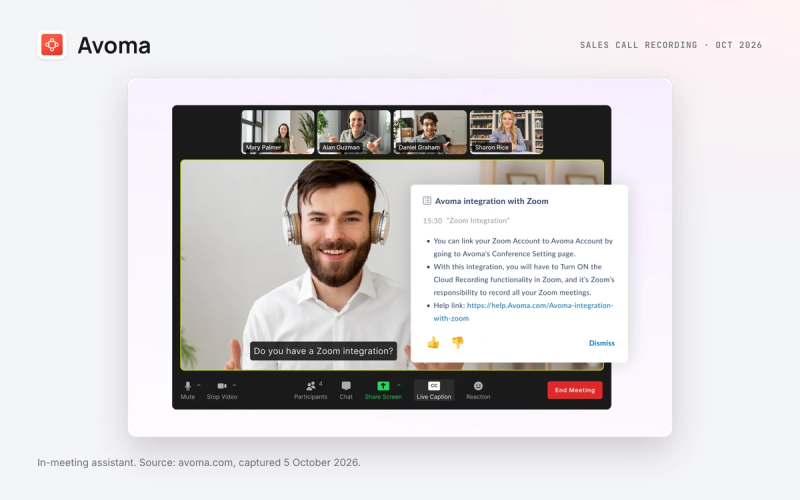
Best for: small and mid-size teams that want a meeting recorder, a scheduler and coaching in one tool, built from add-ons.
Overview. Avoma is a Palo Alto company founded in 2017. It records and transcribes meetings in 75+ languages, writes AI notes, and sells conversation intelligence and revenue intelligence as add-ons on top of the recorder seat.
Top features
- AI notes and a chat over past meetings
- Scheduler and lead router in the same tool
- Conversation intelligence add-on for coaching
- MCP server for AI assistants
Pricing. Startup $19, Organization $24, Enterprise $39 per recorder seat per month billed annually ($29 and $39 monthly for the first two). Conversation intelligence is a $29 add-on per seat per month billed annually ($35 monthly). 14-day free trial (avoma.com/pricing).
Pros
- Published pricing and a real trial
- Viewers are free
Cons
- Coaching and analysis are paid add-ons
- Seat caps per tier (25 on Startup, 100 on Organization)
What reviewers say. Avoma is rated 4.6 on G2 from 1,365 reviews.
→ Compare in detail: Claap vs Avoma
7. Attention
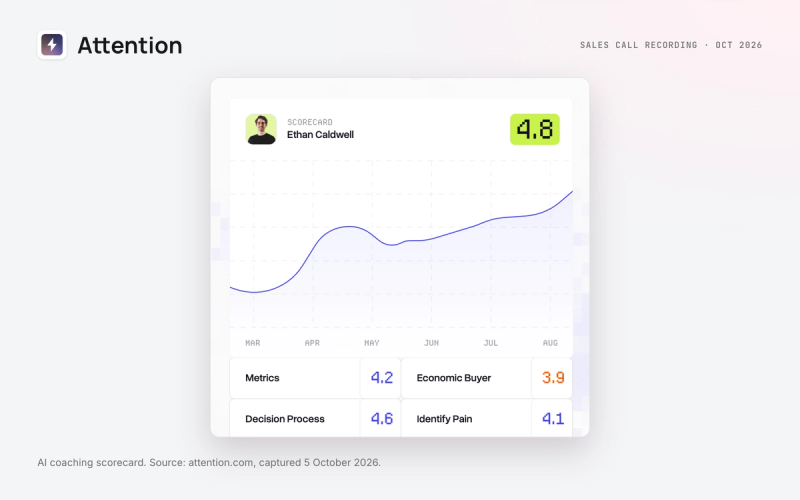
Best for: US revenue teams that want recorded calls to fill the CRM and trigger workflows, with RevOps time to configure them.
Overview. Attention is a New York company founded in 2021. It records sales calls, fills CRM fields and follow-ups from them, scores calls, and lets teams build custom agents on the data. Its MCP server is the largest we found in the category: 81 tools with read and write scopes (docs.attention.com).
Top features
- CRM auto-fill and follow-up emails after each call
- Call scorecards
- Custom agents and workflows on call data
- Read and write MCP
Pricing. Not public.
Pros
- Strong CRM automation
- Read and write MCP
Cons
- No public pricing
- Little public documentation on dialers and languages
What reviewers say. Attention is rated 4.6 on G2 from 78 reviews (read 6 October 2026).
→ Compare in detail: Claap vs Attention
8. Fathom
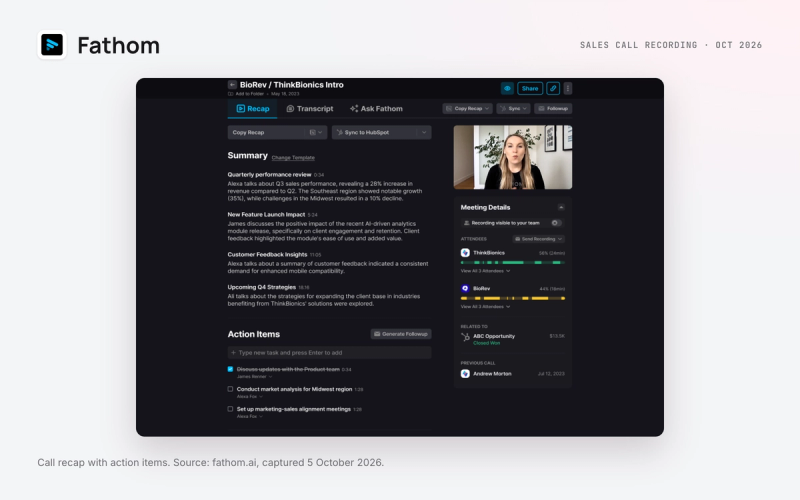
Best for: individuals and small teams that want free, unlimited recordings and good notes on video calls.
Overview. Fathom is a general-purpose AI notetaker. Its free plan records and transcribes unlimited video meetings, with or without a bot, and writes instant summaries. It does not record phone calls from a dialer, and CRM field sync, coaching metrics and scorecards start on the Business plan.
Pricing. Free plan. Premium $16 per month billed annually ($20 monthly). Team $15 per seat billed annually (2+ users). Business $25 per seat billed annually ($34 monthly) (fathom.ai/pricing).
Pros
- The most generous free plan in this list
- Bot-free or bot capture
Cons
- Video meetings only
- CRM field sync and coaching only on Business
What reviewers and buyers say. Fathom is rated 5.0 on G2 from 7,064 reviews. A founder of a US B2B data startup who uses it told us: "I use Fathom, it takes notes, the notes are great, they get sent to me in my email, but then I want to follow up with people three days, four days, five days later, I have to go back, read through the notes [...]" He added that it was "probably not worth" switching from Fathom yet.
Feature comparison
| Gong | Modjo | Claap | Aircall | HubSpot | Avoma | Attention | Fathom | |
|---|---|---|---|---|---|---|---|---|
| Video meetings | Yes | Yes | Yes | No | No | Yes | Yes | Yes |
| Video without a bot | Not stated | Yes | Yes | n/a | n/a | Not stated | Not stated | Yes |
| Phone calls | Own dialer + integrations | 8 dialers | 4 dialers | Built in | Built in | Not checked | Not stated | No |
| In-person meetings | Not stated | Not stated | Mobile app | No | No | Not stated | Not stated | No |
| Transcription languages | 70+ | 100+ | 99+ | 24 | Not stated | 75+ | Not stated | Not stated |
| Logs to the CRM | Yes | Yes | Yes (Business) | Yes | Native | Yes | Yes | Business plan |
| Public pricing | No | No | Yes | Yes | Yes | Yes | No | Yes |
"Not stated" means we could not confirm it on the vendor's public pages on 7 October 2026. We will update the table when vendors document it.
Is it legal to record sales calls?
Yes, in most countries, if you follow the consent rules where each participant is. When participants are in different places, apply the stricter rule. This is general guidance, not legal advice.
- United States. Federal law is one-party consent (18 U.S.C. § 2511): the rep's own consent is enough. About a dozen states require all-party consent, including California, Florida, Illinois, Pennsylvania and Washington. A rep in Texas calling a buyer in California falls under the California rule.
- European Union and United Kingdom. GDPR applies. You need a lawful basis, usually legitimate interest for training and quality or consent, and you must tell people why you record, who sees it and how long you keep it.
- France. The CNIL requires that each person is informed at the start of the call of the purpose, the recipients, their right to object and their right of access, and the right to object must work in practice: the rep must be able to stop the recording (CNIL). Recording private words without consent is an offence under article 226-1 of the Code pénal.
- Canada. Federal law is one-party consent (Criminal Code s. 184), and privacy law requires telling people why their data is collected.
Tools do not take the responsibility off you. HubSpot's own documentation says consent is "the responsibility of your users". For the GDPR details, see our guide to conversation intelligence and GDPR.
A disclosure line reps can use: "Before we start, I record our calls so I can focus on you instead of taking notes. The recording stays with our team. Is that OK with you?"
How you ask matters. A sales lead at a French freelance marketplace that uses Claap told us that when his reps explain why, buyers mostly say yes, but "if you ask straight away whether they want to be recorded, without explaining, it will be no 80% of the time." That is his estimate, not a study, but it matches what we hear: explain the benefit to the buyer, then ask. Some teams also send the notice in the meeting invitation, so nobody is surprised.
How to roll out sales call recording
- Write a one-page recording policy. Which calls are recorded (customer-facing discovery, demo and negotiation calls), how buyers are told, who can open recordings, how long they are kept, and how a rep stops a recording.
- Start with a pilot. Three to five reps for two weeks, across phone and video, before the whole team.
- Connect the CRM first. Recordings that land on the contact and deal get used. Recordings that sit in a separate library get forgotten.
- Show reps what they get. No more notes after the call, a follow-up email drafted from the call, and coaching based on their best calls rather than the manager's memory.
- Review a few calls together every week. Pick one strong call and one difficult one, and turn the good moments into examples for new hires.
What managers should listen for in recorded calls
- Qualification: is the rep talking to the right buyer about a real problem?
- Discovery: did the rep find the pain before pitching?
- Talk balance: is the buyer doing most of the talking on discovery calls?
- Objections: which ones come up again, and how are they handled?
- Next steps: is there a dated next step that the buyer agreed to?
- Accuracy: did the rep promise anything the product or contract cannot deliver?
To score every call on these points automatically, see sales coaching with Claap.
How we built this comparison
- Vendor facts (pricing, plans, capture modes, languages, hosting) come from each vendor's own website and documentation, checked on 7 October 2026, or on 5 and 6 October where noted. Where a vendor does not publish prices, we use Vendr's transaction data and label it as an estimate.
- G2 ratings were read on g2.com on 5 and 6 October 2026. Aircall and HubSpot Sales Hub ratings are as shown in G2 search results in October 2026.
- Buyer quotes come from recorded sales calls in Claap's and lemlist's workspaces, October 2025 to October 2026. Only the buyer's own words were quoted. Recording data comes from Claap recordings, 30 September 2025 to 29 September 2026, aggregated with no customer identified.
- Conflict of interest: Claap is one of the tools in this list. We have tried to state Claap's limits as plainly as anyone else's. If you spot an error about any vendor, write to us and we will correct it.
Related articles
Frequently asked questions
What is sales call recording software?
Sales call recording software records the phone and video calls reps have with buyers, transcribes them and files each recording against the right contact and deal in the CRM. Most tools also write a summary, and conversation intelligence platforms go further with call scoring, CRM fields and deal risk.
Is it legal to record sales calls?
Yes in most places, if you follow local consent rules. US federal law allows one-party consent, but about a dozen states, including California and Florida, require every participant to agree. In the EU and UK, GDPR requires a lawful basis and clear information. In France, the CNIL requires informing each person at the start of the call and letting them object.
What is the best sales call recording software in 2026?
It depends on where your calls happen. For phone-first teams, Aircall records every call placed through it. For teams that live in HubSpot, its built-in calling records calls placed from the CRM. For phone and video in one place with CRM logging, Gong, Modjo and Claap. For free video recordings and notes, Fathom.
How much does sales call recording software cost?
Published prices run from free to about $50 per seat per month for recording, more with analysis. Fathom is free for unlimited video recordings. Claap is $0, $32 or $60 per seat per month billed annually. Aircall starts at $30 per license with 3 licenses minimum. Avoma starts at $19 plus $29 for conversation intelligence. Gong, Modjo and Attention quote on request.
Can I record sales calls without a bot joining the meeting?
Yes. Modjo, Claap and Fathom can record video calls from the rep's own computer without adding a participant. The buyer then does not see a bot, so the rep must tell them the call is recorded.
Does HubSpot record calls?
Yes, for calls placed with HubSpot's built-in calling on Sales Hub or Service Hub Starter, Professional and Enterprise. Recording and transcription are on by default, and HubSpot says consent is the user's responsibility. HubSpot does not record calls placed from another dialer or video meetings outside its tools.
How do I record phone calls and video calls in the same place?
Use a tool that records video meetings and imports calls from your dialer. Gong, Modjo and Claap do this. Claap imports Aircall, Ringover, Allo and lemlist VoIP calls and matches each one to a CRM contact by phone number, so phone and video calls land on the same record.
How long should we keep sales call recordings?
Only as long as the purpose you told buyers about requires, and as your privacy policy and customer contracts allow. Set a retention period in the tool, and keep short examples for training longer only if your policy covers it.