

Best Modjo Alternatives (2026). Top 8 Tools Compared & Rated
Looking for a Modjo alternative? Compare the top 8 tools for pricing, GDPR compliance, and sales features. Including Claap, Gong, and tl;dv.


Updated June 2026: pricing, G2 ratings, and AI agent (MCP) access re-checked for every tool.
Looking for a Modjo alternative? You're not alone. Revenue teams are switching to more modern, flexible conversation intelligence platforms that offer better AI automation, transparent pricing, and features built for today's sales workflows.
There are two main families of Modjo alternatives:
- Revenue Intelligence platforms - Full conversation intelligence with deal insights, forecasting, and coaching (closest to Modjo)
- AI Meeting Assistants - Lighter tools focused on recording, notes, and basic analytics at lower price points
If you want the closest "Modjo but better" experience for European teams, look at Claap first. For enterprise-scale revenue operations, Gong leads the market. For budget-conscious teams wanting solid AI notes, consider tl;dvor Fathom.
What are the best Modjo alternatives in 2026?
| Tool | Best For | Price Range | G2 Rating | GDPR | AI Agents (MCP) |
|---|---|---|---|---|---|
| Claap | Best Overall & EU-Friendly | $$ | 4.6-4.7/5 | ✓ | Production since June 2025 |
| Gong | Enterprise Revenue Intelligence | $$$$ | 4.7/5 | ✓ | Beta |
| Avoma | Mid-Market CI + Scheduling | $$ | 4.6/5 | ✓ | Limited |
| tl;dv | Best Free Plan | Freemium | 4.7/5 | ✓ | Limited |
| Fathom | Accurate AI Summaries | $-$$ | 4.8/5 | ✓ | Limited |
| Fireflies | Analytics-Heavy | $-$$ | 4.5/5 | ✓ | Limited |
| Chorus | ZoomInfo Users | $$$$ | 4.6/5 | ✓ | None |
| Otter.ai | Generic Notetaking | $-$$ | 4.2/5 | ✓ | None |
AI agent access checked June 2026. Modjo shipped an MCP integration in its April 2026 product update.
Why are revenue teams leaving Modjo?
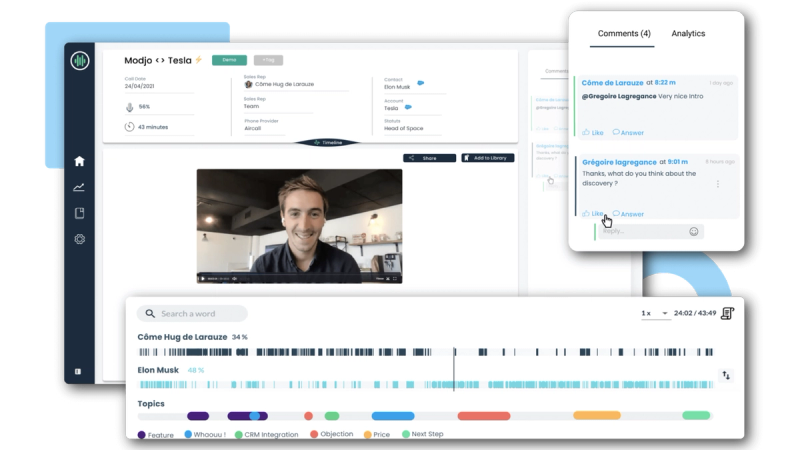
Modjo remains a strong conversation intelligence platform, especially for structured sales teams. But in practice, more and more revenue teams are actively looking for alternatives.
Four recurring themes explain why 👇
1. Cost vs. Real Usage
Modjo's pricing starts high and scales quickly: often with minimum seat requirements and annual commitments.
For many mid-market teams, the ROI doesn’t fully materialize:
“Modjo, I didn’t keep it because it was too expensive and it was a hassle.”: Axel Bombezin, Entrepreneurs.com
Teams frequently report paying for advanced features they don’t fully adopt, while still spending time on manual work after calls.
2. Friction Instead of Flow
Modjo is powerful, but often perceived as heavy and labor-intensive day-to-day:
- Complex setup and multi-week onboarding
- Intrusive assistant experience during calls
- Too many steps to control what gets recorded or analyzed
“With Modjo, going behind the scenes felt laborious, just choosing which meetings to record or not.”, Benoît Stoffel, Hiflow
Instead of disappearing into the background, the tool can become something reps have to manage: which hurts adoption.
3. AI That Feels Retrofitted, Not Native
Revenue teams increasingly expect AI to do the work, not just analyze it.
Prospects mention limitations around:
- Retroactive insights
- Flexibility in topic management
- Automation depth (CRM updates, follow-ups, risk detection)
“The topic management at Modjo was really amazing… but the retroactivity doesn’t work yet.”: Pierre Fertout, Weglot
This creates a gap between insight generation and real execution.
4. Data Stays Trapped at the Call Level
Modjo structures insights per call. But sales questions live at the deal and account level: what did this prospect say across all 12 conversations? Which decision-maker appeared in call 3?
Teams end up re-reading transcripts or maintaining spreadsheets to reconcile what the tool already heard. And when AI agents enter the workflow, call-level data still matters: Modjo shipped MCP in 2026, while Claap's MCP has been in production since June 2025.
1. Claap: Is it the best Modjo alternative for AI agents?
Positioning vs. Modjo
Claap is built on a simple loop: capture every conversation, structure it, and make it usable by humans and AI agents. Capture is bot-free, on video calls and on the phone (native Aircall and Ringover integrations), which is why adoption sticks. Every call lands in Smart Tables: structured AI fields aggregated per meeting, per deal, and per company, pushed straight to your CRM. And everything is exposed through an open API and an MCP server in production since June 2025, so tools like Claude or Dust can query your conversation data directly.
Claap automatically records meetings, generates AI summaries, updates your CRM, surfaces deal insights and helps on sales coaching while making reps save 30+ minutes per call on admin work.
Where Modjo often feels heavy, rigid, or intrusive, Claap is designed to be fast to deploy, intuitive to use, and flexible by default.
“I found the Claap platform much more intuitive. Choosing the calls you want to record is much more complicated on Modjo’s side.”: Benoît Stoffel, Hiflow
Teams switching from Modjo consistently describe Claap as:
“Much more intuitive,” “less intrusive,” and “easier to adopt without disengaging the team.”
Key features
- Automatic Call Recording & Transcription
Works seamlessly across Google Meet, Zoom, and Teams with strong multi-language support: a key advantage for international and EU teams. - AI Notes, Insights & Follow-ups
Structured summaries, objections, risks, next steps, and buying signals: generated instantly using customizable templates that adapt to your sales process. - CRM Auto-Fill & Data Flexibility
CRM fields are updated automatically after each call, without locking teams into a rigid data model. Claap adapts to your structure, not the other way around. - Deal & Pipeline Intelligence
Analyze qualification, objections, competitor mentions, and deal momentum across dozens of calls using Smart Tables, without digging through dashboards. - Scalable Sales Coaching
Track MEDDIC, BANT, SPIN (or custom frameworks), talk ratios, and execution quality. Managers review many calls at a glance and coach with objective data.
Unlike Modjo’s assistant, Claap is non-intrusive by design.
Strengths
- Built for revenue teams, not generic note-taking: Deal insights, coaching workflows, and objection tracking are native to the platform. Save 30 minutes per meeting with automated summaries and CRM updates.
- EU-friendly and GDPR-compliant: European company with strong focus on data privacy and language coverage, critical for Modjo's typical customer base.
- Transparent, mid-market pricing with a genuine free tier and no hidden platform fees. What you see is what you pay.
- Radically easier to adopt: 5-minute setup, no heavy onboarding, no intrusive assistant forcing itself into meetings.
- AI-native, not retrofitted: Built from the ground up for AI workflows, faster insights, better automation, future-ready architecture.
- Flexible by design: Custom templates, adaptable data structures, open APIs & webhooks, no walled garden.
- User sentiment: G2 rating of about 4.6-4.7/5 with 360+ reviews.
- Proven results:
- Surfe shortened their sales cycle by 10 days
- TenderApp improved win rates by 66% (SQL-to-win rate jumped from 9% to 15%)
- Ronspot boosted demo conversion rates by 33% and deal value by 26%
Weaknesses
- Some users report slower processing on very long videos
- A few UI options could be surfaced more clearly as the product grows
Pricing
- Basic: Free – 10 videos + 300 minutes of recording per user
- Pro: $32/user/month ($40 monthly) – Unlimited videos, storage, and 1,000 minutes per month
- Business: $60/user/month ($75 monthly) – Full AI notes, CRM enrichment, deal insights, and coaching
- Enterprise: Custom – Contact Claap for tailored enterprise features
Best for
Revenue teams (SMB & mid-market) that want Modjo-level conversation intelligence→ without heavy onboarding→ without rigid data models→ without enterprise pricing or friction
The "Revenue Intelligence" Heavyweights (Enterprise)
These are direct Modjo replacements for teams that need deep deal forecasting, robust analytics, and have larger budgets.
2. Gong – Deepest Enterprise Revenue Intelligence (But Very Pricey)
Positioning vs Modjo
Gong is the market-leading revenue intelligence OS, going far beyond Modjo in depth. It combines conversation intelligence, deal intelligence, and people intelligence into a single platform used by 4,500+ companies. It's overkill for many SMBs, but the benchmark at enterprise level.
Key features
- Conversation Intelligence: Automatic recording and transcription with smart trackers for topics, competitors, pricing, sentiment, and talk-ratio analytics
- Deal Intelligence: Pipeline views with engagement scores, deal risk signals, opportunity health, and forecast support based on activity patterns
- People Intelligence: Rep-level performance and coaching insights, identification of top-performer behaviors for enablement
- Revenue AI OS: Gong Revenue Graph + AI agents for workflows across CRM and GTM tools
Strengths
- Extremely rich analytics across calls, emails, and deals; widely seen as the enterprise standard
- G2: 4.7/5 from about 6,600 reviews, with users praising coaching capabilities and deal visibility
- Strong ecosystem of integrations and mature implementation playbook
Weaknesses
- Gong Pricing and complexity are main complaints:
- 2025 pricing shows Foundation core at ≈$108-120/user/month, bundled packages (Core + Engage + Forecast) at ≈$240-250/user/month
- Mandatory platform fees from $5k-$50k and implementation fees $15k-$65k can double first-year cost
- Common 3-year contracts with 5-15% renewal uplifts
- Reviews highlight difficult call search, AI trackers requiring manual tuning, and declining support quality in some implementations
Pricing
Quote-based only, but buyer data points to:
- ≈$108-120/user/month for core Foundation
- ≈$240-250/user/month when Engage & Forecast included
- Plus platform + implementation fees
Best for
Large, process-mature sales organizations that can invest six figures+ per year, need full revenue OS capabilities, and have RevOps resources to drive adoption.
3. Chorus by ZoomInfo – Best if You're Already a ZoomInfo Customer
Positioning vs Modjo
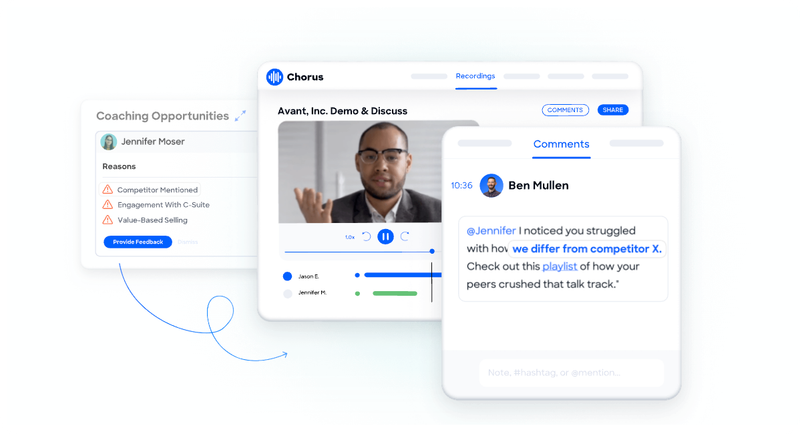
Chorus is a conversation intelligence platform acquired by ZoomInfo and deeply integrated with its B2B data graph. Functionally it overlaps with Modjo, but its real power appears when you already pay for ZoomInfo.
Key features
- Call and meeting recording, transcription, and search across calls, emails, and meetings
- ZoomInfo integration: Automatic contact enrichment, buying committee and stakeholder mapping, intent and research behavior overlays
- Sales coaching & enablement: Snippets and call libraries for onboarding, scorecards and coaching workflows
- Deal and forecasting support via synced communications and contact data
Strengths
- Deep data synergy with ZoomInfo: powerful when you already use it for prospecting
- Users like its impact on onboarding and coaching, with ability to listen to top calls and share snippets
- G2 shows thousands of reviews with positive sentiment around insights and team ramp-up
Weaknesses
- Pricing structure is opaque and dependent on ZoomInfo:
- Flat fee ≈$8,000/year including 3 seats, plus $1,200/additional seat/year
- Maps to roughly $105-137/user/month depending on seat count
- You also need a ZoomInfo subscription, so total cost is significantly higher
- Users note Zoom integration quirks, missed recordings, and somewhat dated interface
- No self-serve free trial; requires sales engagement
Pricing
Flat fee ≈$8,000/year for 3 seats, then $1,200/additional seat/year: plus required ZoomInfo subscription.
Best for
Mid-market and enterprise teams already depending on ZoomInfo who want CI tightly coupled with that data, and can handle bundled, less transparent pricing.
4. Avoma – Balanced Conversation & Revenue Intelligence
Positioning vs Modjo
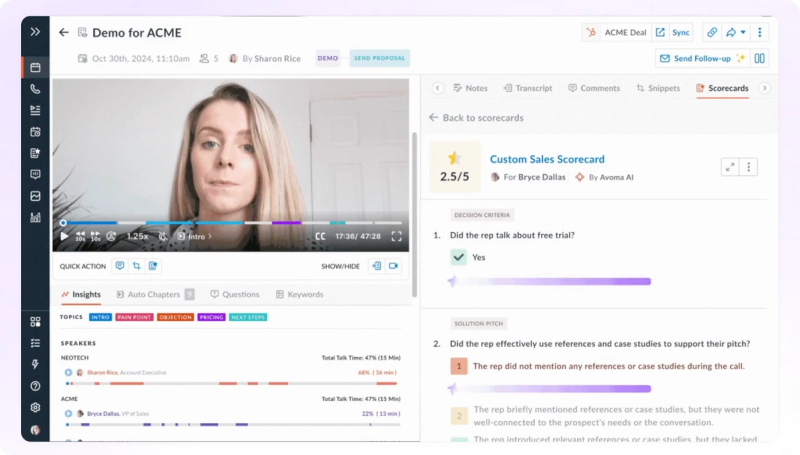
Avoma started as a meeting assistant and has grown into an all-in-one platform combining AI meeting notes, conversation intelligence, revenue intelligence, and scheduling/lead routing. Often recommended as a more accessible alternative to Gong/Modjo for mid-market teams.
Key features
- AI Meeting Assistant: Auto-recording and transcription, AI-generated notes and follow-up emails, calendar automation and dialer integration
- Conversation Intelligence: Smart trackers for topics, competitors, objections; talk-ratio, sentiment, engagement metrics; AI coaching scorecards
- Revenue Intelligence: Automated CRM field updates for MEDDIC/BANT/SPICED, deal risk analysis, churn signals, pipeline health, win/loss analysis
- Scheduling and lead routing as native modules
Strengths
- Broader scope than Modjo: combines CI + RI + scheduling, so teams can centralize more workflows
- Simpler, more transparent pricing than Gong/Chorus, with no separate platform fee; viewer seats are free
- Reviews praise tight HubSpot and CRM integrations, time saved in note-taking, strong support and onboarding
Weaknesses
- Some analyses argue Avoma's CI uses more keyword-based logic, making it less context-aware than newer "agentic" platforms
- Users mention occasional delays in notes appearing in CRM and some complexity in setup for advanced templates
- Some reviewers find it pricey for small teams and note that contracts can lead to paying for more seats than used
- Startup / AI Meeting Assistant: ≈$19-29/recorder seat/month
- Organization / Conversation Intelligence: typically $29-39/seat/month (some sources: CI module at $59/user/month)
- Revenue Intelligence: ≈$79/user/month for full RI features
- Enterprise: $39/seat/month+ with minimum seat counts and advanced access controls
Best for
Teams that want more than a notetaker but don't want Gong's cost or complexity: especially SaaS SMB and mid-market sales orgs already invested in HubSpot or similar CRMs.
The "Agile" AI Meeting Assistants (Lightweight)
Lower-cost alternatives for teams that just want recording, notes, and basic analytics without heavy pipeline features.
5. tl;dv – Generous Free Plan and Strong Sales Coaching Features
Positioning vs Modjo
tl;dv is an AI meeting assistant with surprisingly strong sales-oriented features (speech analytics, topic trackers, CRM sync, coaching) while keeping a very generous free tier. It's less of a full revenue platform than Modjo, but very attractive for cost-sensitive teams.
Key features
- Unlimited recording and transcription on the free plan for Zoom/Meet/Teams, with 30+ languages supported
- AI notes and summaries with templates and "Ask tl;dv" queries across past meetings
- Sales-oriented analytics: Speech analytics, talk-time, interruptions; topic trackers (pricing, objections, competitors); question detection
- Clipping and reels: Highlight segments, build reels, push timestamps into Slack, HubSpot, Salesforce, Notion, Google Docs, etc.
Strengths
- Best-in-class free tier: unlimited recordings and transcripts with AI moment summaries, timestamps, and integrations
- Strong sales-team scenario coverage including coaching workflows
- Reviews highlight high-quality recordings, intuitive interface, easy setup, searchable transcripts
Weaknesses
- Reviews mention transcription issues on multilingual calls and weaker accuracy when multiple languages are mixed
- Some users report AI struggles with complex or highly technical discussions, requiring manual edits
- Free plan reliability: reports of the bot not always joining meetings reliably on free tier
- Free forever: Unlimited meetings, transcripts, AI moment summaries, basic integrations
- Pro: ≈$18/user/month – Unlimited notes, transcript search, improved AI features, CRM/Zapier integrations
- Business: ≈$59/user/month – More advanced coaching tools and analytics for larger teams
- Enterprise: Custom plans with security and advanced controls
Best for
Startups, product and CS teams, and sales teams who want strong AI notes and coaching on a generous free plan, and are okay with adding revenue intelligence from another tool later.
6. Fathom – Simple, Accurate AI Notetaker with Sales-Friendly Plans
Positioning vs Modjo
Fathom is an AI meeting assistant built around accurate, structured summaries and sales workflows, but without full-blown revenue intelligence. Often positioned as more accurate and polished than generic notetakers.
Key features
- Auto-join bot for Zoom, Google Meet, and Teams, with high-quality recording and transcription
- AI summaries with customizable templates (topics, decisions, action items), delivered minutes after each call
- Highlights, tagging, and clips for sharing important moments
- Integrations with Salesforce, HubSpot, Close, Slack, Asana, etc., especially at Team/Business tiers
- Multi-language support (Spanish, French, German, and more)
Strengths
- Reviewers frequently call Fathom "more accurate than other AI notetakers"
- G2 milestone: 6,800+ reviews, indicating huge adoption
- HubSpot marketplace reviews highlight massive time savings, good alignment with sales workflows, very low friction in onboarding
Weaknesses
- Free plan is heavily limited: unlimited recordings but only 5 AI summaries/month, pushing users quickly into paid tiers
- Users report recording glitches with multiple speakers or strong accents, Fathom interfering with Zoom UI in some setups
- Some advanced sales features (deal view, coaching metrics) are locked behind higher-priced plans
- Free: Unlimited recordings, but only 5 AI summaries/month and limited integrations
- Premium: $19/user/month (≈$15 annually) – Unlimited AI summaries, expanded integrations
- Team: ≈$29/user/month – Unlimited CRM sync, team-wide features, shared libraries, comments, keyword alerts
- Business / Team Pro: $39/user/month – Deal View, coaching metrics, advanced security, SSO, retention policies
Best for
Teams wanting a user-friendly, accurate AI assistant for sales and client calls, with good CRM sync, but not needing full multi-touch revenue intelligence.
7. Fireflies.ai – Analytics-Heavy AI Notetaker with Conversation Intelligence
Positioning vs Modjo
Fireflies started as an AI notetaker but has evolved into a meeting insights and conversation intelligence platform, with strong analytics (talk ratios, filler words, sentiment, topic tracking) and a very wide integration ecosystem. More CI-style analytics than Otter/Fathom, but less full-fledged deal intelligence than Modjo/Gong.
Key features
- Fred, the bot, auto-joins Zoom/Meet/Teams/Webex calls and records/transcribes in 100+ languages
- Real-time and post-meeting transcripts; searchable archive, clips, and comments
- Conversation Intelligence suite: Talk-to-listen ratio, filler words, monologues, silence duration, sentiment analysis, topic insights from tracked keywords
- Integrates with 200+ tools, including Salesforce, HubSpot, Slack, Asana, project tools, etc.
Strengths
- Strong analytics for coaching and sales enablement: talk ratios, sentiment, and topic trends help managers understand rep performance
- Third-party reviews note high transcription accuracy on clear audio and robust real-time transcripts
- Trustpilot: 4.5/5 with ~488 reviews, with users praising accuracy, time saved, and multi-language robustness
- Very broad integrations; good choice for teams needing to connect CI with a large SaaS stack
Weaknesses
- Bot intrusiveness: Multiple users complain that Fred joins too many meetings automatically and can feel invasive
- Long meetings can have 10-15 minute processing delays for transcripts and summaries
- Many advanced AI features and analytics are locked behind Business/Enterprise and/or AI credit systems, making total cost less predictable
- Free: 800 minutes storage, limited transcription, no advanced integrations
- Pro: ≈$10-18/user/month – Unlimited transcription for hosted meetings, AI summaries, basic analytics
- Business: ≈$19-29/user/month – Shared workspaces, CRM integrations, richer analytics and API access
- Enterprise: ≈$39/user/month – Compliance features (HIPAA), admin controls, dedicated support; AI add-ons extra
Best for
Teams with high meeting volume who care deeply about conversation analytics (talk ratios, sentiment, topics) and want rich integrations, but do not need a full revenue OS like Gong.
8. Otter.ai – Mainstream Notetaker with Limited Revenue Focus
Positioning vs Modjo
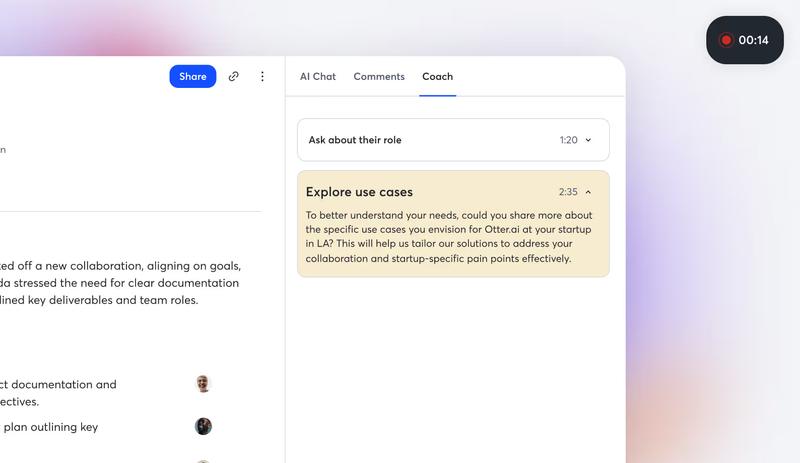
Otter is one of the most widely known AI meeting note-takers, primarily optimized for real-time transcription and summaries, not specifically for revenue intelligence. It can be a light Modjo alternative if your focus is "stop taking manual notes" rather than sales analytics.
Key features
- Otter Notetaker bot auto-joins Zoom/Meet/Teams meetings via calendar integration and transcribes in real time
- Live transcript visible to meeting participants with highlights, comments, and collaborative notes
- Automatic meeting summaries and action items, plus AI chat to query past meetings
- Channels and shared workspaces to organize transcripts and notes
Strengths
- Very easy to use and widely adopted; users praise its intuitive interface and fast setup
- Strong real-time transcription and decent accuracy in good audio conditions
- Suitable across many roles (students, journalists, internal meetings), not just sales
Weaknesses
- Not focused on revenue intelligence: Limited analytics compared with Modjo/Gong/Claap; mostly just transcripts, summaries, and basic collaboration
- Reviews frequently highlight accuracy drops with accents, technical terms, or noisy audio; poor speaker recognition
- Billing and cancellation complaints, plus frustration with plan changes and perceived value of paid tiers
- For large teams, Business/Enterprise pricing becomes less competitive against more sales-oriented tools
- Basic (Free): 300 minutes/month, 30 minutes per conversation, limited imports
- Pro: $8.33/user/month (annual billing) – 1,200 minutes/month, 90-minute meeting cap, 10 file imports
- Business: $20/user/month (annual) – 6,000 minutes/month, 4-hour cap, more team features
- Enterprise: Custom; substantial annual deals for large deployments
Best for
Teams that mainly want reliable transcription plus simple summaries across many meeting types, and are less focused on sales-specific coaching or revenue analytics.
How should you choose the right Modjo alternative?
Here's a simple framework to guide your decision:
Choose Claap if
- You want conversation intelligence that reps actually adopt
- You’re replacing Modjo because it’s too expensive, rigid, or intrusive
- You need fast insights, flexible workflows, and real AI automation
- GDPR, multi-language support, and pricing transparency matter
Claap isn’t just a Modjo alternative.
It’s what conversation intelligence looks like when it’s built for how revenue teams actually work in 2026.
Choose Gong if:
- You're an Enterprise (500+ reps) needing deep forecast analytics
- You have six-figure+ budget and dedicated RevOps resources
- You need the most comprehensive revenue intelligence OS on the market
Choose Avoma if:
- You want CI/RI plus scheduling and lead routing in one platform
- You're a mid-market team looking for simpler pricing than Gong
- HubSpot is central to your sales stack
Choose tl;dv, Fathom, or Fireflies if:
- You just want automated notes and have a limited budget
- You're okay with lighter revenue intelligence features
- You need a generous free tier to get started (tl;dv) or prioritize accuracy (Fathom) or deep analytics (Fireflies)
FAQs
What’s the best free alternative to Modjo?
tl;dv is the most generous free alternative to Modjo.
It offers unlimited recordings, transcripts, and AI-generated moments on its free plan.
Fathom also has a free tier, but it limits you to 5 AI summaries per month.
If you want real conversation intelligence without paying upfront, tl;dv is the best choice. Advanced coaching and deep CRM integrations require an upgrade. Teams that need those features should consider Claap or Modjo.
Which tool is best for European sales teams?
Claap is the strongest option for European teams.
It’s built by a European company with strong GDPR compliance, supports 99+ languages, and offers transparent pricing in euros. It also combines conversation intelligence with CRM enrichment and AI agents, which works well for sales teams.
Compared to US-centric platforms, Claap is better aligned with European data privacy standards and sales workflows.
How much does Gong cost compared to Modjo?
Gong is one of the most expensive options on the market.
Pricing typically ranges from $108–250 per user per month, depending on modules (Foundation, Engage, Forecast), plus:
- Mandatory platform fees: $5k–$50k
- Implementation fees: $15k–$65k
Modjo’s pricing is similarly opaque and requires custom quotes.
If you want transparent pricing without hidden fees, consider:
- Claap: $32–60/user/month, billed yearly
- Avoma: $19–79/user/month
Both offer strong conversation intelligence without enterprise-level overhead.
Do these tools integrate with Salesforce and HubSpot?
Yes, but integration depth varies a lot.
- Gong, Claap, Avoma, and Chorus offer native bi-directional CRM sync, automatically enriching records with call insights.
- tl;dv, Fathom, and Fireflies usually provide one-way sync or require higher-tier plans for full CRM enrichment.
Always check whether the tool supports your specific CRM fields and workflows.
Not all “CRM integrations” deliver the same value.
Can I switch from Modjo without losing historical call data?
There’s no direct one-click migration from Modjo.
Your best approach is to:
- Export key calls and insights from Modjo before switching
- Start fresh with your new tool for ongoing conversations
Platforms like Claap, Gong, and Avoma make it easy to rebuild a searchable call library thanks to strong organization and search features.
Most teams fully transition within 2–4 weeks.
Which Modjo alternative works best with AI agents?
Claap. Its MCP server has been in production since June 2025, letting AI agents like Claude query structured conversation data (deals, accounts, objections, competitor mentions) directly.
Modjo shipped MCP in 2026, Gong's MCP access is still beta, and lighter notetakers offer limited or no agent access.
Does Modjo have an MCP server?
Modjo shipped its MCP and AI agent integrations in its April 2026 product update.
Teams that want production-grade AI agent access to their call data today typically look at Claap, whose MCP has been live since June 2025.
What is agent-ready conversation data?
Conversation data structured into typed fields (pain, budget, competitors, next steps) that AI agents can query directly, instead of raw transcripts they must re-read on every request.
Structured data means faster answers, lower token costs, and fewer hallucinations.