

Best Fireflies alternatives: 7 tools compared
Compare the best Fireflies alternatives for sales teams: Fathom, Claap, Otter, tl;dv, Fellow, Avoma and Gong, with CRM sync prices and G2 reviews.


Updated 13 October 2026.
Fireflies alternatives overview
- Fathom is best for reps and small teams who want a free note taker that just works. Its free plan records and summarizes without a monthly cap.
- Claap is best for sales teams that want calls to fill the CRM and feed coaching. It writes each call into HubSpot or Salesforce fields and scores calls on your sales method.
- Otter is best for live transcription, in-person meetings and mobile use. Its paid plans start lower than any other tool here.
- tl;dv is best for teams that want structured notes templates and recordings they can share. Its templates apply a notes structure to every matching meeting.
- Fellow is best for managers who run agendas, one-on-ones and meeting notes in one place. Its Business plan adds CRM sync for sales teams.
- Avoma is best for teams that want scheduling, notes and call scoring in one tool. Coaching sits in a paid Conversation Intelligence add-on.
- Gong is best for large revenue teams with budget for a full revenue platform. Its prices are quote-only and include a platform fee.
Why sales teams look for a Fireflies alternative
The average seller spends 40% of their time selling, according to Salesforce's 2026 State of Sales report (Salesforce). Most of the remaining time goes to admin, and call notes and CRM updates are a large part of it.
That is why the note taker matters. Fireflies records and transcribes calls well, and many teams start there. Sales teams usually outgrow it when they need the call to update deal fields, feed coaching and stay organized by team, which is where a sales-focused tool earns its seat.
So this guide compares the seven Fireflies alternatives sales teams shortlist most often. For each one you get who it suits, what it costs once CRM sync is included, its integrations, its pros and cons and what G2 reviewers say.
Fireflies alternatives at a glance
Prices below are per seat per month, billed yearly, for the cheapest plan that syncs call notes to HubSpot or Salesforce.
| Tool | Best for | Free plan | Price with CRM sync | G2 rating |
|---|---|---|---|---|
| Fathom | Reps and small teams | Yes, unlimited recordings | $25 (Business, 2-seat minimum) | 5.0 (7,000+ reviews) |
| Claap | Sales teams of 5 to 100 reps | Yes, 10 videos per user | $60 (Business) | 4.6 (480+ reviews) |
| Otter | Live and in-person transcription | Yes, 300 minutes a month | $8.33 (Pro) | 4.4 (505 reviews) |
| tl;dv | Notes templates and shared recordings | Yes | $59 (Business, native CRM apps) | 4.7 (546 reviews) |
| Fellow | Agendas, one-on-ones and notes | Yes, 5 AI notes per user | $15 (Business) | 4.7 (2,300+ reviews) |
| Avoma | Notes, scheduling and scoring | 14-day trial | $19 (Startup), $48 with coaching | 4.6 (1,365 reviews) |
| Gong | Large revenue teams | No | Quote only, Vendr median $55,359 a year | 4.7 (6,700+ reviews) |
What Fireflies does well, and what it costs
Fireflies records Zoom, Meet and Teams calls with a meeting bot, then writes a transcript, a summary and action items. Every plan includes unlimited transcription and AI summaries; storage and AI credits are what the plans meter (Fireflies).
- Free: $0, with 400 minutes of storage per team.
- Pro: $10 per seat per month billed yearly, $18 monthly, with 8,000 minutes of storage per seat.
- Business: $19 billed yearly, $29 monthly, with unlimited storage and team analytics.
- Enterprise: $39 per seat per month, billed yearly only, with SSO and HIPAA.
Pro syncs full transcripts to HubSpot; the integration rules that route notes to the right deal need Business (Fireflies help center). Fireflies holds 4.7 out of 5 on G2 across 753 reviews. Our full breakdown is in Fireflies pricing.
Where Fireflies falls short for sales teams
Fireflies comes up often on our own sales calls, usually when a team is replacing it. Here is what buyers told us, in their words:
- A sales leader at a US device-protection company: "we use Fireflies ... And maybe there's an integration into HubSpot, but today it's just like a separate platform."
- A sales enablement lead at a Belgian energy-software company, on automatic HubSpot tasks: "what happened was we Had like 20 tasks for one deal."
- The same buyer, on cost: "company-wide Fireflies it's a bit too expensive for what we're using it for."
- A sales enablement lead at a US aviation software company: "fireflies and uh, and [another note taker], it's mostly not takers, but it's not really built for more insights."
- A RevOps consultant who runs Fireflies for clients: "being able to take the call recordings from there and then push push everything through into a CRM is great. But then nothing really happens after that."
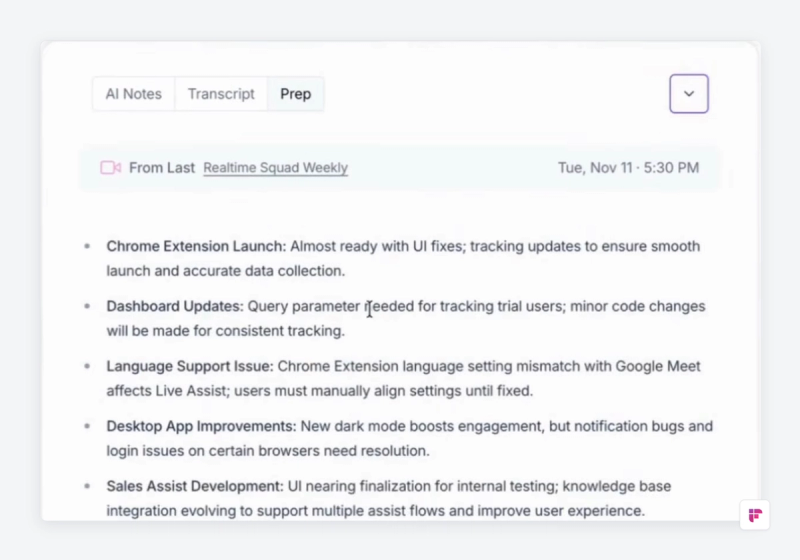
The pattern: the notes are fine, and the trouble starts after the call. Buyers want the call to land in the right CRM fields, with less noise, and to feed coaching.
How we built this comparison
We compared the tools sales teams most often weigh against Fireflies on five criteria:
- CRM sync. Whether notes and fields reach HubSpot or Salesforce, and on which plan.
- Cost for a sales team. The cheapest plan that syncs to the CRM, with seat minimums and add-ons.
- Capture. Meeting bot, bot-free recording, phone and in-person calls.
- Sales features. Call scoring, coaching, deal views and follow-up emails.
- Reviews. G2 rating and review count, and what reviewers praise or criticize.
Important note: Read AI and Jamie are both popular Fireflies alternatives, but their G2 review base is thin: Read AI holds 4.0 out of 5 across 43 reviews (G2) and Jamie 4.5 out of 5 across 25 reviews (G2). We left them out of this selection until more buyers have reviewed them.
1. Fathom, best for reps and small teams who want a free note taker
Fathom is the safe pick for a rep or a small team that mostly wants good notes for free; teams that need deal fields and coaching pay for Business or look elsewhere.
Who Fathom works best for
- Individual reps and founders who sell.
- Small teams that want summaries in HubSpot without a project.
Fathom overview
Fathom records Zoom, Meet and Teams calls, transcribes them and writes an instant summary. The free plan keeps unlimited recordings. Business adds CRM field sync, a Deal View of every call on a deal, coaching metrics and AI scorecards (Fathom).
Fathom pricing
- Free: $0, unlimited recordings and summaries.
- Premium: $16 per user per month billed yearly, $20 monthly.
- Team: $15 per user per month billed yearly, $19 monthly, with a 2-user minimum.
- Business: $25 per user per month billed yearly, $34 monthly, with CRM field sync.
For a sales team, Business is the plan that does the job: $25 × 2-seat minimum = $50 a month at the smallest.
Fathom integrations
- Zoom, Google Meet and Microsoft Teams.
- HubSpot and Salesforce, with field sync on Business.
Fathom pros and cons
Pros
- Generous free plan with unlimited recordings.
- Very fast setup and a simple interface.
- The highest G2 rating in this comparison.
Cons
- CRM field sync and scorecards need Business.
- Team features are lighter than dedicated sales platforms.
What G2 reviewers say about Fathom
Fathom holds 5 out of 5 on G2 across more than 7,000 reviews (G2).
- "They also integrate meeting notes directly into Hubspot which is a big win for us." SDR Manager, Mid-Market (review)
- "The team workspace features feel less mature than what specialized competitors like Gong offer for sales coaching." IT Manager, Mid-Market (review)
A quick note: Claap is our product. To keep this comparison fair, we relied on third-party reviews and linked every major claim to its source.
2. Claap, best for sales teams that want calls to fill the CRM
Claap fits sales teams of 5 to 100 reps that want every call to update deal fields and feed coaching at a published price; a team that only wants transcripts will find a cheaper tool above.
Who Claap works best for
- Sales teams on HubSpot or Salesforce that run a method such as MEDDIC or SPICED.
- Managers who coach from calls and want each rep scored the same way.
Claap overview
Claap records Zoom, Meet and Teams calls without a bot through its Chrome extension or Mac app, or with a visible bot if you prefer. After each call it writes the notes, fills the deal fields you choose and drafts the follow-up email from your templates (automatic note taker).
It also scores every call on your own criteria, so a manager sees each rep's average next to the team's, criterion by criterion (conversation intelligence). ClaapAgent answers questions across a deal's calls, and Claude or ChatGPT can read the same data through the Claap MCP.
Claap pricing
- Basic: free, 10 videos per user and 300 minutes in total.
- Pro: $32 per seat per month billed yearly, unlimited recordings, 1,000 minutes a month and 99+ languages.
- Business: $60 per seat per month billed yearly, with CRM sync, AI coaching and ClaapAgent across all meetings.
- Enterprise: on quote, with SSO, SCIM and the Claap API.
Claap integrations
- HubSpot, Salesforce, Attio and Pipedrive on Business.
- Aircall and lemlist calls from Pro.
- Zapier, Make, n8n and webhooks on Business.
- The Claap MCP on every plan.
Claap pros and cons
Pros
- Calls fill CRM fields, so deal data stays current without rep admin.
- Bot-free recording on every plan.
- Call scoring and coaching on your own sales method.
Cons
- CRM sync and coaching need Business.
- No built-in dialer: phone calls come through Aircall or lemlist.
What G2 reviewers say about Claap
Claap holds 4.6 out of 5 on G2 across more than 480 reviews (G2).
- "I like how it summarizes the calls and highlights any key deal signals, helping with quick follow-ups." Security operations, Small-Business (review)
- "While Claap is really good at recording and sharing sales conversations, I think it could do more to give sales leaders the information they need." Sales Manager, Enterprise (review)
3. Otter, best for live transcription and in-person meetings
Otter is the cheapest way to get transcripts synced to a CRM, and it shines in live and in-person meetings; sales teams that want scoring and deal views will need more.
Who Otter works best for
- Reps who meet buyers in person and record on their phone.
- Teams on a tight budget that want transcripts in Salesforce or HubSpot.
Otter overview
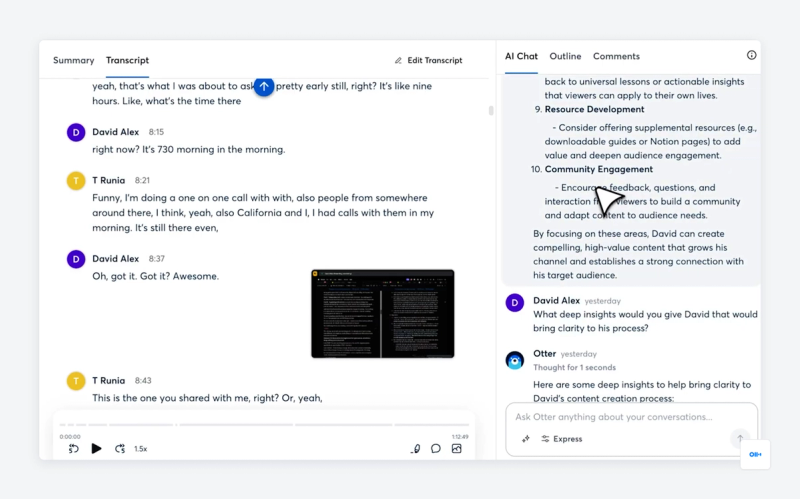
Otter writes a live transcript with speaker names during the meeting, then a summary and action items. Otter AI Chat answers questions across your meeting history, and an MCP server lets Claude or ChatGPT query transcripts (Otter). Otter transcribes six languages, one per conversation.
Otter pricing
- Basic: free, 300 transcription minutes a month and 30 minutes per conversation.
- Pro: $8.33 per user per month billed yearly, $16.99 monthly, 1,200 minutes a month and 90 minutes per conversation.
- Business: $19.99 per user per month billed yearly, $30 monthly, with up to 4 hours per conversation.
- Enterprise: custom, with SSO and HIPAA.
More detail in our guide to Otter pricing.
Otter integrations
- Zoom, Google Meet and Microsoft Teams.
- Salesforce, HubSpot and Zapier from Pro.
- MCP server for Claude and ChatGPT.
Otter pros and cons
Pros
- Strong live transcription and mobile app.
- The lowest paid price in this comparison.
Cons
- Six transcription languages.
- Few sales coaching features.
- A privacy class action over recording without consent is ongoing in California.
What G2 reviewers say about Otter
Otter holds 4.4 out of 5 on G2 across 505 reviews (G2).
4. tl;dv, best for structured notes templates and shared recordings
tl;dv suits teams that want the same notes structure on every meeting and easy clips to share; native CRM apps and coaching sit on its pricier Business plan.
Who tl;dv works best for
- Teams that run repeatable meeting types, such as discovery or onboarding.
- Managers who share call moments with the team.
tl;dv overview
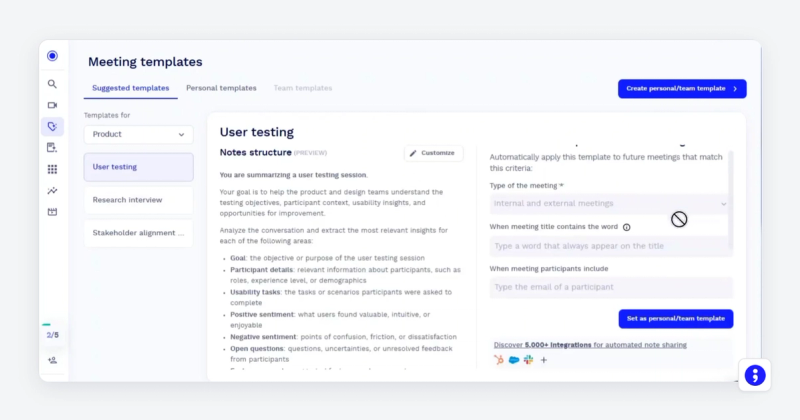
tl;dv records and transcribes Meet, Zoom and Teams calls. Summaries are automatic or follow templates you set, and templates apply to every matching meeting (tl;dv help center).
tl;dv pricing
- Free: $0, with capped AI notes.
- Pro: $18 per seat per month billed yearly.
- Business: $59 per seat per month billed yearly, with native Salesforce and HubSpot apps, AI coaching and sales playbooks (Frontdesk Review).
- Enterprise: custom.
More detail in our guide to tl;dv pricing.
tl;dv integrations
- Google Meet, Zoom and Microsoft Teams.
- Salesforce, HubSpot and Pipedrive.
tl;dv pros and cons
Pros
- Notes templates keep every call of a type consistent.
- Easy to clip and share recordings.
Cons
- Native CRM apps and coaching need Business.
- tl;dv shows prices in local currency, so a US quote can differ from European ones.
What G2 reviewers say about tl;dv
tl;dv holds 4.7 out of 5 on G2 across 546 reviews (G2).
5. Fellow, best for agendas, one-on-ones and meeting notes in one place
Fellow is a strong pick for managers who want agendas, one-on-ones and AI notes in one tool; it is a meeting tool first, so deal-level sales features are light.
Who Fellow works best for
- Sales managers who run one-on-ones and team meetings with shared agendas.
- Companies that want one note taker across sales and other teams.
Fellow overview
Fellow records meetings, writes AI notes and keeps them next to the agenda and action items. The Team plan caps AI notes at 10 per user per month; Business makes them unlimited and adds the CRM integration (MeetGeek review).
Fellow pricing
- Free: $0, 5 AI notes and 5 recordings per user.
- Team: $7 per user per month billed yearly, $11 monthly.
- Business: $15 per user per month billed yearly, with unlimited AI notes and CRM integration.
- Enterprise: $25 per user per month billed yearly, 10-user minimum.
Fellow integrations
- Salesforce and HubSpot on Business.
- Asana and Jira for action items.
Fellow pros and cons
Pros
- Agendas, one-on-ones and notes in one place.
- Low price for CRM sync.
Cons
- The free plan's AI notes run out fast.
- Few deal and coaching features for sales teams.
What G2 reviewers say about Fellow
Fellow holds 4.7 out of 5 on G2 across more than 2,300 reviews (G2).
6. Avoma, best for scheduling, notes and call scoring in one tool
Avoma suits small and mid-sized sales teams that want one tool from booking the meeting to scoring it; the coaching features cost extra.
Who Avoma works best for
- Teams that book, record and review meetings in one tool.
- Managers who want AI scorecards without a Gong-sized contract.
Avoma overview
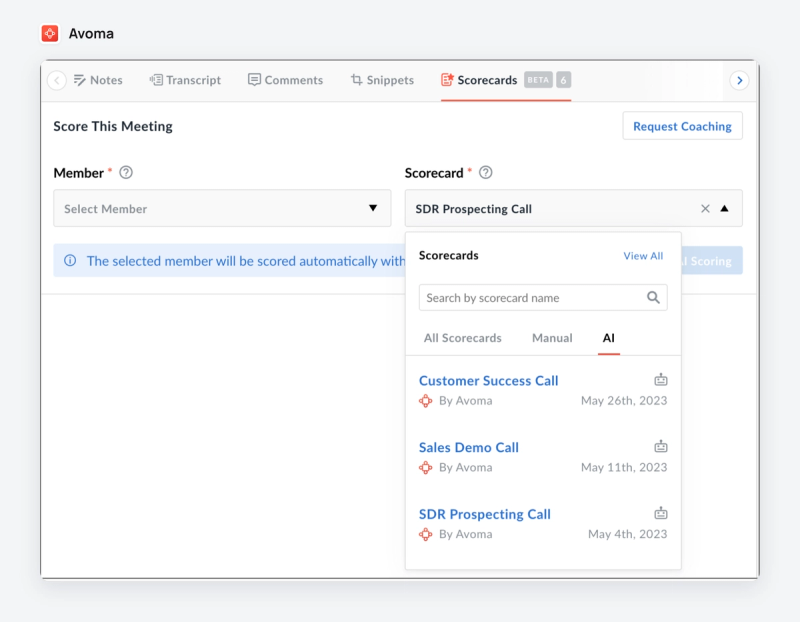
Avoma covers scheduling, meeting notes and CRM sync on its base plans. Call scoring, AI coaching recommendations and custom scorecards sit in the Conversation Intelligence add-on (Avoma).
Avoma pricing
- Startup: $19 per recorder seat per month billed yearly, $29 monthly.
- Organization: $24 per recorder seat per month billed yearly.
- Enterprise: $39 per recorder seat per month billed yearly, 10-seat minimum.
- Conversation Intelligence add-on: $29 per seat per month billed yearly, $35 monthly.
With coaching, the cheapest setup is $19 + $29 = $48 per seat per month. Viewers are free, and a 14-day trial includes the add-ons.
Avoma integrations
- Salesforce and HubSpot CRM sync from Startup.
- Zoho CRM.
Avoma pros and cons
Pros
- Scheduling, notes and scoring in one product.
- Only recorder seats are paid.
Cons
- Coaching needs a paid add-on.
- Reviewers report the notetaker sometimes misses calls.
What G2 reviewers say about Avoma
Avoma holds 4.6 out of 5 on G2 across 1,365 reviews (G2).
- "I really appreciate the Ask Avoma feature as it saves a lot of time by helping me check specific details from conversations." Enterprise AE, Mid-Market (review)
- "Sometimes the notetaker does not join the call and sometimes randomly drops off." Enterprise AE, Mid-Market (review)
7. Gong, best for large revenue teams with budget
Gong is the safe pick above 50 reps with a RevOps team and budget; for a team moving off Fireflies, it is usually far more platform, and cost, than the job needs.
Who Gong works best for
- Revenue teams of 50 reps or more.
- Companies that want forecasting, engagement and call analysis from one vendor.
Gong overview
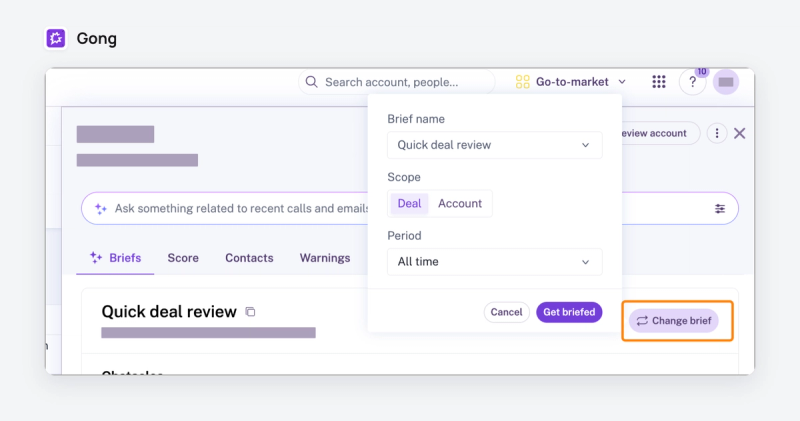
Gong records calls, analyzes deals and forecasts revenue. Its AI deal brief summarizes a deal or account over a chosen period, and its deal likelihood score ranks open deals from calls, emails and CRM data (Gong help center).
Gong pricing
Gong publishes no prices: it charges a per-user license plus a platform fee (Gong). Vendr puts the median Gong contract at $55,359 a year across 593 purchases (Vendr).
Gong integrations
- Salesforce, HubSpot and Microsoft Dynamics.
- Zoom, Google Meet and Microsoft Teams.
Gong pros and cons
Pros
- The deepest deal and forecast analytics here.
- A large ecosystem and long track record.
Cons
- Quote-only pricing with a platform fee.
- A heavy rollout for small teams.
What G2 reviewers say about Gong
Gong holds 4.7 out of 5 on G2 across more than 6,700 reviews (G2).
How to choose a Fireflies alternative
- You mostly want free, reliable notes: start with Fathom.
- You want calls to fill HubSpot or Salesforce fields and feed coaching: Claap.
- You record in person or on mobile, on a budget: Otter.
- You want the same notes structure on every meeting: tl;dv.
- You run agendas and one-on-ones in the same tool: Fellow.
- You want scheduling and scoring together: Avoma with its add-on.
- You have 50+ reps and a RevOps team: Gong.
Takeaways
- Fireflies is a solid note taker. Sales teams leave it when they need the call to reach the CRM cleanly and drive coaching.
- Price the plan that syncs to your CRM: that is Business on Fathom, Claap, tl;dv and Fellow, Pro on Otter, and any plan on Avoma.
- For free notes, Fathom is hard to beat. For live transcripts on a budget, Otter.
- For sales teams that want deal fields, scoring and follow-up emails from every call, Claap covers the job at a published price.
- Gong makes sense once the team is large enough to use a full revenue platform.
Frequently asked questions
What is the best alternative to Fireflies for sales teams?
It depends on what you need after the call. Fathom is the best free note taker, Claap is built for sales teams that want calls to fill CRM fields and feed coaching, and Gong suits large revenue teams with budget.
Is there a free alternative to Fireflies?
Yes. Fathom's free plan keeps unlimited recordings and summaries, Otter's free plan includes 300 transcription minutes a month, and Claap's Basic plan includes 10 videos per user. CRM sync needs a paid plan on most of them.
Which Fireflies alternative records without a bot?
Claap records Zoom, Meet and Teams calls without a bot through its Chrome extension, on every plan, and its Mac app, from Pro. A visible bot is still available for teams that prefer it.
Which Fireflies alternative is cheapest with CRM sync?
Otter is the cheapest, with Salesforce and HubSpot from its Pro plan at $8.33 per user per month billed yearly. Fellow follows at $15 on Business, then Avoma at $19 on Startup.
How much does Fireflies cost?
Fireflies Pro costs $10 per seat per month billed yearly or $18 monthly. Business costs $19 yearly or $29 monthly, and Enterprise costs $39 per seat per month, billed yearly only.
Is Otter better than Fireflies?
Otter is stronger on live transcription, in-person meetings and price, while Fireflies covers more languages. Our Fireflies vs Otter comparison goes through both.