


How to Increase Sales Productivity: 16 Proven Strategies [2026]
Boost sales productivity with 16 proven strategies. Automate admin, coach reps with AI, and see how top teams drive higher ROI.

![How to Increase Sales Productivity: 16 Proven Strategies [2026]](https://cdn.sanity.io/images/gb4upfg4/staging/befb349a20f21ee3e8534730b41b530faa77b6a5-1536x864.jpg?w=1080&h=608&fit=crop&auto=format&q=75)
Mondays shouldn’t start with a CRM guilt trip. If your top sales reps still spend more time cleaning notes than closing deals, you don’t have a sales problem: you have a system problem.
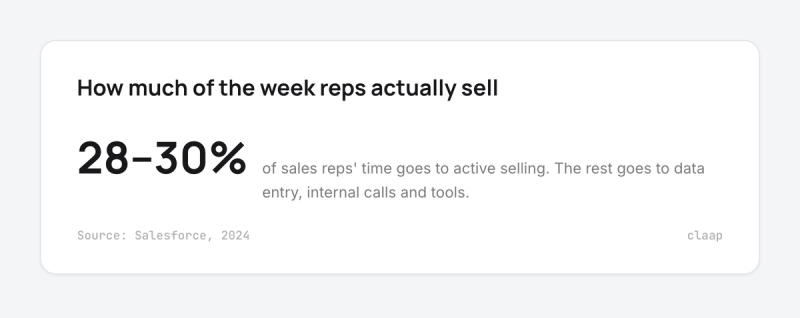
A Salesforce report shows that sales reps spend only 28–30% of their time actively selling (Salesforce, 2024). The rest disappears into admin hell: data entry, internal calls, and tools that promise productivity but deliver drag.
That’s exactly the gap sales productivity tools were built to close: freeing sellers from admin so they can focus on what matters: selling.
For modern sales teams, productivity isn’t just about activity; it’s about turning every effort into measurable progress. Top sales professionals balance their time, tools, and focus to hit ambitious targets while avoiding burnout.
What is Sales Productivity and Why It Matters
Sales productivity measures how efficiently a sales team uses its time: to chase and speak with qualified leads, and turn them into new customers.
It’s not about more calls or meetings; it’s about smarter motion that compounds.
High-performing teams close better deals, faster: driven by data and discipline, not noise, busywork, or manual tasks.
At Claap, we call it amplified selling: automation that frees time, and AI agents that turn real sales conversations into insights and actions.
The ROI of Improving Sales Productivity
Every minute reclaimed from admin is a minute that can move a deal forward.
Streamlining administrative tasks and automating manual processes doesn’t just cut wasted motion: it shortens sales cycles, improves efficiency, and directly boosts sales performance across the board.
- Top-quartile companies generate 2.5× higher gross margin per sales dollar compared with the bottom quartile (McKinsey, 2024).
- Automating non-selling work can free up about 20% of sales capacity (Markets and Markets, 2025).
But the real ROI isn’t just financial. Productivity gains cascade across the organisation:
- Faster onboarding: new hires ramp to full productivity in ~3 months instead of 6
- Lower turnover: reduced burnout and clearer coaching loops cut voluntary attrition.
- Happier customers: reps spend more time listening and less time logging.
Turning every sales call or touchpoint into revenue requires knowing what works, what’s at risk, and where to focus next
From Insight to Action: 16 Proven Strategies to Increase Sales Productivity
Improving sales team productivity isn’t a single leap: it’s a series of small, consistent wins.
These 16 strategies come from hundreds of sales teams: practical moves that reduce admin, sharpen focus, and accelerate deals.
You can’t sell more hours into the day, but you can sell smarter inside them.
1. Automate the Admin That’s Killing Your Pipeline
Every sales team talks about efficiency, but few measure how much time actually disappears into admin.
Reps spend an average of 3.4 hours per week entering customer data; one-third spend over an hour daily. For a $100k bookings rep, ~31% admin time equals roughly $595/week in lost selling time (Markets and Markets, 2025).
Teams using automation are 14.5% more productive and close deals 20% faster (Utmost Agency, 2024). When routine tasks vanish, selling time expands, and so does morale.
Quick wins:
- Auto-sync call notes and CRM updates.
- Replace manual reminders with triggers.
- Use AI to summarize calls and detect next steps automatically.
- Auto-generate follow-up tasks from meetings or emails.
- Consolidate notes from multiple apps into a single CRM view.
- Set up workflow rules that auto-assign leads or escalate stalled deals.
- Create templates for recurring messages, proposals, or outreach sequences.
💡Automation isn’t about replacing people: it’s about removing friction that slows them down.
Sales teams can leverage tools like:
- HubSpot Sales Hub or Salesforce Sales Cloudn/aautomate CRM updates, reminders, and pipeline tracking.
- Claap, Gong or Chorusn/aautomatically capture meeting conversations, transcribe calls, and highlight key points.
- Zapier or Make (formerly Integromat): connect apps to automate repetitive workflows like notifications, task creation, or data syncing.
2. Implement Strategic Time Blocking
Every context switch kills momentum: Slack pings, emails, CRM updates. The best teams protect deep work time.
Sales strategist Anthony Iannarino recommends 90-minute blocks dedicated to high-value selling: prospecting, deal advancement, and follow-ups.
Jill Konrath advises: “Don’t do your email first thing in the morning. You’ll get sucked in before you know it.”
Try this:
- Protect 8:00–11:00 AM for live selling.
- Check your inbox only 2–3 times per day.
- End each block with 10 minutes of next-step planning.
💡Productivity starts when your calendar reflects your priorities, not everyone else’s.
3. Stop Paying for Tools Your Team Doesn’t Use
66% of sales reps feel overwhelmed by the number of platforms they juggle (Clevenio, 2024). High-performing teams aren’t necessarily using fewer tools: they use them intentionally. Teams mastering a core stack are 57% more efficient at sales development (SalesGenie).
Smart tools and integrated systems improve visibility, reduce non-selling activities, and help teams focus on what matters. Platforms that combine meeting intelligence, notes, and coaching analytics in one place, like Claap, can reduce tool fatigue without adding friction.
Start with a simple audit:
- Which tools directly support pipeline movement or coaching?
- Which duplicate effort or fragment data?
- Which are rarely used?
💡A smaller, smarter tech stack = more selling, less switching.
4. Prioritize High-Value Opportunities (The 80/20 Rule)
80% of revenue comes from roughly 20% of customers (LinkedIn, 2024). Yet many reps spend half their week chasing small accounts that barely move the needle.
Focusing on high-value accounts increases revenue per sales FTE by 3–15% and reduces cost-to-serve by up to 20% (McKinsey). AI tools can reveal deal momentum, stalled prospects, and risk signals, helping reps focus on the opportunities that matter most.
💡Sales productivity isn’t about doing more: it’s about knowing what to do next, and why.
5. Reduce Meeting Overload
Meetings are a hidden tax on sales performance. The average rep spends 7–10 hours per week on internal calls, most of which add little value (Fresh Perspective Sales, 2024).
The issue isn’t collaboration: it’s clutter. Many standing updates could be async, freeing time for actual selling. Quick audits often reveal that half of recurring meetings can be shortened, merged, or removed.
Try these rules:
- No agenda, no meeting.
- Default to 25-minute sessions.
- Share async updates using video or meeting summaries.
💡Protecting time consistently preserves focus and momentum.
6. Use Interactive Demos
Live demos are one of the biggest hidden drains on selling time. Reps run the same 20-minute product walkthrough over and over, often for buyers who are still deciding whether the category is even relevant to them.
Interactive demos remove that repetition. Instead of booking another call, you send a clickable replica of your product that the buyer explores on their own: no scheduling, no screen share, no rep required.
The productivity gain works in two directions. Inbound leads self-qualify before they ever reach a rep, so live time goes to people who already understand what they are buying. And after the call, your champion gets a link they can forward to the rest of the buying committee instead of asking you to re-run the demo for each new stakeholder.
Quick wins:
- Embed an interactive demo on your product and pricing pages so inbound leads self-qualify before booking.
- Send a personalized demo in your post-call follow-up instead of a slide deck.
- Give your champion a shareable link for internal buy-in, so you are not re-demoing to every new stakeholder.
- Build one demo per use case rather than one generic tour for everyone.
- Use demo engagement data (who clicked, how far they got) to prioritize follow-up.
Guideflow is one of the strongest options in this category. It captures your product in a few clicks with no code, lets you personalize each demo per prospect using CRM variables, and embeds anywhere: your website, emails, ads, or help center. Its HTML capture produces demos where the interface is genuinely clickable rather than a static screenshot, and there is a free plan if you want to test the motion before rolling it out to the whole team.
💡Every demo a buyer can run without you is an hour back in your week, and a deal that keeps moving while you are asleep.
7. Establish Daily Non-Negotiable Activities
Inconsistent performance often stems from inconsistent rhythms. Spikes one week, flatlines the next: pipeline health suffers.
Top reps anchor their day around non-negotiables: small, repeatable actions that protect momentum.
“There has to be a minimum you do each day: regardless of how you feel.”
Set your floor, not just your ceiling:
- 3 daily revenue-driving actions.
- Track leading indicators, not just closed deals.
- Build habits that make motivation optional.
These rituals strengthen a sales team’s ability to focus on high-value deals, maintain momentum, and boost sales productivity day after day.
💡Discipline beats intensity.
8. Align Sales and Marketing Priorities
When sales and marketing operate on different data, productivity leaks. Reps chase unqualified leads while marketers optimize campaigns that don’t convert.
Aligned GTM teams grow 20% faster (McKinsey).
Pro tips for alignment:
- Invite marketing to pipeline reviews: Make lead quality discussions a regular part of your sales cadence. Understanding which leads convert and why ensures campaigns focus on the right targets.
- Share call insights: Use real buyer conversations to refine messaging, email campaigns, and content. Marketing should echo the language that resonates most with prospects.
- Define shared KPIs: Track metrics like lead-to-opportunity conversion, pipeline velocity, and account engagement so both teams work toward the same goals.
- Agree on lead definitions: Ensure both teams have a clear, shared definition of MQLs, SQLs, and ideal customer profiles.
- Leverage feedback loops: Sales should provide ongoing feedback on campaign effectiveness, and marketing should adjust targeting or content accordingly.
- Use integrated tools: Platforms that capture calls, emails, and campaign performance in one place (like Claap or CRM-integrated intelligence tools) make alignment measurable and actionable without adding admin.
When alignment clicks, sales enablement becomes seamless: reps act on the same insights marketing sees, campaigns convert better, and the organization moves as one unit rather than two disconnected teams.
Conversation intelligence tools that capture real buyer interactions, like Claap, Gong, Fireflies, Modjo, or tl;dv, help both teams hear the same voice straight from the source.
9. Implement Skills-Based Training and Development
Generic training doesn’t build top performers: reps forget 80% within a month. Continuous, in-workflow coaching improves performance across every stage of the sales process.
Best practices:
- Map skills that correlate with conversion: Identify behaviors, talk tracks, and techniques that top reps use to win deals, and target these in training.
- Reinforce learning in context, not classrooms: Deliver micro-learning moments directly in the tools and workflows reps already use.
- Celebrate improvement, not attendance: Focus on measurable skill growth rather than time spent in training sessions.
- Use AI-driven call analysis:Tools like Claap can turn real conversations into teachable moments: short, actionable, and replayable lessons that are tied directly to actual deals.
- Create role-specific training paths: Differentiate coaching for SDRs, AEs, and account managers to reflect their unique objectives and challenges.
- Integrate feedback loops: Provide timely, specific feedback on live deals so reps can immediately apply learning and improve performance.
- Encourage peer-to-peer learning: Share top-performing call examples across the team to spread best practices organically.
When training is targeted, contextual, and continuous, reps not only retain skills longer: they consistently apply them to drive revenue.
10. Streamline Your Qualification Process
Up to 50% of opportunities end in “no decision” due to weak qualification (Fresh Perspective Sales, 2024). The best teams qualify fast and disqualify even faster.
Frameworks like BANT or MEDDIC help reps separate potential from noise. AI call highlights can surface engagement patterns, urgency, and stalled deals: helping shorten cycles and keep forecasts accurate.
To streamline qualification:
- Define clear stage exit criteria: Ensure reps know exactly what qualifies a lead to move forward at each stage.
- Track “no decision” reasons: Use historical patterns to improve qualification and forecast accuracy.
- Coach reps on diagnostic questioning: Teach them to uncover real pain points, authority, and buying intent early.
- Leverage AI insights: Tools can highlight deal patterns, engagement signals, and stalled opportunities.
- Use a standardized framework: BANT, MEDDIC, or similar frameworks help separate promising leads from noise.
- Review and iterate regularly: Qualification criteria should evolve as markets, buyer behaviors, and product offerings change.
💡 Great sellers don’t chase every lead: they protect their time for the right ones.
11. Leverage Shared Services for Admin Tasks
Top-performing sales organisations treat time as a team resource, not an individual constraint. They use shared services, operations support, virtual assistants, or regional admin hubs, to offload repetitive, non-selling work.
Offloading repetitive tasks and manual processes gives leaders time to refine sales methodology and improve sales outcomes.
According to McKinsey, leading B2B companies offload up to 50% of non-selling tasks, freeing 20–30% more capacity for customer-facing activities. Those reclaimed hours turn into real revenue growth and happier reps.
Start small: delegate quote prep, CRM hygiene, or proposal formatting
.
12. Respond to Leads With Urgency
Speed is the ultimate conversion lever. Leads cool fast; the longer they wait, the harder they are to convert.
Companies responding within 60 minutes are 7× more likely to qualify a lead; under 5 minutes, conversion can be 100× higher than waiting 30 minutes (LeadsForge AI, 2024).
Quick fixes:
- Set a 5-minute SLA for inbound leads.
- Automate alerts to prevent cold leads.
- Review response metrics weekly.
- Prioritize high-value leads first: Use scoring or intent signals to ensure your fastest responses go to the most promising prospects.
- Use templates for common responses: Save time while keeping communication personalized and consistent.
- Track and celebrate rapid follow-ups: Encourage the team by recognizing reps who consistently hit response targets, reinforcing the behavior.
💡Speed builds trust, and pipeline velocity.
13. Use AI and Predictive Analytics
Teams leveraging AI see 33% higher efficiency and 10–20% ROI gains (Utmost Agency, 2024).
Practical steps:
- Automate data capture and call summaries.
- Layer predictive insights on clean data.
- Use AI coaching to replicate top-performer behaviors.
- Prioritize leads with AI scoring: Focus attention on prospects most likely to convert based on historical patterns and engagement signals.
- Identify at-risk deals early: Predictive analytics can flag stalled or slipping opportunities, enabling timely interventions.
- Personalize outreach at scale: Use AI to suggest next best actions, messaging, or follow-up timing for each prospect.
💡AI doesn’t replace intuition: it refines it with evidence, helping reps focus on what truly drives revenue.
14. Implement Dynamic Performance Steering
Traditional sales management relies on rear-view data: last quarter’s numbers, last month’s pipeline. By the time issues appear, it’s too late.
Dynamic feedback loops flip that model. Real-time analytics and adaptive incentives can reduce churn by 5% and increase win rates 7–10% within a year (McKinsey).
Try this:
- Replace static dashboards with live signals.
- Hold short, data-driven momentum huddles.
- Adjust incentives quarterly based on business focus.
💡Steer performance in real time, not after the quarter is gone.
15. Create a Defined Sales Process
Teams without a defined process miss quota ~60% of the time (The Sales Collective). Map the customer journey, set stage-exit criteria, and codify best practices from top performers.
Call analysis can turn great conversations into repeatable playbooks, capturing winning talk tracks and applying them instantly.
Quick wins:
- Document your process once.
- Let tools and recorded calls keep it alive and evolving.
💡Turn winning calls or deals into living playbooks, and ensure your process evolves with every conversation.
16. Measure What Matters
Most teams are drowning in metrics but starved of insight. Tracking activity without understanding impact creates noise rather than clarity.
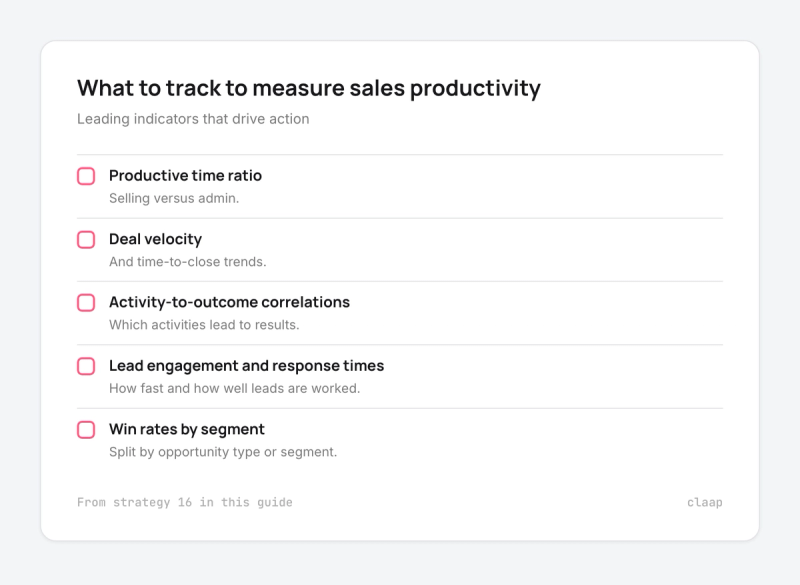
Top-performing organizations focus on metrics that drive action: productive-time ratio, deal velocity, and activity-to-outcome correlations. Leaders who track these see ~15% higher forecast accuracy (Forrester, 2024).
Strong sales performance metrics help teams:
- Measure sales efficiency and pipeline health.
- Identify top-performing behaviors to replicate across the team.
- Track how reps convert sales-qualified leads into paying customers.
- Monitor impact on deal size, customer retention, and satisfaction.
What to track:
- Productive time ratio (selling vs. admin).
- Deal velocity and time-to-close trends.
- Activity-to-outcome correlations.
- Lead engagement patterns and response times.
- Win rates by opportunity type or segment.
💡 If you can measure what matters, and act on it, you can systematically multiply your sales results.
FAQs
1. How much time do sales reps actually spend selling?
Today’s reps spend barely a third of their week actively selling. The rest goes to admin, meetings, and follow-ups. The fastest way to increase sales productivity is to automate low-value work.
2. What’s the ROI of automation in sales?
Automation can deliver significant productivity gains and ROI by freeing reps from manual tasks, allowing them to focus on high-value activities.
3. How fast should you respond to leads?
As fast as you can. Speed converts. Responding quickly to inbound leads drastically increases the likelihood of qualifying and closing deals.
4. What are the best strategies to improve sales productivity?
Start with these five: automate admin, focus on top accounts, align sales and marketing, adopt AI for insights, and measure leading indicators. Together, they unlock time, clarity, and better results.
5. How long does it take new sales hires to become productive?
On average, new reps take around 11 months to reach full productivity. Continuous, contextual coaching can reduce ramp time by up to 30 percent.
6. What’s the performance gap between top and bottom sales teams?
Top-quartile companies generate 2.5× more gross margin per sales dollar, thanks to better time allocation, structured coaching, and efficient processes.
7. What are the key metrics that measure sales productivity?
Focus on productive time ratio, deal velocity, and activity-to-outcome ratios. These leading indicators predict results more reliably than lagging metrics like revenue alone.
8. How do sales and marketing teams collaborate for better productivity?
Sharing conversion data, lead feedback, and call insights helps teams stay aligned. Aligned go-to-market teams close deals faster and achieve stronger growth.
9. What’s the 80/20 rule in sales productivity?
Roughly 80 percent of revenue comes from 20 percent of customers. Prioritizing high-value accounts improves revenue per seller and maximizes team effort.
10. How can sales leaders boost team motivation without micromanaging?
Replace activity policing with visibility and coaching. Productivity improves when reps see progress, not pressure. Consistent recognition and transparent metrics foster trust and sustained performance.
Final Thoughts
Sales productivity isn’t about squeezing harder: it’s about freeing sellers to do what only they can: build trust, close deals, and create value.
Start small. Automate one task. Remove one low-value action or admin task. Shorten one meeting. Coach one call, and watch those wins compound.