


Sales manager skills: the 7 that matter most
The sales manager skill that pays back most is choosing which few calls to review each week. Here are the 7 skills that matter most, what each looks like in a normal week, and how to check you have it.


Updated 21 October 2026.
Sales manager skills overview
- Call triage is picking the few calls each week that deserve a review, so coaching time goes where deals are won or lost.
- Coaching from evidence is coaching one behavior at a time, from a moment in a real call, and checking it moved.
- Deal inspection is reading each deal through what the buyer said, and finding the qualification gaps before the forecast call.
- Win-loss review is reading closed deals for the real reason they ended, and turning the pattern into a few changes.
- Hiring and ramp is choosing reps who learn fast, and getting them to their first deals with real calls as material.
- Running one-on-ones is using the hour on the rep's next deals and one skill, with the status update done before it.
- Clear communication is carrying the numbers up and the reasons down, in plain words, without spin.
A sales manager's most valuable skill is deciding which few calls deserve a review each week, because the coaching hour is already full and listening to more calls is the first thing that slips.
In the 2025 State of Sales Coaching survey run by Aircall and MySalesCoach, 38% of reps said they rarely or never receive coaching, while 90% of sales leaders said they coach their team at least once a month.
Our reading of that gap, from our calls with sales leaders: managers do coach, in the one-on-one, and the work that gets dropped is the work before it, finding the call that shows the problem.
Sales manager skills at a glance
| Skill | What it looks like in a week | How to check you have it |
|---|---|---|
| Call triage | A short list of calls picked for review, chosen by score or outcome | You can name the call behind each piece of feedback you gave |
| Coaching from evidence | One behavior per rep, shown on a real call moment | The behavior's score moved after you coached it |
| Deal inspection | Each committed deal checked against the last buyer conversation | No deal reaches the forecast call with an unknown decision maker |
| Win-loss review | Closed deals read for the buyer's own reason | You can state this quarter's top loss reason in the buyer's words |
| Hiring and ramp | New reps listening to the team's best calls in week one | New hires pass a call-clip exercise in the interview, and new reps cite the calls they learned from |
| Running one-on-ones | The hour spent on next deals and one skill | Reps arrive with their own call picked |
| Clear communication | One weekly note up and one down, same numbers | Leadership and reps describe the quarter the same way |
The rows above are our own working checklist for managers.
The skill most managers skip: choosing which calls to review
A country sales lead managing several teams at a European property marketplace put it plainly on a call with us:
- "I typically have an hour per one-on-one for the team. But then on top, to spend one or two hours [...] reviewing videos, whatever that. That's causing most of my problems because I, I don't have enough time for this."
The fix is a shorter list. Pick the calls by signal: the lowest-scored calls on the criterion you are coaching this month, the calls on deals that just slipped, and one strong call to share with the team. A sales manager at a construction software company described exactly that list when setting up their team (translated from French):
- "For my call reviews with [my reps], or to prepare my one-on-ones, [I want] to see a bit what happened and have a system. Some scoring on calls that went badly [...] that it brings them up for me automatically. Calls that went badly and, the other way round, calls that went very well, to talk about them with the team too."
Use call scores to build the list when your team runs more calls than you can hear, because a score tells you where to listen. The score never replaces the listening. Our guide to call scoring covers how to write criteria that managers trust.
Block the call review the same day every week, before the one-on-ones it feeds.
Use automation for anything that is a copy of a conversation (call notes, CRM updates, recap emails) when it takes a rep more than a few minutes after each call, because those minutes come out of selling time and out of your review time too.
Coaching from evidence
Coach one behavior at a time, and show it on a real call moment. "Ask better discovery questions" changes nothing. "Here, at minute twelve, the buyer mentioned a second team and you moved on" changes the next call.
The same country sales lead named the risk that makes this skill urgent:
- "The thing that worries me the most is that some bad habits are just sneaking into the daily behavior."
Choose one criterion per month for the whole team when the same habit drifts across reps, because a single focus is easy to check and easy to praise. Each rep's one behavior then sits inside it. Our sales call review routines show a weekly rhythm that fits inside a manager's calendar.
Deal inspection
A good manager reads a deal through what the buyer said, then checks the CRM against it. The questions are the qualification basics: who decides, what the buyer is trying to fix, how they buy, and what happens if they do nothing.
Start with the team's weakest qualification letter when deals stall late, because the team report shows that gap across every rep in one view.
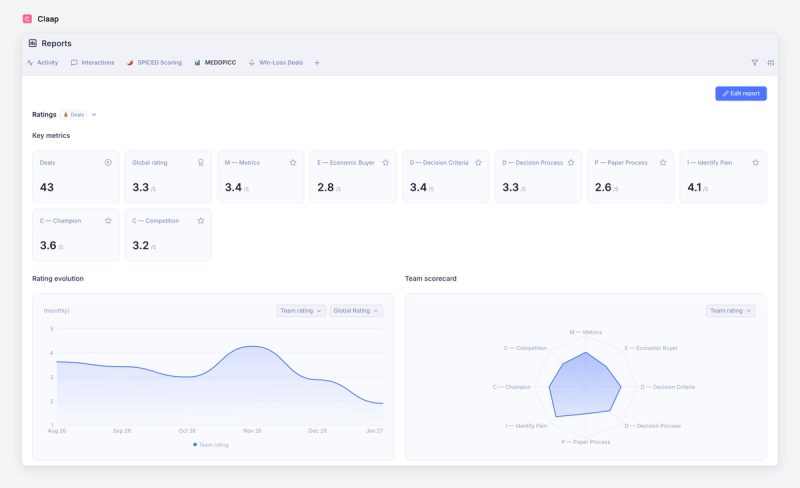
Read a deal-by-deal walk-through in our deal coaching guide.
Win-loss review
Closed deals are coaching material every manager already has. The skill is reading them for the buyer's own reason, and keeping one memorable loss from passing for a trend.
Avoid the CRM's loss-reason pick list when you run the review, because a one-word pick typed at close carries none of the buyer's words. Read the calls and emails of each closed deal instead, write the reason in the buyer's words, and compare won deals with lost ones on the same criteria.
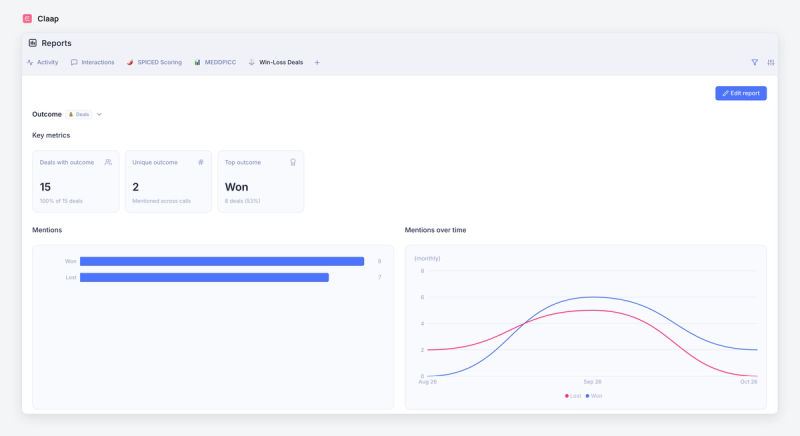
Turn the pattern into three to five actions, each with an owner, and check them at the next review.
Hiring and ramp
Hire for how fast a rep learns. In the interview, play a short clip of a real discovery call and ask the candidate what they would have asked next. In our view the answer says more than a role play built for the occasion.
Start a new rep's ramp with the team's best calls, because they hear how your buyers actually talk. A curated list of strong calls by stage (first call, demo, pricing conversation) is, in our view, better week-one material than a slide deck.
Running one-on-ones
Spend the one-on-one on the rep's next two or three deals and on one skill.
Skip the pipeline status update in the one-on-one if the CRM can carry it, because reading fields aloud uses the hour you meant for coaching. Ask the rep to bring one call they want to talk about. The call they pick tells you where they think they struggle.
Clear communication
A sales manager translates in both directions. Up, the forecast and the risks, with the reason behind each deal that moved. Down, what leadership decided and why, in the words a rep would use.
Keep one weekly note each way, built from the same numbers. When leadership and the team describe the quarter differently, the manager in between has stopped translating.
Where Claap fits
A quick note: Claap is our product. To keep this guide fair, we linked each product claim in this section to the page that makes it.
Claap helps with call triage, coaching, deal inspection and win-loss review. It scores every recorded sales call on your criteria, starting from MEDDIC, MEDDPICC, BANT or SPICED templates or your own method, and shows each rep next to the team average, criterion by criterion, as described on the sales coaching software page. Its sales team performance page adds a daily Slack recap of yesterday's calls for managers, a ready starting point for the review list.
For closed deals, Claap writes the win or loss reason from what the buyer said, with the quote behind it, and sends a weekly readout of won and lost deals, as its win-loss analysis page describes.
AI coaching, deal insights and the Deals view come with the Business plan, at $60 per seat per month billed yearly, according to Claap's pricing page.
When this advice does not fit
The call-triage advice is wrong if your team is two or three reps and you sit in on most calls yourself. At that size you hear the problems live, and a review list adds process you do not need.
Key takeaways
- Pick the calls you review by signal (lowest scores on this month's criterion, slipped deals, one strong call) instead of listening at random.
- Coach one behavior at a time, on a real call moment, and check that its score moved.
- Inspect deals against the last buyer conversation before the forecast call.
- Read closed deals for the buyer's own reason, and turn the pattern into a few owned actions.
- Spend the one-on-one on the next deals and one skill, and keep status updates out of it.
Frequently asked questions
What skills does a sales manager need?
Seven skills: call triage, coaching from evidence, deal inspection, win-loss review, hiring and ramp, running one-on-ones, and clear communication. Product knowledge and CRM fluency are the entry ticket for the role; these seven are what separate managers once they are in it.
What does a sales manager do day to day?
A sales manager reviews calls and deals, runs one-on-ones with reps, prepares the forecast, and hires and ramps new reps.
How can a sales manager coach reps with little time?
Pick fewer calls, chosen by signal, and let call scores point you to them. Then ask each rep to bring one call of their own to the one-on-one, so part of the triage is done by the person who was on the call.
What is the difference between a sales manager and a sales leader?
A sales manager runs a team of reps day to day: calls, deals, coaching and the forecast. A sales leader, such as a head of sales or VP of sales, sets the strategy, the targets and the structure across several managers.
How do you assess sales manager skills in an interview?
Give the candidate a short recording of a real discovery call and ask what feedback they would give the rep, and in what order. Then ask them to inspect a deal from its notes and say what is missing before it can be forecast.