


6 secrets for driving sales conversations that convert
Dive into the world of sales conversations and uncover insider tips to elevate your game. With strategies for personalized engagement and leveraging tools like Claap, you'll transform your approach and drive success.


What is a sales conversation?
A sales conversation is a two-way discussion in which a seller uncovers a prospect’s needs, connects those needs to a relevant solution, and agrees on a clear next step.
Well, think of it as those discussions you have when you're trying to sell something – could be a product, a service, or even an idea. It's basically the art of talking with potential customers in a way that convinces them to make a purchase.
It is just like when you're chatting with a friend but with a bit of a sales pitch thrown in. You’ll have to find the right balance between being friendly and persuasive.
What are the different steps of sales conversations?
- First off, you kick things off with a friendly introduction. You know, the basics - saying hi, introducing yourself, and maybe a little small talk to ease into things.
- Next up, you’ll have to find common ground or spark some interest. This is your icebreaker moment where you aim to build some rapport and get the conversation flowing.
- Once you've warmed things up, it's time to dig deep. This is the discovery phase where you ask questions, listen actively to what your prospect has to say, and get a clear picture of their needs and pain points.
- Armed with that knowledge, you move into the pitch. But hold your horses, your sales conversation must not be a monologue. You should tailor your pitch to address the specific needs and concerns of your prospect that you uncovered earlier.
- Of course, there might be some objections along the way. That's cool – it's all part of the sales conversations game. You tackle them head-on, addressing concerns and building trust as you go.
- And finally, it's time to seal the deal. Whether it's asking for the sale, scheduling a follow-up, or whatever the next step may be, you must be sure to wrap things up smoothly and confidently, calling for a clear action.
And there you have it – the simple breakdown of a sales conversation. Easy, right?
In this article, we're going to give you some sales call tips and secrets on how to have more effective ones. Let's dive in!
6 secrets to elevate your sales conversations
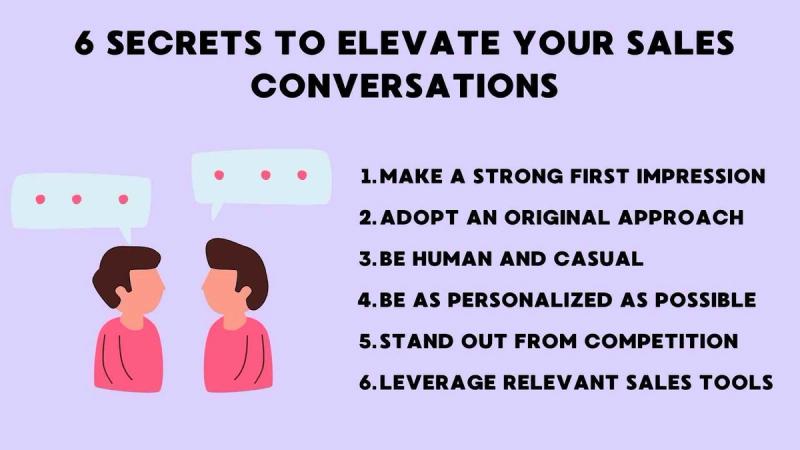
- Make a strong impression from the very first seconds
- Adopt an original approach, so that your prospect remembers you
- Keep the conversation human and casual
- Be as personalized as possible
- Show clearly how you stand out from the competition
- Leverage relevant sales tools to elevate your sales game
Let's dive into each of these secrets one by one.
Secret #1: Make a strong impression from the very first seconds
First impressions matter, big time. So, when you kick off a sales conversation, aim to wow your prospect right from the get-go.
How can you do that? You should start with a killer opening line that grabs their attention and sets a positive tone. I advise you to make yourself a list of 5 or 6 original openings for your sales conversations that you can reuse depending on who you're calling.
For example, instead of diving straight into business talk, you could:
- Lead with a personalized compliment;
- Ask a thought-provoking question related to their industry or interests;
- Make a (smart) joke, if you feel it's appropriate with your prospect…
Remember, you've got mere seconds to make an impact, so make them count. Speed matters after the conversation too: following up within one hour converts MQLs to SQLs at 53%, compared with 17% after 24 hours, according to 2026 benchmarks.
Secret #2: Adopt an original approach, so that your prospect remembers you
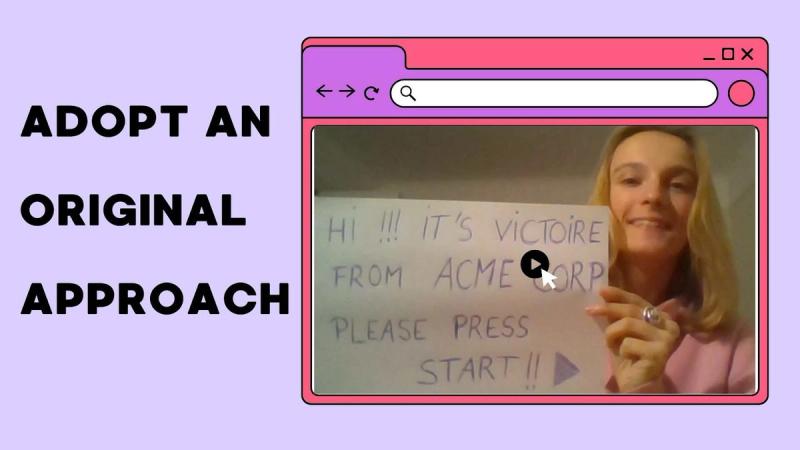
In a sea of sales pitches and presentations, you need to stand out like a beacon in the night. That means drafting a super-effective script and injecting some personality and creativity into your approach.
Think outside the box and find unique ways to engage your prospect. Maybe it's using humor, telling a compelling story, or incorporating multimedia elements like videos or interactive demos.
By leveraging multimedia content, you can make a memorable impression on your prospect. Why don’t you use video in your sales process for example? We've covered all the aspects of video prospecting in a dedicated article.
Whatever you do, make sure it's authentic and aligned with your brand voice. The goal? To leave a lasting impression that sticks in their mind long after the conversation ends.
Secret #3: Keep the conversation human and casual
Nobody wants to feel like they're being sold to by a robot. Keep your sales conversation light, natural, and, above all, human. That means avoiding the overly formal language and corporate jargon in favor of a more casual tone.
You should imagine that you're chatting with a friend over coffee – that's the vibe you're aiming for. Ask about their company plans, share a funny anecdote, or simply lighten the mood before diving into business talk.
By building a genuine connection and showing your human side, you'll put your prospect at ease and lay the foundation for a more productive conversation.
And above all, even if you use a sales call script or template, you definitely don't want your prospect to get the impression that you're reading from a document or following a well-rehearsed plan.
Secret #4: Be as personalized as possible
One-size-fits-all approaches just don't cut it in sales. There's nothing more annoying than to have a completely impersonal and generic speech delivered to you. And above all, it doesn't make you want to buy or enter into a partnership with the seller!
To truly win over your prospects, you need to show them that you've done your homework and understand their unique needs and challenges. So, before diving into your sales pitch, take the time to research your prospect's company, industry, and specific pain points.

Use this information to tailor your messaging and offer solutions that are perfectly aligned with their goals. Address them by name, reference recent interactions or events, and highlight how your product or service can specifically address their needs.
By showing that you've taken the time to personalize your approach, you'll demonstrate your commitment to their success and increase your chances of sealing the deal.
Secret #5: Show clearly how you stand out from the competition

Competition is fierce in the world of sales. Everyone claims to have a revolutionary product or service that they want to sell to the whole world.
Instead of shying away from this competition, embrace it as an opportunity to showcase what sets you apart. Take some time to identify your unique selling points – whether it's your innovative technology, exceptional customer service, or unbeatable pricing. Then, weave these key differentiators into your sales conversation at every opportunity.
Show your prospect exactly why they should choose you over the competition and how your offering can provide them with greater value or benefits. For example you can use:
- Case studies;
- Testimonials from satisfied clients;
- Product demonstrations.
In any case, make sure you're clearly articulating your value proposition and leaving no doubt in your prospect's mind that you're the best choice.
Secret #6: Leverage relevant sales tools to elevate your sales game
In today's digital age, there's no shortage of tools and technologies designed to streamline the sales process and supercharge your effectiveness.
From CRM systems and email automation platforms to video conferencing software and social media tools, there's something out there for every aspect of the sales process. Don't be afraid to leverage these resources to your advantage:
- Use CRM data to track your interactions with prospects and tailor your approach accordingly;
- Create multimedia content for your product demo, for example. Sometimes recording your screen is all you need;
- Send personalized follow-up emails at the click of a button;
- Host virtual demos or webinars to showcase your product or service to a wider audience;
- Try conversation intelligence tools or revenue intelligence tools to track data on your sales processes and convert more deals;
- Use a conversation intelligence platform like Claap to capture sales conversations, enrich your CRM, coach reps, and activate AI agents with the resulting context;
By embracing the right sales tools and technologies, you can work smarter, not harder, and close more deals in less time.
To elevate your sales game, Claap is an essential tool. Let's find out why.
Use Claap to elevate your sales conversations
What is Claap
Claap is a conversation intelligence platform for the AI agent era. It captures every sales conversation and turns it into CRM updates, coaching, follow-ups, and context for AI agents, featuring:
- Meeting recordings with transcription in 99 languages;
- AI-generated structured notes and summaries, plus CRM Auto-Complete;
- Deal Insights that score deals using evidence from real conversations;
- AI coaching grounded in recorded calls;
- Built-in AI agents and connections to your own agents through Claap MCP.
4 ways to convert more sales conversations with Claap

#1: Capture every sales conversation and its context
Record sales conversations across channels and use multilingual transcription to preserve the details that would otherwise disappear after the call.
Claap turns each conversation into structured AI notes and concise summaries. Share them with your team to align on the prospect’s needs, objections, and next steps.
#2: Enrich your CRM without manual admin
Claap’s CRM Auto-Complete writes structured conversation data into your CRM, helping reps keep opportunity records current without spending their selling time on manual updates.

Sales leaders can use Deal Insights to assess opportunities using evidence from actual conversations, while RevOps gets cleaner, more consistent pipeline data.
By reducing admin and preserving deal context, sales teams can spend more time improving conversations and moving opportunities forward.
#3: Coach sales teams using real calls
Claap helps sales managers coach at scale using real customer conversations rather than generic examples. Reps can revisit strong discovery questions, product demonstrations, and objection-handling moments.
Annotations, comment threads, and shared clips make feedback precise and easy to act on.
This gives reps practical coaching grounded in the conversations they are having now, helping them refine their approach over time.
#4: Activate AI agents with conversation context
Claap makes sales conversation context available to built-in AI agents and to your own agents through Claap MCP.
Instead of leaving transcripts and insights in a passive repository, your team can use that context to support follow-ups, CRM updates, deal analysis, and coaching workflows.
Ready? Start with Claap’s free Basic plan, with no credit card required. It includes 10 videos per user, 300 total transcription minutes, basic AI summaries, API access, and Claap MCP.
Frequently asked questions
What is a sales conversation?
A sales conversation is a two-way discussion in which a seller uncovers a prospect’s needs, connects those needs to a relevant solution, and agrees on a clear next step.
How should you open a sales conversation?
Open with a relevant, personalized line that earns attention, then ask a thoughtful question that moves naturally into discovery.
How do you handle a prospect who goes quiet?
Follow up promptly with a concise message that refers to the prospect’s priorities, adds useful context, and proposes one clear next step.
How personalized should a sales conversation be?
Personalize the conversation around the prospect’s company, role, goals, pain points, and recent interactions without forcing irrelevant personal details.
What tools help improve sales conversations?
Useful tools include a CRM, email automation, video messaging, demo software, and conversation intelligence that captures calls, enriches CRM records, supports coaching, and gives AI agents relevant context.

![Learn how sales videos can help you win more deals [Tips, Techniques & Examples]](https://cdn.sanity.io/images/gb4upfg4/staging/598c98e38c098a0f797d3ca47c5a9083661df3dc-1536x864.jpg?w=800&h=450&fit=crop&auto=format&q=75)