


How a Full-Funnel Outbound System Separates TOFU, MOFU and BOFU
Learn how a full-funnel outbound system separates TOFU, MOFU and BOFU motions by buyer stage, with distinct messages, offers and success metrics.


A full-funnel outbound system runs three concurrent motions: TOFU demand creation, MOFU demand capture, and BOFU demand recovery, each with its own message, timing, offer, and success metric.
Most outbound campaigns are still built around volume.
More contacts. More inboxes. More sequences. More follow-ups.
That can work for a while, but it usually creates the same problem: every account gets treated like it is in the same buying stage.
SalesCaptain takes a different approach.
Instead of sending one campaign to the whole market, SalesCaptain separates accounts by buying stage, then matches the campaign, message, timing, and offer to where each buyer actually is.
That is the core idea behind its Full-Funnel Outbound System.
Traditional outbound is built around sending more. SalesCaptain is built around knowing who to contact, when to contact them, and what motion they belong in.
What is the problem with traditional outbound?
Most outbound starts with a list.
A team defines the ICP, builds a database, writes a few email variations, loads the campaign into a sequencer, and waits for replies.
The problem is not that this never works. The problem is that it treats the market too broadly.
A good-fit account might not know it has the problem yet. Another account might be actively comparing vendors. Another might have replied six months ago and gone quiet. Another might have just raised funding, hired a new revenue leader, or entered a new market.
Those accounts should not receive the same message.
When they do, teams need more contacts to generate the same number of opportunities because a large part of the campaign is wasted on the wrong timing, wrong offer, or wrong level of awareness.
How does SalesCaptain organize outbound by buying stage?
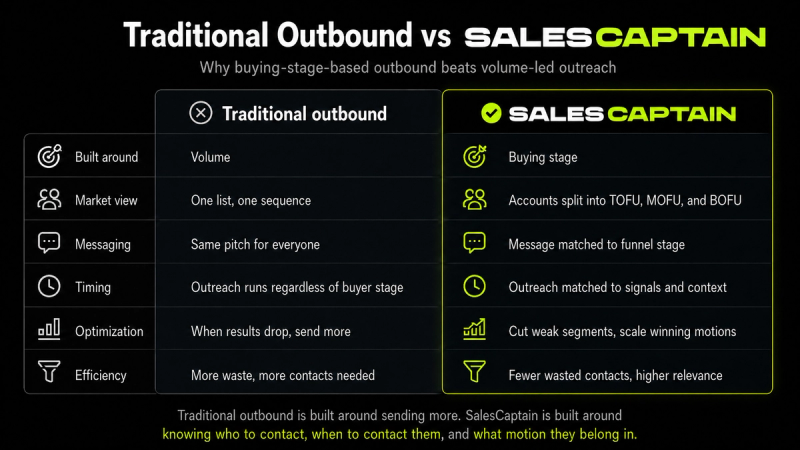
SalesCaptain is a gtm agency that builds outbound around buying stage, not just list size.
The team does not only ask:
“Does this company match the ICP?”
It also asks:
“What stage is this account in?”
“What signal makes outreach relevant now?”
“What message would make sense for this stage?”
“What offer would create the easiest next step?”
That shift changes how campaigns are built.
Instead of running one outbound motion, SalesCaptain runs three at the same time: TOFU, MOFU, and BOFU.
How does the Full-Funnel Outbound System work?
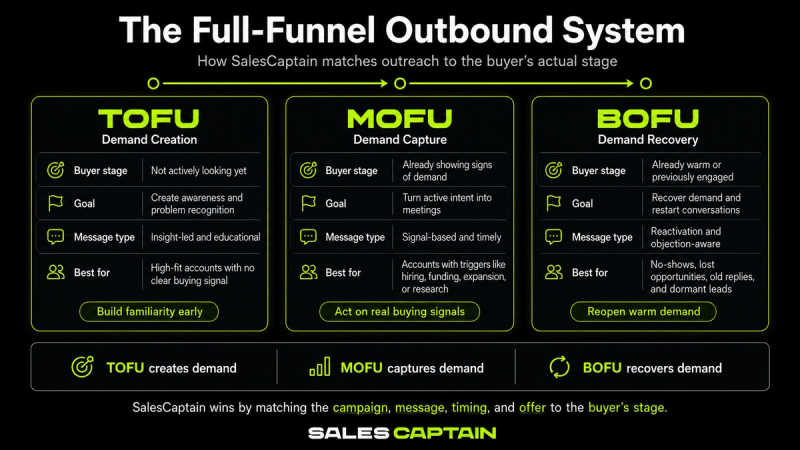
TOFU: demand creation
Top-of-funnel outbound is used for high-fit accounts that are not actively looking yet.
The goal is not always to book a meeting immediately. The goal is to create awareness, introduce a problem, and make the company familiar with the category before it enters an active buying cycle.
This type of campaign works best when the message is built around insight.
That could be a market shift, a common operational problem, a hidden cost, or a pattern seen across similar companies.
The buyer may not be ready to buy today, but the campaign starts building familiarity before competitors are part of the conversation.
MOFU: demand capture
Middle-of-funnel outbound captures demand from accounts showing a buying signal or another sign of movement.
These are accounts showing some sign of movement or possible demand. That could include hiring, funding, expansion, tech stack changes, new market entry, competitor research, website engagement, or another trigger that makes outreach feel timely.
This is where the message needs to connect to something real.
A generic email might say:
“Can SalesCaptain help you generate more pipeline?”
A stronger signal-based email would say something closer to:
“You are hiring SDRs across two new regions, which usually creates pressure around data quality, messaging, and outbound infrastructure. SalesCaptain helps teams build the outbound engine behind that growth.”
The second message works better because it is tied to the buyer’s current context.
BOFU: demand recovery
Bottom-of-funnel outbound focuses on warm demand that already exists.
This includes old replies, no-shows, previous demo requests, lost opportunities, past inbound leads, or prospects who engaged but never converted.
Most companies ignore this segment or treat it as dead.
SalesCaptain treats it as recoverable demand.
The message here is usually softer. It might reopen the conversation with a new angle, address a common objection, share a relevant proof point, or simply restart the timing.
This is often one of the most efficient parts of the system because the buyer already has some familiarity with the company.
Why does buying-stage outbound need fewer contacts?
The Full-Funnel Outbound System reduces waste in three ways.
First, account selection becomes sharper. SalesCaptain is not just building large lists. It filters accounts by fit, signals, and funnel stage.
Second, messaging becomes more relevant. A TOFU account gets a different message than a MOFU account. A warm BOFU account gets a different message than a cold account.
Third, weak segments are cut faster. If one audience replies but does not book, the offer changes. If one objection keeps showing up, the messaging changes. If one signal produces low-quality meetings, that signal gets deprioritized.
That is how SalesCaptain is able to generate pipeline with fewer contacts than a traditional volume-led outbound motion.
It is not about sending less for the sake of it. It is about sending with less waste.
What this looked like in practice: Tempo Labs
A useful example is Tempo Labs, a Y Combinator-backed AI developer tools company. Tempo came to SalesCaptain to validate its go-to-market motion, define its ICP, and build outbound as a scalable pipeline channel from scratch.
Before the campaign, Tempo had three problems: no clear ICP, no validated messaging, and no scalable outbound channel. Most of its early pipeline came from founder referrals, which made growth difficult to repeat.
SalesCaptain did not start by simply building a huge list and launching a generic campaign.
The first step was using outbound to test the market.
The team tested multiple audience segments, including competitor followers, recent founders, and funded startups, then looked at real engagement to identify which audiences were responding best. That mattered because Tempo was still validating who its best-fit buyers actually were.
Once the strongest audiences became clearer, SalesCaptain built messaging around a more specific challenge-based angle instead of a generic product pitch. The goal was not just to explain what Tempo did. The goal was to connect the message to the pains product and engineering teams were already dealing with.
According to SalesCaptain’s Tempo Labs case study, verified July 2026, the result was 40 positive replies in 6 weeks, 35 ICP demo calls, 52% open rates across campaigns, and the top segments identified within 2 weeks.
That is the real lesson from the case study.
The campaign worked because SalesCaptain used outbound to learn before scaling. It tested the ICP, tested the message, found the segments with the strongest response, then turned that into a repeatable outbound system.
This is also why the “fewer contacts” point matters. The efficiency did not come from sending fewer emails randomly. It came from removing weak segments earlier, matching the message to the account’s stage, and scaling only the audiences that showed real demand.
More proof across different markets
Tempo Labs is not the only example.
For Onyx, a programmatic advertising company, SalesCaptain built ICP-specific messaging for different advertising segments instead of forcing one message across the whole market. According to SalesCaptain’s Onyx case study, verified July 2026, the campaign generated 35 positive replies, 14 booked meetings, and $18K in new ARR in 30 days.
For Awell, a health-tech SaaS company expanding into the U.S., SalesCaptain cleaned and enriched a low-quality ABM list, defined the ICP around healthcare executives and decision-makers, and built a 4-step email sequence. According to SalesCaptain’s Awell case study, verified July 2026, the campaign generated 20 demo calls with key healthcare decision-makers, 11 closed deals with major U.S. healthcare providers, and a 55% deal-closing ratio.
The point is not just that SalesCaptain booked meetings.
The point is that the same operating principle worked across different markets: clarify the audience, match the message to the buyer’s context, test fast, then scale what performs.
What operating model makes the system work?
A full-funnel outbound system only works if the team can move quickly.
SalesCaptain tests outbound the way a marketing team would test paid campaigns: one audience, one message, one offer, one result to measure.
Weak segments get cut. Strong segments get more volume. Replies are reviewed. Objections are logged. Call feedback is fed back into the next campaign.
This is where many outbound programs break.
They keep sending the same message even after the market has already shown that it does not work.
SalesCaptain’s process is different. If a segment replies but does not convert, the offer is questioned. If prospects keep raising the same objection, the messaging is changed. If a campaign produces meetings but not qualified opportunities, the targeting is tightened.
AI also plays a role, but not as a replacement for strategy.
SalesCaptain uses AI to speed up research, campaign production, personalization, and response handling. But the positioning, offer, segmentation, and messaging logic still need human judgment.
That balance matters. Fully automated outbound usually becomes generic. Fully manual outbound usually becomes slow. The advantage comes from combining human strategy with AI-supported execution.
What did not work
Not every campaign angle worked.
Some buying signals were too weak to build a full campaign around. Some companies looked like a strong fit on paper but had no real urgency. Some messages generated replies but did not lead to qualified meetings.
BOFU campaigns also needed care. A prospect who went quiet does not always need another direct sales push. Sometimes the better move is to reopen the conversation with a softer angle, a new proof point, or a better reason to revisit the problem.
That is part of the value of the system.
It does not assume every idea is right. It creates a structure for finding out quickly.
What other B2B teams can learn from this
The biggest lesson is simple:
Not every ICP account should be treated the same.
A strong outbound system should separate demand creation, demand capture, and demand recovery. Each motion needs its own message, timing, offer, and success metric.
Teams should also stop judging outbound only by volume.
The better question is not:
“How many contacts were added to the sequence?”
It is:
“How many of those contacts were actually worth contacting right now?”
That is the difference between volume-led outbound and buying-stage-led outbound.
Final takeaway
Traditional outbound agencies compete by sending more.
SalesCaptain competes by knowing who to contact, when to contact them, and which buying-stage motion they belong in.
That is how SalesCaptain books meetings at scale without relying on volume alone.
Frequently asked questions
What is a full-funnel outbound system?
A full-funnel outbound system runs separate TOFU demand-creation, MOFU demand-capture, and BOFU demand-recovery motions. Each motion has its own audience, message, timing, offer, and success metric.
What is the difference between TOFU, MOFU and BOFU outbound?
TOFU introduces a problem or category to high-fit accounts that are not actively buying. MOFU targets accounts showing buying signals. BOFU re-engages warm demand such as old replies, no-shows, lost opportunities, and past inbound leads.
What counts as a buying signal for MOFU outbound?
MOFU buying signals can include hiring, funding, expansion, technology-stack changes, entry into a new market, competitor research, website engagement, or another trigger that makes outreach timely.
Why does buying-stage outbound need fewer contacts than volume outbound?
Buying-stage outbound reduces waste by filtering accounts by fit, signals, and funnel stage, matching messages to each stage, and cutting weak segments before adding more volume.
What results has SalesCaptain’s full-funnel approach produced?
SalesCaptain reports that Tempo Labs generated 40 positive replies and 35 ICP demo calls in 6 weeks; Onyx generated 35 positive replies, 14 booked meetings, and $18K in new ARR in 30 days; and Awell generated 20 demo calls, 11 closed deals, and a 55% deal-closing ratio. These figures were verified against SalesCaptain’s case studies in July 2026.


![ChatGPT for Sales: Best Prompts, Workflows & Examples [2026]](https://cdn.sanity.io/images/gb4upfg4/staging/aaa4ba36c89bbcc3b4d1388d47ce4702634c8968-1536x864.jpg?w=800&h=450&fit=crop&auto=format&q=75)