


When Should you Bring in an External Sales Partner?
Looking to unblock your sales performance? When it stalls, an external partner gets you moving again.


Even the best Sales Leaders eventually face the same reality: a sales engine can slowly lose momentum, quietly at first… and then suddenly, all at once.
Deals move slower, sales cycles stretch, and teams start operating on gut-feel despite having a clean CRM and decent tooling.
You tighten the process, you add training, you adopt new tools… and still, the results don’t take off as expected.
That’s because at that stage, technology alone is no longer enough.
What you need is an outside perspective: neutral, experienced, objective.
A perspective that can spot blind spots, re-establish rhythm, secure execution, and help you rebuild a sales engine that scales again.
This is exactly where fractional sales leadership or a sales coaching partner makes a difference. By combining data-driven insights, human coaching, and hands-on execution, these partners turn a tired sales team into a high-velocity revenue machine.
1. 6 signals that your sales team has hit a performance ceiling
It’s rarely a lack of talent. It’s usually:
- a breakdown in dynamics,
- blind spots in execution,
- too much tunnel vision,
- or operational drag.
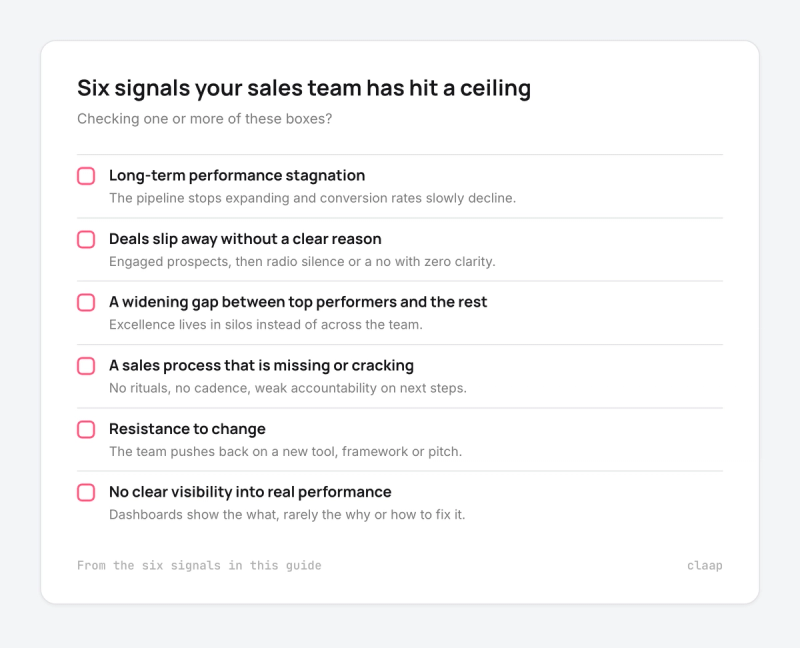
Here are the six most common warning signs:
1. Long-term performance stagnation
When the pipeline stops expanding… when your conversion rates slowly decline…
Even if you add process, run training sessions, and refine the playbook… the effort-to-impact ratio keeps degrading.
A fractional sales leader brings analytical distance that internal teams, too deep in the daily grind, simply don’t have anymore.
2. Deals slip away without a clear reason
Engaged prospects, positive conversations… and then: radio silence.
Or worse: a no with zero clarity behind it.
An external set of eyes often spots patterns quickly:
- objections handled poorly,
- weak discovery,
- missed buying signals,
- a pitch that’s too product-centric,
- insufficient qualification.
As Maxime Robles, founder of Ignify, puts it:
“Very often, what breaks performance is the ability to run a real discovery and qualify properly.”
“You have to know when to say no to bad business.”
3. A widening gap between top performers and the rest
When 20% of reps generate 80% of the revenue, it’s a clear signal: you need to scale excellence across the team, not let it live in silos.
Targeted coaching helps convert individual skill into collective performance.
4. A sales process that is nonexistent, poorly executed, or cracking under scale
You have a playbook? Good.
But do your reps actually follow it?
At Ignify, we repeatedly see:
- no sales rituals,
- no structured cadence,
- weak accountability on next steps,
- meetings where time gets wasted instead of compounding progress.
In short:
Sales management is management through repetition. A strong operational rhythm creates outsized results.
and more importantly:
You need to anchor habits through repetition until they become your team’s second nature.
5. Resistance to change
New tool? New discovery framework? New pitch?
And the team pushes back: subtly or openly.
An external partner can bypass emotional baggage and internal bias.
Maxime explains it well:
We help them because the motivation is there: they just don’t always have the right tools.
6. Lack of clear visibility into real performance
Managers drown in dashboards, but don’t know what actions to take.
Tools show the what.
Rarely the why: or the how to fix it.
Soon, everyone is working harder… but not smarter.
An external expert helps interpret the data, identify real levers, and turn insights into operational action.
👉 Checking one or more of these boxes?
A performance assessment led by a fractional sales leader can help you pinpoint exactly what’s clogging your revenue engine.
2. The 4 Growth Stages of a Sales Organization Where an External Partner Makes a Real Impact
If your company is in any of these 4 phases, bringing in outside expertise can save you months, sometimes years, of trial and error. With real experts, you gain shortcuts, avoid rookie mistakes, and accelerate execution.
One thing clients tell us all the time is:
Ignify helped me achieve 12 months of progress in just 3 months. Basically, we help them bypass all the avoidable mistakes.
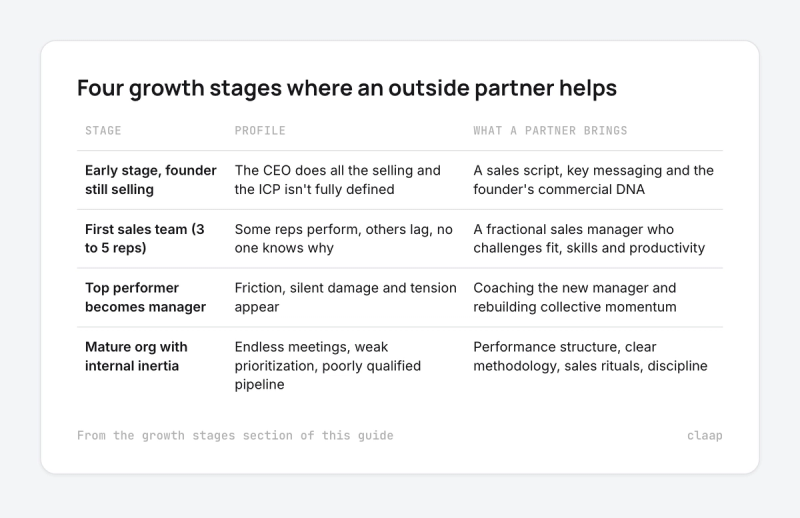
🔹 1. Early-stage: the founder is still selling
Profile:
- the product has just launched,
- the CEO is doing 100% of the selling,
- the ICP isn’t fully defined yet,
- there’s a strong need for market–product confrontation.
What an external partner brings:
- crafting the sales script,
- extracting key messaging,
- capturing the founder’s commercial DNA.
As Maxime says:
We’re here to extract the founders’ brain juice.
This script then becomes the foundation for onboarding, training, messaging, and team alignment: your commercial bible, and the backbone of future growth.
🔹 2. First sales team (3 to 5 reps) with uneven performance
Profile:
- The CEO has hired 3–5 sellers,
- Some are performing well, others are lagging,
- No one really knows why.
What an external partner brings:
The expert steps in as a fractional sales manager, and challenges:
- role fit & profiles,
- real competencies,
- receptiveness to feedback,
- adherence to productivity expectations.
🔹 3. The top performer becomes manager… and things start breaking
Profile:
- your former top seller becomes a manager,
- and suddenly friction, silent damage, and tension appear.
Maxime puts it bluntly:
Very often, Sales Managers are promoted because they were great reps, but they can end up creating human disasters.
A sales rep thinks individually. A manager needs to think collectively.
It’s a completely different posture.
What an external partner brings:
- coaching the new manager through the transition,
- navigating human dynamics,
- detecting invisible tensions,
- rebuilding collective momentum.
🔹 4. Mature sales org with internal inertia
Profile:
- the structure is in place,
- but progress is slow: painfully slow.
Symptoms:
- endless meetings,
- weak prioritization,
- poorly allocated time,
- poorly qualified pipeline.
What an external partner brings:
- performance structure (effort → productivity → conversion),
- clear methodology,
- meaningful sales rituals,
- team discipline & rigor.
3. When Technology Isn’t Enough: The Catalytic Power of Sales Coaching
Conversation intelligence platforms like Claap, Gong, and Modjo are powerful and have dramatically changed how sales teams operate.
They give visibility into the pipeline and customer interactions, reveal what really happens in prospect conversations, and highlight why deals close (or don’t).
But they don’t change behavior.
And sales is ultimately a game of posture → how you show up.
That’s where a dedicated sales expert comes in: whether a fractional VP of Sales, a Sales Coach, or an external sales leader: bringing a human perspective, cross-company experience, and hands-on support.
Together, these enable you to interpret the data, convert it into actionable change, and build a continuous learning rhythm within the team.
A. The Human Factor as a Transformation Lever
Good coaching isn’t about giving random feedback.
It builds trust, structure, and cadence.
It helps reps regain ownership of their process, listen better, and gain confidence.
And it helps the manager shift from “pipeline inspector” to true team coach.
This is why Ignify often starts with the human layer: for example, spending an entire day on-site observing interactions, listening to pitches and informal conversations, and interviewing key team members.
Does every rep on the team:
- believe in the product?
- believe in the founders and the mission?
- believe in themselves?
Because if the answer is no, you can fix the script; but not the fight.
A struggling team often reflects a lack of belief in the product and the founders. When you’re convinced, you’re convincing.Reps need to have real grit.
B. Sales posture: the true driver of closing
A core shift Maxime teaches: stop “selling a solution.”
Sometimes reps are just selling a solution to a problem. But that’s what Google is for.
Instead: ask questions, listen, reframe, create awareness, demonstrate.
Don’t tell people how good you are: prove it.
C. The Limitations of Self-Coaching Through Data Alone
A Sales Manager may see that:
- deals are dying because of pricing,
- or the close rate drops after the demo,
but without external coaching, it’s hard to step back and see what lever actually matters:
Do we fix discovery?
Value articulation?
Objection handling?
An external expert, battle-tested across multiple sales orgs, helps identify and prioritize root causes, then install the right operational reflexes.
D. The Winning Combination: Conversation Intelligence + Human Expertise
Real transformation happens when you combine data strength with human interpretation. For example:
- Claap, a conversation-intelligence platform, captures and analyzes all customer interactions: objections, buying signals, silences, tone, pricing…
- Ignify, a fractional sales leadership partner and premium Claap partner, turns those insights into concrete action: prioritization, coaching sessions, sales rituals, targeted training.
Together, they create a continuous improvement loop where every call becomes a learning asset: refining the pitch, strengthening the playbook, and elevating the entire team.
Maxime summarizes it clearly:
Claap has become the backbone of our coaching approach.
The platform enables Ignify to review calls, highlight objections, assess qualification, jump instantly to key moments, document takeaways, build playbooks, and update the CRM seamlessly.
And most importantly:
Claap makes us twice as impactful for our clients.Every call becomes a learning asset and an opportunity for improvement.
4. What Results Can You Expect from External Sales Support?
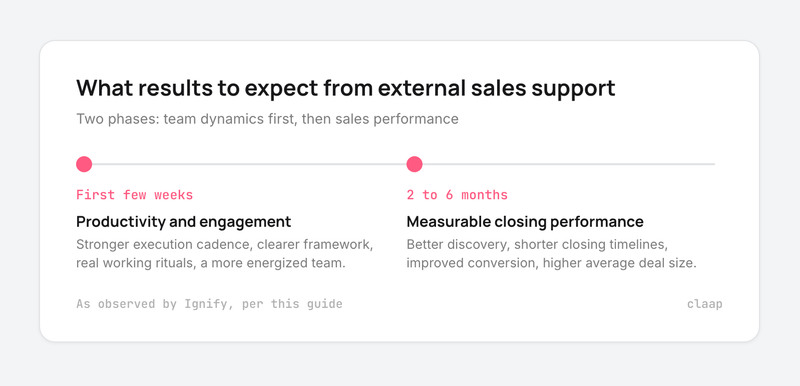
At Ignify, they consistently see a two-phase impact: first on team dynamics, then on sales performance.
- Within the first few weeks: productivity & engagement
- stronger execution cadence & activity levels,
- clearer framework and improved discipline,
- real working rituals (not just meetings),
- a more energized team that understands the ‘why’ behind their work.
- Within 2–6 months: measurable closing performance. Several sales metrics improve:
- higher-quality conversations: better discovery, stronger pitch delivery,
- shorter closing timelines,
- improved conversion rates,
- higher average deal size,
- managers better equipped: acting as coaches rather than controllers.
5. How to Choose the Right Partner to Accelerate Your Sales Performance
Bringing in an external partner can be game-changing.
But choosing the right one makes all the difference: the wrong partner wastes time, stays theoretical, and can even make problems worse.
The right one installs discipline, rhythm, and a methodology that permanently upgrades your sales dynamics.
Here’s what to look for:
1. Verify their DNA: have they actually built a real sales machine before?
A strong external partner isn’t just a “nice trainer” or a former top seller.
It’s someone who deeply understands your business model, your sales cycle, and your scaling challenges.
👉 Ask them:
- Can they operate across strategy + management + process + execution?
- Does their approach drive real transformation AND increase team autonomy?
- Have they actually run a sales org and developed sales managers?
- Do they work on complex sales cycles (multi-stakeholder, enterprise) or just transactional motions?
- Have they helped teams break a measurable performance ceiling (e.g., +20% win rate)?
2. Look for a partner that combines coaching and data
Modern sales coaching isn’t based on “intuition.”
The best partners, whether firms, consultants, or independents, leverage tools and proven methodologies to:
- objectively assess strengths and weaknesses,
- identify winning and failing patterns,
- measure progress over time.
This data-driven mindset anchors change in reality, not in guesswork.
3. Evaluate their methodology and adaptability
Some consultants apply the same playbook to every client.
Big red flag.
A real partner adapts to your maturity level, your culture, and your business goals.
👉 Great questions to ask in your evaluation:
- How do you identify coaching priorities?
- How do you tailor your action plan?
- How do you measure success?
4. Watch out for the red flags
- Vague promises like “+50% closing guaranteed”
- No post-coaching follow-up
- No data-backed performance tracking
- Too much motivational hype, not enough execution
Sales coaching is not team building.
It’s a structured transformation lever that should deliver concrete, trackable results.
6. Conclusion: the winning formula = data + humans
Bringing in external sales leadership isn’t an admission of weakness.
It’s actually an act of managerial clarity: recognizing when performance has plateaued and when a fresh, external perspective is necessary.
The best Sales Leaders don’t just monitor numbers: they teach, observe, calibrate, and continuously re-inspire their teams.
Data provides visibility.
Humans provide energy, method, rhythm, and accountability.
And it’s the combination of the two: clear insights + hands-on guidance: that builds a sales engine that is stronger, faster, and truly scalable.