

Sales Performance Coaching: A Data-Driven Framework
Master sales performance coaching with our 4-step framework. Learn to use AI tools, measure ROI, and boost win rates without burning out.


Sales performance coaching is widely recognized as one of the strongest drivers of revenue growth.
Research shows that teams with effective coaching achieve up to 19% higher revenue and 28% higher win rates. Yet, most sales organizations still struggle to make coaching work in practice.
I see the same pattern again and again, and it’s becoming costly in today’s tighter market.
Managers believe they are coaching their sales teams, but when you look at what actually happens, only 26% of sales reps receive weekly coaching, even though frequent ones have a direct impact on performance.
When coaching is rare, feedback comes too late. It’s often based on what the manager remembers and focuses on outcomes rather than skills. Without data and a clear coaching process, it becomes hard to measure, even harder to improve, and this is where your quota’s ambitions start to fade.
This guide presents a practical, data-driven framework for sales performance coaching. It explains why coaching often fails, when it works, and how sales teams can build a system to improve skills and deal execution over time.
The Execution Gap in Sales performance Coaching
Many sales leaders I speak with agree that sales performance coaching is important and openly believe in its value. They talk about it often. However, when you look at how sales professionals actually spend their weeks, a different reality emerges: coaching is simply not happening often enough. This is a leadership problem.
Two signals make this execution gap clear:
- Time allocation: Sales managers dedicate very little time to coaching. Most of their workweek is consumed by forecasting, reporting, internal meetings, and deal management.
- Coaching frequency: While 96% of sales leaders agree that coaching improves performance, only 26% of sales reps receive weekly coaching.
Taken together, these numbers explain the problem. Coaching is widely recognized as essential, but it is rarely treated as a weekly discipline. Without dedicated time and structure, coaching remains a priority in theory, not a habit in practice.
When coaching gets pushed aside, quality suffers. Managers want to help, but limited time often leads them to skip call reviews altogether. Feedback then relies on what they remember, which makes it vague and hard to apply.
This is what Mark Ackers, Co-Founder at MySalesCoach, calls the “generic trap”. It helps explain why 29%of sales reps say the coaching they receive is not actionable.
Effective coaching creates a clear performance advantage. Poor coaching, on the other hand, can actively hurt results.
From what I’ve seen, the difference comes down to execution. Sales performance coaching works when it is grounded on real sales conversations and supported by data.
What Is Sales Performance Coaching? (And Why It’s Not Training)
Sales performance coaching is often confused with training, from what I’ve seen across many organizations. In reality, they serve very different purposes.
-> Training is about exposure. You teach a method, a script, or a framework, typically in a one-directional transfer of information
-> Coaching is about interaction. It challenges, adapts in real time, and turns insight into action.

The limits of training alone are well documented:
- Rapid Forgetting: Sales reps forget up to 50% of training content within five weeks without reinforcement, this is known as the “forgetting curve.”
- Skill Decay: New skills fade quickly without immediate and repeated application, turning knowledge into unused theory.
- Habit Persistence: Even expensive sales training programs often fail to break ingrained bad habits or address real performance gaps.
This is where sales performance coaching becomes critical. Coaching exists to close the gap between knowing and doing. It helps reps apply consistently what they’ve learned on actual calls and real deals.
However, sales coaching only works when it is done well.
Research from Gartner and CEB shows that bad coaching is twice as harmful as good coaching is helpful. When feedback is opinion-based, delayed, or generic, it undermines confidence and hurts performance.
This is why modern sales performance coaching must be data-driven. Reviewing real calls matters. Using actual conversations removes guesswork and keeps feedback grounded in facts. With conversation intelligence tools, teams can now turn meetings into clear coaching material instead of relying on memory.
In short, training introduces skills. Sales coaching reinforces them. Without coaching, training fades. Without structure and data, coaching becomes risky. When both are well executed, performance improves, and the impact lasts.
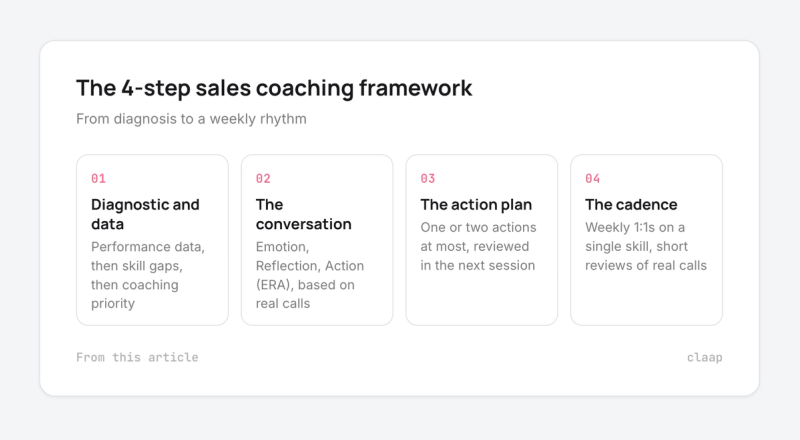
The 4-Step Sales Coaching Framework
This framework is based on real-world examples and reflects what it takes to actually move deals with active coaching.
Step 1: Diagnostic and Data
Most coaching fails because it starts in the wrong place. Managers try to coach everyone, on everything, all at once.
That does not work.
Effective coaching starts with a diagnosis. You use data to determine where coaching will have the greatest impact. CRM data, deal outcomes, and observed skills usually tell a clear story.
Some reps struggle with discovery. Others lose deals late in the cycle. Others stall after demos
The logic is simple:
Performance data → skill gaps → coaching priority
Step 2: The Conversation
To be effective, coaching conversations need structure. A simple model Emotion, Reflection, Action (ERA) works well because it guides the discussion step by step :
- Emotion : Create a useful shock that breaks auto-pilot mode. Even if it's uncomfortable. Listen to real-life calls, good and bad. Ask your team to come up with pros and cons. Make visible what could break performance. It has to come from them.
And a note to yourself: if it’s not based on real calls, it won’t create real impact.
- Reflexion : Co-build the method. Create a buy-in from your sales team based on alignment. Turn intuition into framework.
- Action : Anchor the right behaviors. Move your sales from "I understand” to “I can do it” to build confidence through execution. And it can start with role plays grounded in real cases.
This is what makes sales performance coaching : reactions, decisions and execution
Step 3: The Action Plan
Sales coaching without follow-up fades quickly.
Every session should end with a clear action plan. One or two actions at most. Those actions are reviewed in the next session. This loop creates accountability and reinforces behavior change.
The result is clear: when coaching skills exceed expectations, up to 95% of reps reach quota. Not because they were told what to do, but because they practiced it.
Step 4: The Cadence
Coaching only works when it is tied to real work. Monthly reviews come too late to reflect what actually happened in customer conversations.
As Maxime Robles, Founder of Ignify, puts it:
“Sales management is about repetition. When structure and rhythm are in place, results follow.”
What works better is a weekly rhythm built around short, focused sessions. Not more meetings, but better timing.
- Weekly 1:1s focused on a single skill
- Short reviews of real calls or meetings
- Feedback delivered while context is still fresh
The impact is measurable. Teams receiving more than two hours of coaching per week reach 56% win rates, compared to 43% for teams receiving less than 30 minutes.
High-Impact Coaching Techniques by Scenario
Sales performance coaching delivers results when it adapts to the situation. Over time, I’ve observed four recurring scenarios where the coaching approach needs to change. Treating them all the same usually leads to shallow feedback and failure..
1. Skill gaps
This scenario is about learning and skill development. Coaching needs to stay close to real work and observable behavior.
Effective techniques include:
- Reviewing real sales calls to analyze specific moments
- Using call recordings as “game tape” to understand what actually happened
- Focusing on one skill at a time instead of correcting everything at once
This approach makes improvement concrete. Reviewing real conversations, using a meeting recorder like Claap, accelerates skill development because feedback is grounded in facts, not memory or opinion.
2. Deal acceleration
Here, sales performance coaching is less about skills and more about decision-making. The most valuable work happens before the next call.
Managers typically focus coaching on preparation:
- Clarifying the objective of the upcoming conversation
- Defining what progress should look like
- Mapping stakeholders, which is especially critical in complex deals
The focus then varies by sales motion. In SaaS and enterprise sales, coaching often centers on deal risk, renewals, and expansion. In transactional sales, it focuses more on pace, repetition, and consistency.
3. Remote and hybrid teams
In remote environments, sales coaching frequency often drops due to the lack of informal, spontaneous interactions.
To counter this:
- Timeliness matters: Feedback should be delivered immediately after a call, not days later.
- Asynchronous coaching scales. Comments and annotations allow managers to give feedback without scheduling more meetings.
4. Retention and expansion
In longer sales cycles, coaching doesn’t stop once the deal closes. Managers coach reps on renewals and expansion while helping them spot early risk signals.
This type of coaching protects revenue and supports long-term growth, especially in SaaS and enterprise environments.
Teams with consistent post-sale coaching are better at retaining customers and expanding existing accounts. Leaders consistently point out that most deal risk appears after the contract is signed, not before. Without ongoing coaching, early warning signs are missed and renewals become reactive instead of planned.
When sales performance coaching adjusts to these scenarios, it becomes more relevant, more actionable, and far more effective.
👉 Check out our article on how to improve sales performance here.
The Tech Stack: Scaling Your Sales Coaching Program
I love this quote from Sandro Maag, Co-Founder at Kemiex:
“The ability to capture critical meeting information and provide valuable insights has transformed how we approach sales.”
It reflects what I see across many sales teams today. Sales coaching program often fails to scale because its effectiveness depends too heavily on individual availability and memory.
Scalable sales coaching requires the right infrastructure: tools that complement managers, streamline the coaching process, and ensure consistent execution over time.
Here are the core infrastructure elements that make sales coaching scalable.
Conversation intelligence:
Recording and reviewing sales conversations fundamentally changes how coaching works. Managers no longer need to join every call. Feedback becomes factual and specific because it is based on what was actually said, not what someone remembers.
This enables more frequent coaching and greater consistency across reps. Tools like Claap or Gong have become essential for teams that want coaching to scale beyond a handful of top performers.
CRM integration
Sales coaching must live next to sales data. When coaching activity is connected to pipeline and deal outcomes, patterns start to emerge. Managers can see which skills were coached and how performance evolves over time.
Without this connection, coaching stays disconnected from revenue and becomes difficult to justify.
Attribution and impact tracking
Sales leaders eventually ask whether coaching actually impacts revenue. Measuring this precisely is difficult, but teams can still make informed decisions using simple comparisons.
Most teams:
- Track performance before and after consistent coaching begins
- Compare coached reps with similar, uncoached peers
- Account for market or seasonal trends to avoid false conclusions
This approach doesn’t deliver perfect attribution, but it provides directional insight that helps teams prioritize and defend coaching investments.
👉 Check the best sales analytics tools here.
Asynchronous coaching for remote teams
Remote work has reduced sales performance coaching frequency. 45% of reps report receiving less coaching in remote or hybrid environments, making asynchronous feedback critical.
Sharing short, timely feedback right after a call keeps context fresh and avoids the need to schedule unnecessary meetings. Asynchronous coaching helps close the gap created by distance while preserving manager time.
Coaching by Sales Motion & Methodology
Sales methodology plays a larger role than many teams expect. Teams that follow a formal methodology such as MEDDIC or SPIN are 33% more likely to be top performers. These frameworks bring structure to deals and give sales teams a shared language.
However, methodology alone is not enough. Sales coaching is what makes frameworks usable in real situations. Without coaching, frameworks remain theoretical and are applied inconsistently. Many sales teams end up “checking the boxes” without understanding what good execution actually looks like.
Coaching translates concepts into behaviors: call after call, deal after deal.
In SaaS and enterprise sales, coaching needs to address complexity. Deals involve multiple stakeholders, long cycles, and higher levels of risk. Coaching here is less about scripts and more about judgment. I often coach reps on:
- Managing multiple stakeholders while maintaining momentum
- Identifying deal risk early, before it shows up in the forecast
- Keeping alignment between economic buyers, champions, and end users
Measuring ROI: The Sales Coaching Scorecard
Sooner or later, leadership asks the same question: Does coaching actually impact results?
Answering it requires a scorecard that connects coaching activity to performance, without overcomplicating the analysis.
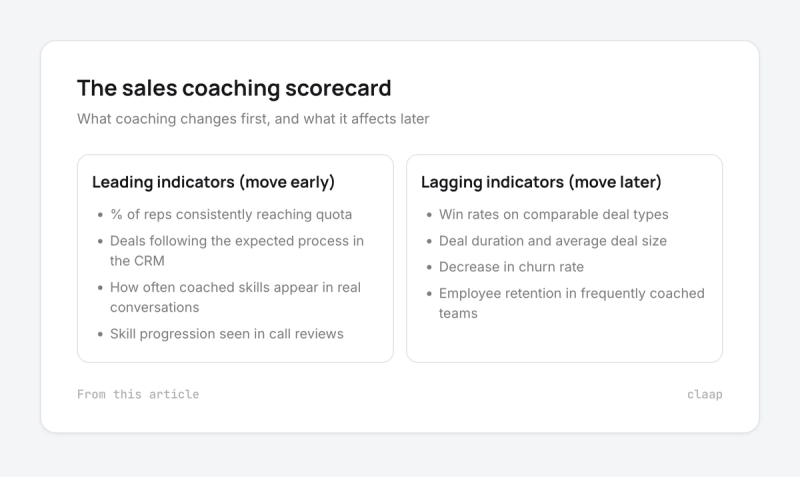
I start by separating what coaching changes first from what it affects later.
👉 Check out our article on the sales metrics & kpis that matter.
Leading indicators show whether coaching is taking effect.
Leading indicators show whether coaching is taking effect. These metrics move early and allow sales teams to adjust before the quarter ends.
Common leading indicators include:
- The percentage of reps consistently reaching quota over time
- Whether deals follow the expected sales process in the CRM
- How often coached skills appear in real conversations
- Skill progression observed through call reviews and coaching sessions
Lagging indicators confirm whether coaching translated into results.
Lagging indicators confirm whether coaching translated into business outcomes. These metrics move later but validate the effort.
Typical lagging indicators include:
- Win rates on comparable deal types
- Changes in deal duration for similar opportunities and % increase in average deal size
- Decrease in churn rate
- Employee retention in teams with frequent coaching
Looking at these trends over time helps separate coaching impact from short-term fluctuations.
To connect coaching more directly to revenue, I use a simple coaching effectiveness approach. It is not perfect, but it is practical.
The logic is straightforward: You track how much coaching you receive, then compare revenue with your colleagues before and after consistent coaching begins. The results are compared across you and the team with similar territories and deal sizes.
Teams that apply this type of correlation are better equipped to explain coaching ROI and to confidently defend investment decisions.
Bottom line
Sales performance coaching creates impact when it is grounded in reality. Teams improve when coaching is based on real conversations and reinforced over time. Also, there is more clearness in the results when feedback is connected to deals and tracked consistently. Without this foundation, coaching remains subjective and difficult to scale.
This is where conversation intelligence changes the equation. By capturing meetings, representatives eliminate assumptions and decrease the need for manual effort.
Automatic notes and CRM updates keep data accurate without slowing sales teams down. Managers gain clearer visibility into deals and can coach based on what actually happens in the field.
If your goal is to make coaching more actionable and easier to measure, start with your sales conversations and book a demo with Claap to explore more.
Frequently asked questions
How much does effective sales coaching improve performance?
Sales performance coaching can improve performance by up to 19% in revenue and 28% in win rates when applied consistently and tied to real sales activity. These gains come from better execution, not motivation. Coaching improves how sales reps run discovery, manage objections, and progress deals. Over time, small improvements compound across the pipeline and translate into measurable revenue impact.
What is the difference between sales training and sales coaching?
Sales performance training teaches frameworks and methods. Sales coaching reinforces how those methods are applied in real situations. Training happens at specific moments. Coaching happens continuously. Coaching turns knowledge into habits by working from real calls and real deals.
How often should a sales manager coach?
Sales managers should coach their sales reps every week, even in short sessions. Weekly coaching keeps feedback close to real activity and prevents issues from building up. Short call reviews or focused 1:1s are more effective than long monthly sessions because context stays fresh.
How do you measure the ROI of sales coaching?
ROI is measured by linking coaching activity to performance trends over time. Sales teams track changes before and after coaching starts, compare coached and non-coached reps, and observe shifts in win rates or deal speed. The goal is direction, not perfect attribution.
What are the best sales coaching certification programs?
Well-known options include Richardson, RAIN Group, and Korn Ferry, each with a different focus. The best sales coaching programs teach managers how to diagnose performance issues and coach skills in real situations, rather than relying on motivation or generic advice.
How does sales coaching differ for remote teams?
Remote sales performance coaching requires more structure and faster feedback. Without informal office interactions, coaching needs to be intentional. Asynchronous feedback and short reviews help maintain frequency and trust without adding meetings.
Does AI replace sales managers?
No. AI supports sales managers by providing data and visibility. AI highlights gaps and patterns. Managers provide judgment, context, and accountability. Coaching works best when both are used together. { "@context": "https://schema.org", "@type": "FAQPage", "mainEntity": [{ "@type": "Question", "name": "How much does effective sales coaching improve performance?", "acceptedAnswer": { "@type": "Answer", "text": "Sales performance coaching can improve performance by up to 19% in revenue and 28% in win rates when applied consistently and tied to real sales activity. These gains come from better execution, not motivation. Coaching improves how sales reps run discovery, manage objections, and progress deals. Over time, small improvements compound across the pipeline and translate into measurable revenue impact. " } }, { "@type": "Question", "name": "What is the difference between sales training and sales coaching?", "acceptedAnswer": { "@type": "Answer", "text": "Sales performance training teaches frameworks and methods. Sales coaching reinforces how those methods are applied in real situations. Training happens at specific moments. Coaching happens continuously. Coaching turns knowledge into habits by working from real calls and real deals. " } }, { "@type": "Question", "name": "How often should a sales manager coach?", "acceptedAnswer": { "@type": "Answer", "text": "Sales managers should coach their sales reps every week, even in short sessions. Weekly coaching keeps feedback close to real activity and prevents issues from building up. Short call reviews or focused 1:1s are more effective than long monthly sessions because context stays fresh. " } }, { "@type": "Question", "name": "How do you measure the ROI of sales coaching?", "acceptedAnswer": { "@type": "Answer", "text": "ROI is measured by linking coaching activity to performance trends over time. Sales teams track changes before and after coaching starts, compare coached and non-coached reps, and observe shifts in win rates or deal speed. The goal is direction, not perfect attribution. " } }, { "@type": "Question", "name": "What are the best sales coaching certification programs?", "acceptedAnswer": { "@type": "Answer", "text": "Well-known options include Richardson, RAIN Group, and Korn Ferry, each with a different focus. The best sales coaching programs teach managers how to diagnose performance issues and coach skills in real situations, rather than relying on motivation or generic advice. " } }, { "@type": "Question", "name": "How does sales coaching differ for remote teams?", "acceptedAnswer": { "@type": "Answer", "text": "Remote sales performance coaching requires more structure and faster feedback. Without informal office interactions, coaching needs to be intentional. Asynchronous feedback and short reviews help maintain frequency and trust without adding meetings. " } }, { "@type": "Question", "name": "Does AI replace sales managers?", "acceptedAnswer": { "@type": "Answer", "text": "No. AI supports sales managers by providing data and visibility. AI highlights gaps and patterns. Managers provide judgment, context, and accountability. Coaching works best when both are used together. " } }] }