

Best Grain alternatives: 7 tools for sales teams
Grain records and clips calls well. Sales teams leave it when they need stronger AI for summaries and deal reviews. Here are 7 alternatives, compared on price with CRM sync, coaching and G2 reviews.

Updated 29 October 2026.
Grain alternatives overview
- Fathom is best for reps and small teams who want a free note taker that just works. Its free plan keeps unlimited recordings and summaries.
- Claap is best for sales teams that want calls to fill the CRM and feed coaching. It writes each call into HubSpot or Salesforce fields and scores calls on your sales method.
- Fireflies is best for teams that want low-cost notes synced to HubSpot. Every plan includes unlimited transcription and AI summaries.
- tl;dv is best for teams that want the same notes structure on every meeting. Its templates apply automatically to matching meetings.
- Otter is best for live transcription and in-person meetings on a budget. Its paid plans start lower than any other tool here.
- Avoma is best for teams that want scheduling, notes and call scoring in one tool. Coaching sits in a paid add-on.
- Gong is best for large revenue teams with budget for a full revenue platform. Its prices are quote-only and include a platform fee.
Why sales teams look for a Grain alternative
Grain records and clips calls well, but the buyers leaving it on our own sales calls name the same gap: the AI behind summaries and deal views is too basic to run a sales team on.
That gap matters because selling time is short. The average seller spends 40% of their time selling, according to Salesforce's 2026 State of Sales report (Salesforce). When the call tool cannot coach reps or keep deal data current, managers and reps fill the gap by hand.
So this guide starts with what buyers told us about Grain, then compares the seven alternatives sales teams shortlist most often. For each one you get who it suits, what it costs once CRM sync is included, its integrations, its pros and cons and what G2 reviewers say.
Grain alternatives at a glance
Prices below are per seat per month, billed yearly, for the cheapest plan that syncs call notes to HubSpot or Salesforce.
| Tool | Best for | Free plan | Price with CRM sync | G2 rating |
|---|---|---|---|---|
| Grain (for reference) | Notes, clips and highlight reels | Yes, meetings up to 45 minutes | $29 (Business, 2-seat minimum) | 4.7 (302 reviews) |
| Fathom | Reps and small teams | Yes, unlimited recordings | $25 (Business, 2-seat minimum) | 5.0 (7,000+ reviews) |
| Claap | Sales teams of 5 to 100 reps | Yes, 10 videos per user | $60 (Business) | 4.6 (480+ reviews) |
| Fireflies | Low-cost notes in HubSpot | Yes, 400 minutes of storage | $10 (Pro, HubSpot transcripts) | 4.7 (753 reviews) |
| tl;dv | Notes templates and shared clips | Yes, 10 meetings with AI notes | $18 (Pro), $29 for team-wide CRM | 4.7 (546 reviews) |
| Otter | Live and in-person transcription | Yes, 300 minutes a month | $8.33 (Pro) | 4.4 (505 reviews) |
| Avoma | Notes, scheduling and scoring | 14-day trial | $19 (Startup), $48 with coaching | 4.6 (1,365 reviews) |
| Gong | Large revenue teams | No | Quote only | 4.7 (6,700+ reviews) |
Prices come from each vendor's pricing page (Grain, Fathom, Claap, Fireflies, tl;dv, Otter, Avoma), and ratings from each tool's G2 page.
Where Grain falls short for sales teams
Grain comes up often on our own sales calls, usually when a team is comparing it with Claap or replacing it. Here is what buyers told us, in their words:
- A buyer who benchmarked Gong, Grain and two other tools: "they just weren't strong. And in particular, the biggest thing for them, the AI summaries just sucked. They weren't very good."
- The same buyer, on seeing calls and emails rolled up by deal: "Grain and [another tool] were more basic."
- A buyer with a two-rep sales team that runs Grain with HubSpot, on getting call data out: "It's really difficult for us to actually export or automatically push call transcripts or summaries into a notion doc with grain."
- The same buyer, on access rights: "Last question is just on permissioning, because it's something that, in grain, I find to be very confusing."
- A head of growth at a European hardware and software company, on the Grain plan he paid for as a freelancer a few years back: "they got super expensive and without much good output."
The pattern: recording and clips are rarely the problem. Teams leave Grain when they need the AI to summarize well and read a whole deal, and when they want that data to flow into the rest of their stack.
What Grain does well, and what it costs
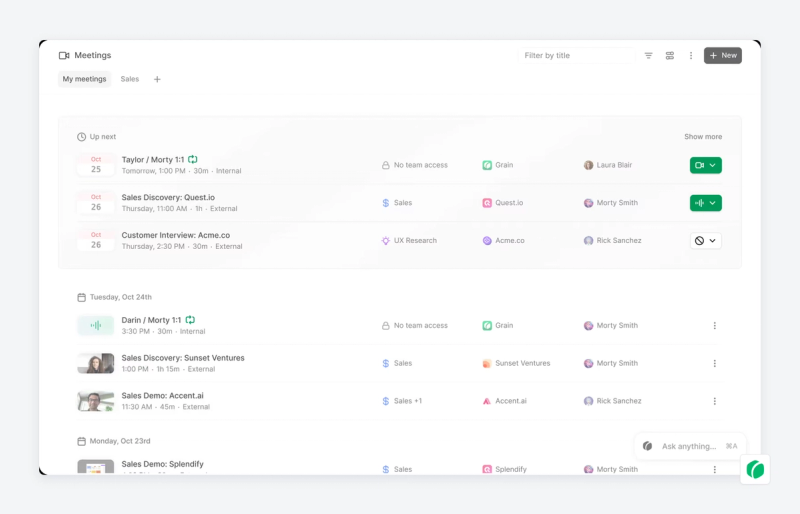
Grain records Zoom, Meet, Teams and Webex calls with a bot or from its desktop app without one, then writes AI notes, next steps and a transcript in 99 languages (Grain). It is strong on clips and highlight reels, and one of the buyers above summed up the day-to-day use plainly: "Currently, we're using Grain, which works totally fine."
Grain's pricing page lists four plans:
- Free: $0, unlimited meetings up to 45 minutes each and 30 days of history.
- Pro: $15 per seat per month billed yearly, $19 monthly, meetings up to 4 hours and full history.
- Business: $29 per seat per month billed yearly, $39 monthly, with a 2-seat minimum, HubSpot and Salesforce, conversation intelligence and a shared workspace.
- Enterprise: on quote, with SAML SSO and SCIM.
A sales team that wants calls in its CRM starts on Business: the HubSpot integration needs Business or above, and only meetings shared to the workspace sync (Grain help center). That is $29 × 2 seats = $58 a month at the smallest (Grain). Grain holds 4.7 out of 5 on G2 across 302 reviews (G2).
How we built this comparison
We compared the tools sales teams most often weigh against Grain on five criteria:
- CRM sync. Whether notes and fields reach HubSpot or Salesforce, and on which plan.
- Cost for a sales team. The cheapest plan that syncs to the CRM, with seat minimums and add-ons.
- AI quality. Summaries and deal views, the gap buyers raise most about Grain.
- Capture. Meeting bot, bot-free recording, phone and in-person calls.
- Reviews. G2 rating and review count, and what reviewers praise or criticize.
Important note: Chorus by ZoomInfo is often listed as a Grain alternative, but it has no standalone G2 page and ZoomInfo rates 1.8 out of 5 on Trustpilot across 340 reviews (Trustpilot). We left it out of this selection. We also left out Granola and Notta, which focus on personal notes and transcription; this guide is for sales teams.
1. Fathom, best for reps and small teams who want a free note taker
Fathom is the safe pick for a rep or a small team leaving Grain for good free notes; teams that need deal fields and coaching pay for Business or look elsewhere.
Who Fathom works best for
- Individual reps and founders who sell.
- Small teams that want summaries in HubSpot without a project.
Fathom overview
Fathom records Zoom, Meet and Teams calls, transcribes them and writes an instant summary. The free plan keeps unlimited recordings. Business adds CRM field sync, a view of every call on a deal, coaching metrics and AI scorecards (Fathom).
Fathom pricing
Fathom's pricing page lists:
- Free: $0, unlimited recordings and summaries.
- Premium: $16 per user per month billed yearly, $20 monthly.
- Team: $15 per user per month billed yearly, $19 monthly, with a 2-user minimum.
- Business: $25 per user per month billed yearly, $34 monthly, with CRM field sync.
For a sales team, Business is the plan that does the job: $25 × 2-seat minimum = $50 a month at the smallest (Fathom).
Fathom integrations
- Zoom, Google Meet and Microsoft Teams.
- HubSpot and Salesforce, with field sync on Business.
Fathom pros and cons
Pros
- Generous free plan with unlimited recordings.
- Very fast setup and a simple interface.
- The highest G2 rating in this comparison.
Cons
- CRM field sync and scorecards need Business.
- Team features are lighter than dedicated sales platforms.
What G2 reviewers say about Fathom
Fathom holds 5 out of 5 on G2 across more than 7,000 reviews (G2).
- "I love being able to share calls with my team, being able to copy the transcript and analyze with whatever AI tool I want, and the talk time / monologue meter on calls is awesome." VP Sales, Small-Business (review)
- "The team workspace features feel less mature than what specialized competitors like Gong offer for sales coaching." IT Manager, Mid-Market (review)
A quick note: Claap is our product. To keep this comparison fair, we relied on third-party reviews and linked every major claim to its source.
2. Claap, best for sales teams that want calls to fill the CRM
Claap fits sales teams of 5 to 100 reps that left Grain for stronger AI: every call updates deal fields and feeds coaching at a published price; a team that only wants notes and clips will find a cheaper tool here.
Who Claap works best for
- Sales teams on HubSpot or Salesforce that run a method such as MEDDIC or SPICED.
- Managers who coach from calls and want each rep scored the same way.
Claap overview
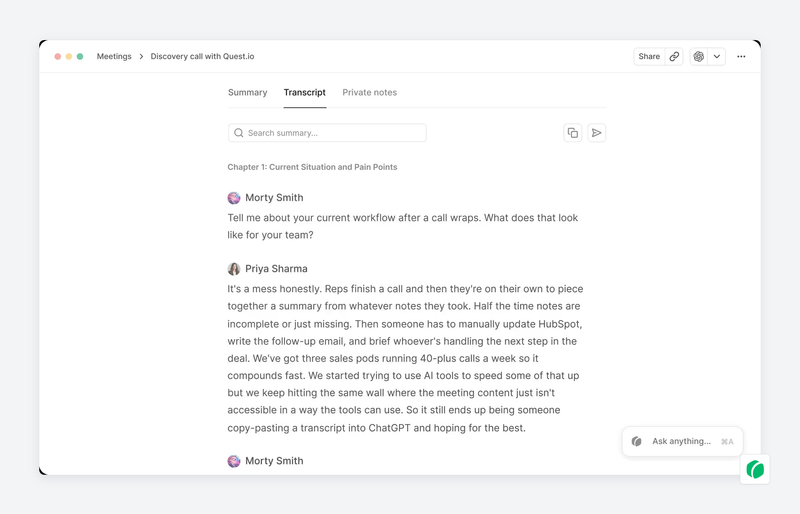
Claap records Zoom, Meet and Teams calls without a bot through its Chrome extension or Mac app, or with a visible bot if you prefer. After each call it writes the notes and, on Business, fills the deal fields you choose in HubSpot, Salesforce, Pipedrive or Attio (automatic note taker).
It turns what buyers said into CRM fields, call scores and deal risks, so a manager reads a deal through its calls and sees each rep's scores next to the team's (conversation intelligence). ClaapAgent answers questions across a deal's calls, and Claude or ChatGPT can read the same data through the Claap MCP.
Claap pricing
Claap's pricing page lists:
- Basic: free, 10 videos per user and 300 minutes in total.
- Pro: $32 per seat per month billed yearly, unlimited recordings, 1,000 minutes a month and transcripts in 99+ languages.
- Business: $60 per seat per month billed yearly, with CRM sync, AI coaching and ClaapAgent across all meetings.
- Enterprise: on quote, with SSO, SCIM and the Claap API.
Claap integrations
- HubSpot, Salesforce, Attio and Pipedrive on Business.
- Dialer calls from Aircall and Ringover, on the same record as video calls.
- Slack and Notion on every plan.
- The Claap MCP on every plan.
Claap pros and cons
Pros
- Calls fill CRM fields, so deal data stays current without rep admin.
- Bot-free recording on every plan.
- Call scoring and coaching on your own sales method.
Cons
- CRM sync and coaching need Business, which costs more than Grain's Business plan.
- No built-in dialer: phone calls come through Aircall or Ringover.
What G2 reviewers say about Claap
Claap holds 4.6 out of 5 on G2 across more than 480 reviews (G2).
- "The call recording and transcription save me a lot of time, especially when I need to go back to a specific conversation." Revenue Operations Analyst, Mid-Market (review)
- "While Claap is really good at recording and sharing sales conversations, I think it could do more to give sales leaders the information they need." Sales Manager, Enterprise (review)
3. Fireflies, best for low-cost notes synced to HubSpot
Fireflies is the cheapest way to get full transcripts into HubSpot; teams that left Grain over summaries and deal views will find the same gap here.
Who Fireflies works best for
- Teams that mostly want searchable transcripts and summaries.
- Companies that want one note taker across sales and other teams on a small budget.
Fireflies overview
Fireflies records Zoom, Meet and Teams calls with a meeting bot, then writes a transcript, a summary and action items. Every plan includes unlimited transcription and AI summaries; storage and AI credits are what the plans meter (Fireflies).
Fireflies pricing
Fireflies' pricing page lists:
- Free: $0, with 400 minutes of storage.
- Pro: $10 per seat per month billed yearly, $18 monthly.
- Business: $19 per seat per month billed yearly, $29 monthly, with unlimited storage and team analytics.
- Enterprise: $39 per seat per month, billed yearly only, with SSO and HIPAA.
Pro syncs full transcripts to HubSpot; the rules that route notes to the right deal need Business (Fireflies help center).
Fireflies integrations
- Zoom, Google Meet and Microsoft Teams.
- HubSpot and Salesforce.
Fireflies pros and cons
Pros
- Unlimited transcription on every plan.
- Low price for CRM sync.
Cons
- Automatic HubSpot tasks can pile up on one deal.
- Few coaching and deal-review features for sales managers.
What G2 reviewers say about Fireflies
Fireflies holds 4.7 out of 5 on G2 across 753 reviews (G2).
- "It's integrated with gmail and hubspot. It's quite accurate with its notes, sharing sentiments of calls, speaker talk time." Sr. Business Consultant, Mid-Market (review)
- "When enabling 'create tasks in hubspot after meeting ends' it creates all the tasks at once in Hubspot." Owner, Small-Business (review)
4. tl;dv, best for structured notes templates and shared clips
tl;dv suits teams that liked Grain's clips and want the same notes structure on every meeting; team-wide CRM integrations sit on Business.
Who tl;dv works best for
- Teams that run repeatable meeting types, such as discovery or onboarding.
- Managers who share call moments with the team.
tl;dv overview
tl;dv records and transcribes Meet, Zoom and Teams calls. Summaries are automatic or follow templates you set, and templates apply to every matching meeting (tl;dv help center). Business adds multi-meeting AI insights, playbook monitoring and objection handling (tl;dv).
tl;dv pricing
tl;dv's pricing page lists:
- Free: $0, with AI notes on 10 meetings.
- Pro: $18 per seat per month billed yearly, with personal CRM integrations.
- Business: $29 per seat per month billed yearly, with team-wide integrations and automations.
- Enterprise: custom.
tl;dv shows prices in local currency, so a US quote can differ from European ones (usagepricing).
tl;dv integrations
- Google Meet, Zoom and Microsoft Teams.
- Salesforce, HubSpot and Pipedrive.
tl;dv pros and cons
Pros
- Notes templates keep every call of a type consistent.
- Easy to clip and share recordings.
Cons
- Team-wide CRM integrations and coaching need Business.
- Prices vary by region.
What G2 reviewers say about tl;dv
tl;dv holds 4.7 out of 5 on G2 across 546 reviews (G2).
5. Otter, best for live transcription and in-person meetings
Otter is the cheapest paid option here and shines in live and in-person meetings; sales teams that want scoring and deal views will need more.
Who Otter works best for
- Reps who meet buyers in person and record on their phone.
- Teams on a tight budget that want transcripts in Salesforce or HubSpot.
Otter overview
Otter writes a live transcript with speaker names during the meeting, then a summary and action items. Otter AI Chat answers questions across your meeting history, and an MCP server lets Claude or ChatGPT query transcripts (Otter).
Otter pricing
Otter's pricing page lists:
- Basic: free, 300 transcription minutes a month.
- Pro: $8.33 per user per month billed yearly, $16.99 monthly, 1,200 minutes a month, with Salesforce and HubSpot.
- Business: $19.99 per user per month billed yearly, $30 monthly.
- Enterprise: custom, with SSO and HIPAA.
Otter integrations
- Zoom, Google Meet and Microsoft Teams.
- Salesforce, HubSpot and Zapier from Pro.
- MCP server for Claude and ChatGPT.
Otter pros and cons
Pros
- Strong live transcription and mobile app.
- The lowest paid price in this comparison.
Cons
- Few sales coaching features.
- A privacy class action over recording without consent is ongoing in California.
What G2 reviewers say about Otter
Otter holds 4.4 out of 5 on G2 across 505 reviews (G2).
6. Avoma, best for scheduling, notes and call scoring in one tool
Avoma suits small and mid-sized sales teams that want one tool from booking the meeting to scoring it; its coaching features cost extra.
Who Avoma works best for
- Teams that book, record and review meetings in one tool.
- Managers who want AI scorecards without a Gong-sized contract.
Avoma overview
Avoma covers scheduling, meeting notes and CRM sync on its base plans. Call scoring, AI coaching recommendations and smart trackers sit in the Conversation Intelligence add-on (Avoma).
Avoma pricing
Avoma's pricing page lists:
- Startup: $19 per recorder seat per month billed yearly, $29 monthly.
- Organization: $29 per recorder seat per month billed yearly, $39 monthly.
- Enterprise: $39 per recorder seat per month, billed yearly only.
- Conversation Intelligence add-on: $29 per seat per month billed yearly, $35 monthly.
With coaching, the cheapest setup is $19 + $29 = $48 per seat per month (Avoma). Viewers are free.
Avoma integrations
- Salesforce and HubSpot from Startup.
- Zoho CRM.
Avoma pros and cons
Pros
- Scheduling, notes and scoring in one product.
- Only recorder seats are paid.
Cons
- Coaching needs a paid add-on.
- Reviewers report the notetaker sometimes misses calls.
What G2 reviewers say about Avoma
Avoma holds 4.6 out of 5 on G2 across 1,365 reviews (G2).
- "Avoma is a more cost effective solution than Gong. That was the main reason for our transition." Sales Director, Small-Business (review)
- "Sometimes the notetaker does not join the call and sometimes randomly drops off." Enterprise AE, Mid-Market (review)
7. Gong, best for large revenue teams with budget
Gong is the safe pick above 50 reps with a RevOps team and budget; for a team moving off Grain, it is usually far more platform, and cost, than the job needs.
Who Gong works best for
- Revenue teams of 50 reps or more.
- Companies that want forecasting, engagement and call analysis from one vendor.
Gong overview
Gong records calls, analyzes deals and forecasts revenue. Its deal likelihood score ranks open deals from calls, emails and CRM data (Gong help center).
Gong pricing
Gong publishes no prices: it charges a per-user license plus a platform fee (Gong). Vendr puts the median Gong contract at $55,359 a year across 593 purchases (Vendr).
Gong integrations
- Salesforce, HubSpot and Microsoft Dynamics.
- Zoom, Google Meet and Microsoft Teams.
Gong pros and cons
Pros
- The deepest deal and forecast analytics here.
- A large ecosystem and long track record.
Cons
- Quote-only pricing with a platform fee.
- A heavy rollout for small teams.
What G2 reviewers say about Gong
Gong holds 4.7 out of 5 on G2 across more than 6,700 reviews (G2).
How to choose a Grain alternative
- Pick Fathom when you mostly want free, reliable notes, because its free plan has no recording cap.
- Choose Claap when calls should fill HubSpot or Salesforce fields and feed coaching, because that is the job Grain's AI struggles with.
- Use Fireflies if you want full transcripts in HubSpot on the smallest budget.
- Pick tl;dv when you want the same notes structure on every meeting, because its templates apply automatically.
- Use Otter if you record in person or on mobile.
- Start with Avoma when you want scheduling and scoring together, and budget for its add-on.
- Pick Gong only if you have 50+ reps and a RevOps team, because its platform fee needs that scale.
This advice is wrong if your team only needs notes and clips: then Grain's own Pro plan, at $15 per seat per month billed yearly, does the job (Grain).
Takeaways
- Grain is a solid recorder for notes and clips. Sales teams leave it when they need stronger AI for summaries and deal views.
- Price the plan that syncs to your CRM: that is Business on Grain, Fathom and Claap, Pro on Fireflies, tl;dv and Otter, and any plan on Avoma.
- For free notes, Fathom is hard to beat. For live transcripts on a budget, Otter.
- For sales teams that want deal fields, call scores and coaching from every call, Claap covers the job at a published price.
- Gong makes sense once the team is large enough to use a full revenue platform.
More comparisons: Fireflies alternatives and Fathom alternatives.
Frequently asked questions
What is the best alternative to Grain for sales teams?
It depends on what you need after the call. Fathom is the best free note taker, Claap is built for sales teams that want calls to fill CRM fields and feed coaching, and Gong suits large revenue teams with budget.
Is there a free alternative to Grain?
Yes. Fathom's free plan keeps unlimited recordings and summaries, according to Fathom's pricing page. Otter's free plan includes 300 transcription minutes a month and Claap's Basic plan includes 10 videos per user, according to their pricing pages. CRM sync needs a paid plan on most of them.
How much does Grain cost?
Grain Pro costs $15 per seat per month billed yearly or $19 monthly, according to Grain's pricing page. Business costs $29 yearly or $39 monthly with a 2-seat minimum on Grain's pricing page, and Enterprise is on quote.
Does Grain integrate with HubSpot and Salesforce?
Yes, on Business and above. Only meetings shared to the Grain workspace sync to HubSpot, so a team has to set its sharing rules first.
Can Grain record without a bot?
Yes. Grain's desktop app captures meetings without a bot, and it can also send a bot to Zoom, Meet, Teams and Webex calls. Claap also records without a bot, through its Chrome extension on every plan and its Mac app.
How do I move my recordings from Grain to another tool?
Download your recordings and transcripts from Grain, or pull them through its API, then upload them to the new tool. Ask the new vendor whether it runs the import for you; Claap's team can help move past Grain recordings.