

Gong vs. Chorus (2026): The Honest Comparison for Sales Teams
Unbiased Gong vs. Chorus comparison. We analyze 2026 pricing models, transcription accuracy, ZoomInfo integration, and real user reviews to help you decide.


If you're a sales leader trying to decide between these two conversation intelligence platforms, here's what you need to know up front:
| Factor | Gong | Chorus |
|---|---|---|
| Pricing (approx.) | ~$250/user/month bundled + $5k-$50k platform fees | ~$100-$150/user/month, $8k minimum annual |
| Primary Use Case | Revenue Operations & Forecasting | Sales Enablement & Coaching |
| Transcription Quality | Market-leading (~85% accuracy, 70+ languages) | Hit-or-miss (30+ languages, known weakness) |
| G2 Rating | 4.7/5 (5,800+ reviews) | 4.5/5 (700+ reviews) |
| Best For | Enterprise teams with RevOps focus | Smaller teams prioritizing coaching |
The Bottom Line:
Gong is the Ferrari of revenue intelligence: expensive, powerful, and built for organizations that need deep pipeline analytics and forecasting.
Chorus is the practical coach: more affordable and focused on helping reps improve their skills through conversation analysis.
Neither is universally "better": your choice depends on whether you're optimizing for strategic revenue operations or individual rep development.

Overview and Market Position: Gong vs Chorus
Gong positions itself as an enterprise-grade revenue intelligence platform designed to transform sales conversations into actionable insights across the entire deal lifecycle. It combines conversation intelligence with forecasting, sales engagement, and deal analytics into a unified ecosystem.
Chorus, now part of ZoomInfo following its acquisition in 2022, is positioned as a conversation intelligence platform that focuses specifically on recording, transcribing, and analyzing customer interactions. Its primary strength lies in enabling sales teams to learn from actual conversations through coaching and skill development.
Both platforms serve mid-market to enterprise organizations, but they approach revenue intelligence from different angles. Gong emphasizes strategic revenue operations and pipeline predictability, while Chorus prioritizes individual and team skill development through conversation analysis.
Pricing: What Do They Actually Cost in 2025?
Gong Pricing (2025)
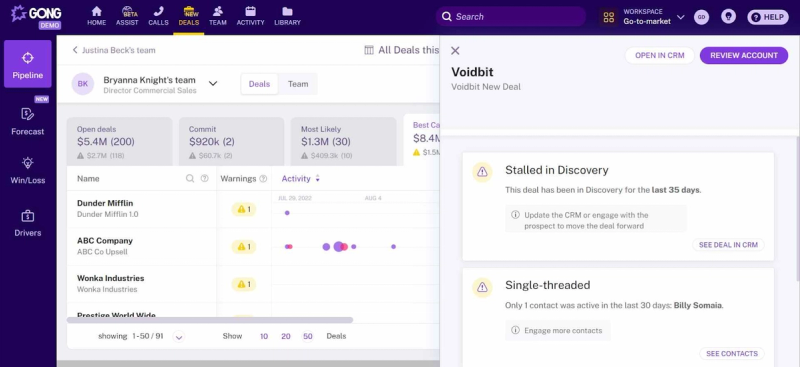
Gong's pricing has evolved significantly and is now more complex:
Foundation Model (2024-2025):
- Base platform fee: $5,000-$50,000 annually (depending on organization size)
- Per-user pricing has shifted from optional modular purchases to bundled offerings
- Foundation tier: ~$120/user/month base
- Current standard quote: $250/user/month for bundled Core + Engage + Forecast
Historical Pricing (2023):
- Professional Edition: ~$160/user/month
- Enterprise Edition: ~$200-220/user/month
Annual Cost Examples (100 users, 2025):
| Configuration | Monthly Cost/User | Annual Cost/User | Platform Fee | Total Annual |
|---|---|---|---|---|
| Core Only | $96 | $1,146 | $20,000 | $134,600 |
| Core + Engage | $146-166 | $1,746-1,986 | $20,000 | $194,600-218,600 |
| Core + Forecast | $136-166 | $1,626-1,986 | $20,000 | $182,600-218,600 |
| Full Bundle | $196-236 | $2,346-2,826 | $20,000 | $254,600-302,600 |
Key Pricing Insights:
- Minimum seats: Typically 5-10 user minimum commitment
- Contract terms: Usually annual contracts with limited month-to-month flexibility
- Price increases: Users report 56% price increase trends when migrating from modular to bundled offerings
- Hidden costs: Implementation fees ($10,000-$50,000 for enterprise deployments), training, and ongoing optimization resources
The shift to bundled pricing represents a significant change. Previously, teams could purchase just "Core" (call recording and basic intelligence). Now, Gong increasingly pushes comprehensive bundles, making it harder to buy only what you need.
Chorus Pricing (2025)
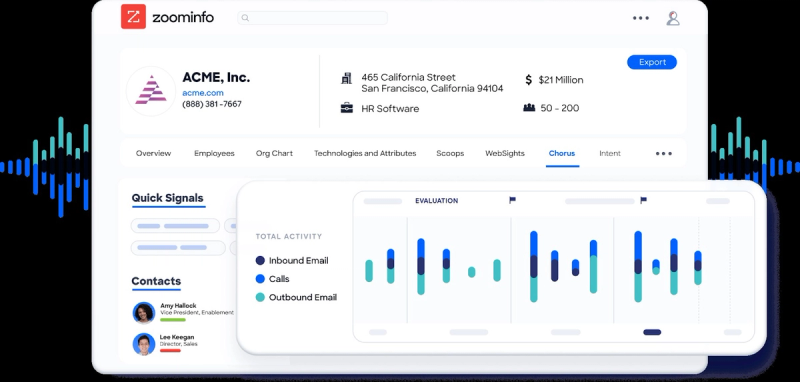
Chorus pricing remains more opaque, with limited public disclosure:
Estimated Pricing Model:
- Per-user pricing: $100-$150/user/month (estimated based on user reports)
- Minimum annual commitment: $8,000 total
- Typical seat minimums: 5-10 users
- Annual contracts standard, monthly billing rare
Pricing Complexity:
User feedback suggests Chorus pricing has become less transparent following the ZoomInfo acquisition. Several patterns emerge from reviews:
- Standalone Chorus pricing exists but requires custom quotes
- ZoomInfo bundle pressure during sales process (users report aggressive cross-selling)
- Pricing varies significantly based on whether you're an existing ZoomInfo customer
- Implementation fees typically lower than Gong but still present
Cost Comparison Reality:
For a 50-person sales team:
- Gong: $12,500/month ($150,000/year) + platform fees = ~$170,000-200,000 total
- Chorus: $6,000-7,500/month = ~$72,000-90,000 total
Chorus typically costs 50-60% less than Gong, but this comes with tradeoffs in feature depth, transcription accuracy, and forecasting capabilities.
Feature Deep Dive: Where They Diverge
Both platforms record calls and generate transcriptions, but that's where the similarities end. Here's what actually differentiates them in practice.
Transcription & Intelligence Quality
Language Support and Transcription Accuracy represent the most significant technical differentiators:
| Feature | Gong | Chorus |
|---|---|---|
| Language Support | 70+ languages | 30+ languages, English-optimized |
| Transcription Accuracy | Market-leading ~85% base accuracy | Known weakness; users report frequent errors |
| Multi-speaker Diarization | Advanced capability | Standard support |
The transcription gap matters more than most teams realize. Gong users consistently praise accuracy, though some report occasional redaction issues with sensitive numbers. Chorus has faced persistent criticism: users note transcription can be "pretty hit or miss" with one reporting: "We tried another product and realized that it is more accurate in transcription than Chorus. We were not expecting miracles but transcription is by far the weakest link."
This isn't just about reading a transcript. When your AI analysis is built on inaccurate transcription, everything downstream suffers: from deal risk identification to coaching insights.
Revenue Intelligence vs. Coaching
This is the philosophical divide that determines which platform fits your organization.
Gong: Built for Deal Strategy
Gong's analysis goes beyond simple keyword matching. The platform identifies:
- Sentiment shifts and emotional tone through acoustic analysis and word choice
- Topic tracking with automatic tagging of competitor mentions, pricing discussions, and product features
- Deal drivers: factors pushing deals forward or creating obstacles
- Coaching opportunities based on talk ratios, question pacing, and objection handling patterns
- Deal risk indicators and stalled opportunity alerts
The platform analyzes "how" conversations happen, not just "what" was said. This includes buyer engagement signals, objection patterns, and decision-maker involvement patterns.
Gong provides comprehensive pipeline visibility including:
- Deals going cold: automatically flags if no buyer response in X days
- Lack of executive involvement: identifies when key decision-makers haven't joined calls
- One-sided communication: highlights when reps have sent multiple emails with minimal responses
- Pipeline gap identification: spots low coverage in specific sales stages or insufficient activity to close in time
Gong answers the question: Are we going to hit our number?
Chorus: Built for Rep Development
Chorus focuses on sales-specific metrics including:
- Talk-to-listen ratios and monologue duration tracking
- Filler word analysis and customer engagement scoring
- Automated detection of next steps, pricing mentions, and competitor objections
- Sentiment analysis and emotional tone assessment
- Theme-based keyword tracking and automatic categorization
However, users report that Chorus's AI can miss conversational context. For example, the platform may not distinguish between "budget constraints" (a prospect concern) and "budget approval" (a buying signal): treating both identically as "budget mentions."
Chorus answers the question: Is my rep executing the right behaviors?
Users note that Chorus excels at identifying coaching opportunities but lacks the depth of deal-level predictive analytics that Gong provides. If your priority is getting reps to quota through skill development, Chorus delivers. If you need to understand why your pipeline is healthy or sick, Gong goes deeper.
Sales Coaching and Enablement
Gong's Data-Driven Coaching:
Gong transforms coaching from subjective feedback into quantified conversations:
- Instead of "you talk too much," managers can reference specific metrics: "You spoke for 78% of this call, while our top reps average 54%"
- Enables side-by-side comparison of top performers vs. struggling reps
- Provides visual, trackable coaching progress over time
- Surfaces patterns like reps who skip discovery questions or have high talk time but low conversion
This approach makes coaching feedback more receptive and measurable. Users highlight that this shift from subjective to quantified feedback significantly increases coaching effectiveness.
Chorus's Coaching Capabilities:
Chorus excels at practical coaching implementation:
- Managers can leave coaching comments directly on call recordings
- Comments include automatic links to the exact moment in the call being referenced
- Great for training new hires through role-based learning libraries
- Users report that Chorus makes it "easy to give direct feedback to reps during call reviews"
- The mobile app supports on-the-go review and feedback (though users note the app interface could be improved)
Both platforms support call libraries and playlists for onboarding, but Gong's approach is more analytics-driven while Chorus is more hands-on and manual.
The "ZoomInfo Factor" (Chorus) vs. The Ecosystem (Gong)
The companies behind these platforms shape the user experience more than you might expect.
Chorus: The ZoomInfo Integration Reality
Since ZoomInfo's 2022 acquisition, Chorus has become part of a larger go-to-market platform. Here's what that means in practice:
Pros:
- Seamless data flow if you already use ZoomInfo for prospecting and enrichment
- Unified billing across the ZoomInfo tech stack
- Contact and company data automatically surfaces in conversation context
Cons that users report:
- High-pressure cross-selling for other ZoomInfo products during sales process
- Interface clutter as ZoomInfo pushes ecosystem features
- Support quality declined post-acquisition according to user reviews
- Less independence in product roadmap decisions
One user summarized it bluntly: "The ZoomInfo integration is great if you're all-in on their ecosystem. But if you're not, it feels like you're constantly being sold to."
Gong: The Independent Ecosystem Player
Gong maintains independence while building deep integrations across the sales tech landscape:
- Native CRM integrations: Salesforce, HubSpot, Microsoft Dynamics
- Sales engagement: Outreach, Salesloft, and others
- Paradoxically, also partners with ZoomInfo for data enrichment, without the acquisition baggage
- 100+ tool integrations without vendor lock-in
- Custom API for enterprise deployments
This matters if your organization values flexibility. Gong won't force you into a specific tech stack. Chorus increasingly assumes you're building around ZoomInfo.
Real User Feedback
User reviews from G2, Capterra, and Reddit provide authentic perspectives beyond polished marketing materials.
What Users Love About Gong
Positive Feedback:
- Deep analytics that save deals: "Gong helped us identify that our best reps were asking 3-4 discovery questions in the first 5 minutes, while struggling reps were jumping straight to pitching. That one insight changed our entire onboarding."
- Forecasting accuracy: Revenue leaders praise Gong's ability to predict which deals will actually close based on conversation patterns
- CRM hygiene improvement: Automatic data capture reduces manual entry errors and keeps Salesforce/HubSpot current
- Multi-language support: International teams highlight the 70+ language capability as essential
Common Complaints:
- "Big Brother" concerns: Reps worry about micromanagement. One user noted: "Gong is a cool tool if it's not used as spyware to micromanage. Unfortunately that's how my company uses it."
- Expensive and complex: Multiple reviews cite high costs and the need for dedicated resources to manage the platform
- Implementation challenges: "Setup took 4 months and required constant CRM cleanup before Gong's insights were even usable"
- Overwhelming data: Some managers find the depth of analytics paralyzing rather than helpful
What Users Love About Chorus
Positive Feedback:
- Easy onboarding for new hires: Training teams love the ability to create call libraries and comment directly on recordings
- Simple to get started: "We were operational in 2 weeks vs. the 3-month Gong implementation timeline quoted to us"
- Good for coaching moments: Managers appreciate the ability to hop into calls quickly and leave time-stamped feedback
- Lower cost: Budget-conscious teams favor Chorus's more accessible pricing
Common Complaints:
- Transcription accuracy issues: This is the most consistent criticism. "Transcription is hit or miss: especially with technical terms or accents. We often have to reference the audio because the text is unreliable."
- Post-acquisition support decline: Multiple users report that support quality dropped after ZoomInfo acquisition
- Aggressive sales tactics: "The Chorus sales team was extremely pushy about adding ZoomInfo products to our contract"
- Limited forecasting depth: RevOps teams note Chorus doesn't provide the predictive analytics they need
Reddit and Community Sentiment
A Reddit discussion comparing the two revealed:
- "Both are great but the price of Gong doesn't make sense tbh. Chorus has the more accurate transcription." (Note: This contradicts other reviews, transcription quality is clearly inconsistent for Chorus)
- "Gong goes a mile wide and a mile deep, enabling true revenue-impacting decisions (ex. hidden deal risks) vs. Chorus going wide but not deep enough"
- ZoomInfo acquisition has made some Chorus users nervous about product roadmap independence
Strengths and Weaknesses
Gong: Comprehensive Analysis
| Strengths | Weaknesses |
|---|---|
| Market-leading transcription accuracy (~85%, 70+ languages) | Expensive ($250/user/month bundled + platform fees) |
| Deep revenue intelligence and forecasting capabilities | Complex setup requiring dedicated RevOps resources |
| Advanced AI analysis (deal risks, buyer engagement patterns) | 2-3 month implementation timeline |
| 100+ integrations without vendor lock-in | Can overwhelm teams with data if not properly configured |
| Quantified coaching metrics for measurable improvement | "Big Brother" perception among reps |
| Independent product roadmap and ecosystem partnerships | Requires excellent CRM hygiene to deliver value |
Chorus: Coaching-Focused Alternative
| Strengths | Weaknesses |
|---|---|
| 50-60% lower cost than Gong | Transcription accuracy is a known weak point |
| Faster implementation (2-4 weeks) | Only 30+ languages, primarily English-optimized |
| Excellent for coaching and onboarding new reps | Limited forecasting and deal intelligence depth |
| Time-stamped comments make feedback actionable | Support quality declined post-ZoomInfo acquisition |
| Simpler interface and easier team adoption | High-pressure cross-selling during sales process |
| Good integration with ZoomInfo ecosystem (if you use it) | Product roadmap tied to ZoomInfo priorities |
Claap: A Modern Alternative for Sales Teams
If both Gong and Chorus feel like compromises, Gong too expensive and complex, Chorus too limited and tied to ZoomInfo, there's a third path.
Claap represents the next generation of conversation intelligence: AI-native, built for agility, and designed for teams that want enterprise-grade insights without enterprise-grade complexity. That's the perfect Gong alternative.
Your AI Brain Assistant
Unlike static dashboards, Claap lets you actually talk to your sales data. Ask questions like:
- "Suggest an icebreaker for Client X based on our last call"
- "Remind me what we discussed with Acme Corp in Q3?"
- "Create a competitor scorecard based on the last 3 months of calls"
This shifts the paradigm from "reports you have to dig through" to "answers you get instantly." Gong and Chorus make you hunt for insights. Claap surfaces them conversationally.
Full Pipeline Visibility Without the Bloat
Claap automatically records, transcribes, and summarizes your sales meetings: highlighting key action items, objections, deal risks, and competitive mentions in real time. You get the "Gong-like" revenue intelligence (spot blockers, identify patterns, track deal health) without the six-month implementation timeline or the platform fees.
Real results from teams using Claap:
- TenderApp: 66% uplift in win rates in one quarter (SQL-to-win rate jumped from 9% to 15%)
- Surfe: Shortened sales cycle by 10 days
- Ronspot: Improved demo conversion rates by 33% and boosted deal value by 26%
Smart Templates & Tables That Adapt to Your Process
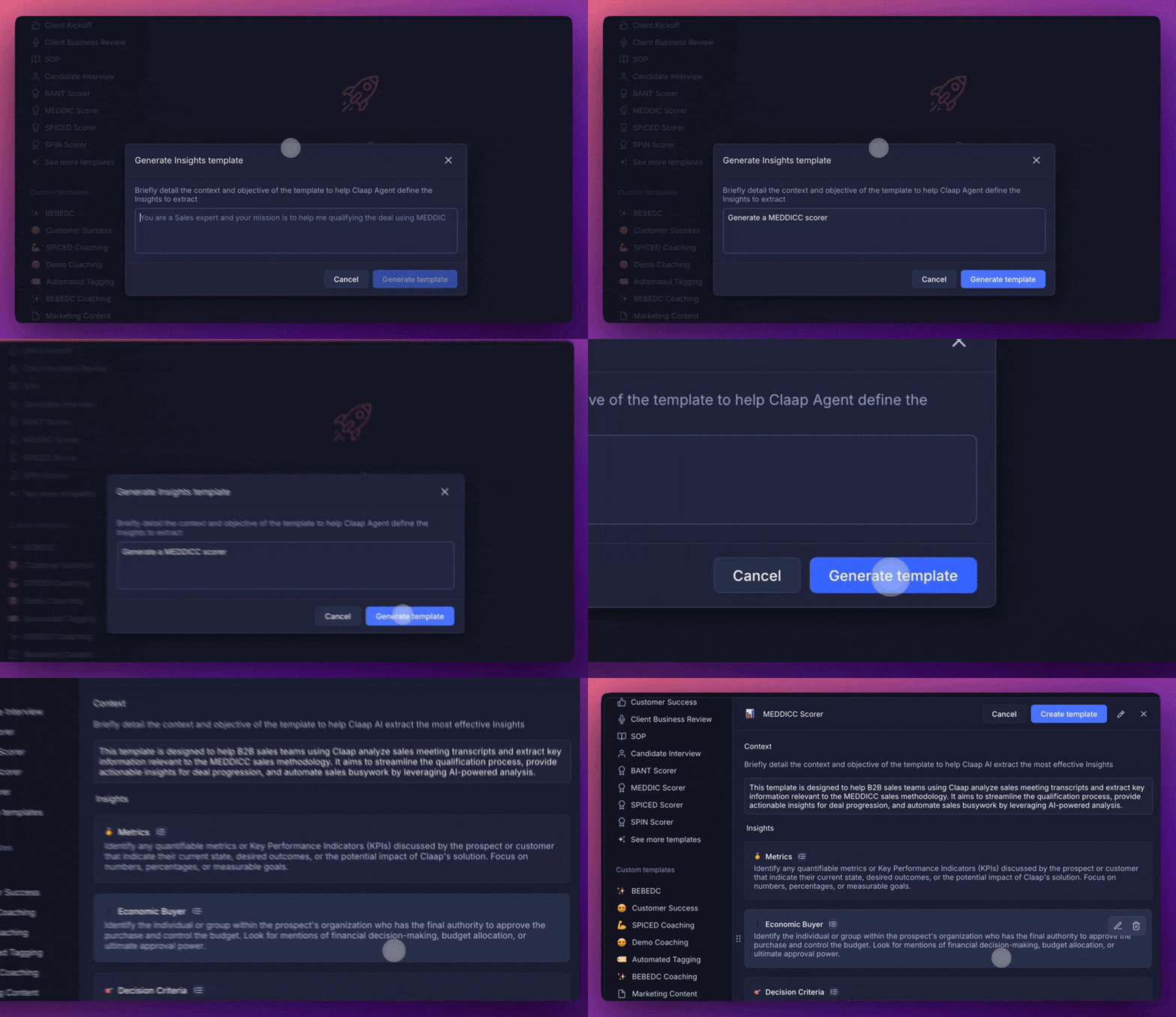
Customize summary templates that match your actual sales methodology: whether it's MEDDIC, BANT, SPIN, or your own framework. Unlike rigid tools that force you into their structure, Claap bends to fit your process.
The Smart Tables module analyzes multiple calls at once, comparing outcomes and extracting patterns effortlessly. Want to see how your team handles pricing objections across 50 discovery calls? Two clicks.
Coaching That Actually Scales
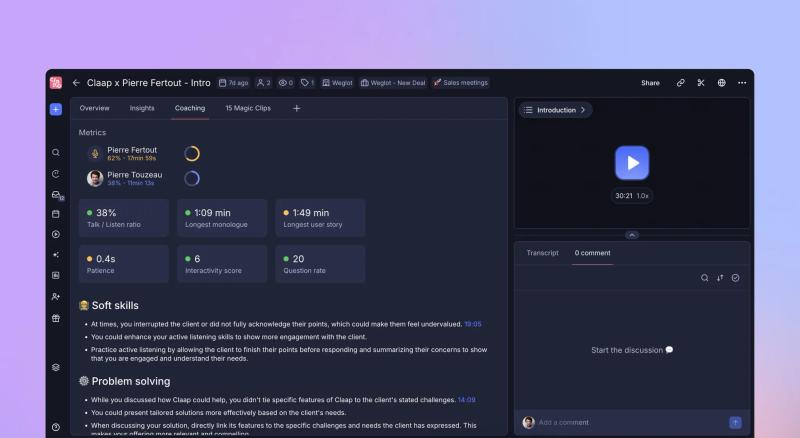
Claap analyzes talk ratios and conversation patterns to automatically spot coaching opportunities. Managers can review dozens of calls at a glance, identify what top performers do differently, and deliver targeted feedback based on real data, not gut feelings.
Unlike Chorus (manual coaching comments) or Gong (analytics-heavy dashboards), Claap balances automation with actionability. You get AI-powered insights that help reps improve, packaged in a way that's actually usable for coaching sessions.
Seamless Integration Without Lock-In
Native connections to the tools you already use:
- CRMs: HubSpot, Salesforce, Attio: automatically enriched after every call
- Collaboration: Notion, Slack, Jira: insights flow where your team works
- Custom workflows: API and MCP support for advanced automation
One user who switched from Modjo noted: "Claap's UX, transcriptions, and AI summaries are a level above. It fits perfectly into our sales stack."
The Pricing Reality
Here's where Claap stands apart:
- Free Plan: 10 videos + 300 minutes (actually usable, not a trial)
- Pro Plan: $32/user/month (unlimited videos, 1,000 min recording)
- Business Plan: $60/user/month (AI notes, CRM enrichment, deal insights, coaching)
- Enterprise: Custom (but still a fraction of Gong's $250/user/month bundled pricing)
For a 50-person sales team, you're looking at $3,000/month for Claap Business versus $12,500/month for Gong's bundled offering. That's $114,000 in annual savings, without sacrificing the features that actually drive quota attainment.
Try Claap free for your first 10 videos or talk to the team to see how it compares in your specific use case.
Decision Framework: Which One Fits You?
Choose Gong if:
- You are a mid-to-enterprise team (100+ employees) with mature sales processes
- You need multi-language support (70+ languages) for international operations
- You have a dedicated RevOps function to manage implementation and optimization
- Budget is secondary to data depth: you need comprehensive revenue intelligence
- Your priority is forecasting accuracy and deal risk identification
- You want ecosystem independence with 100+ tool integrations
- You're willing to invest 2-3 months in implementation for long-term strategic value
Choose Chorus if:
- You are a smaller team (<50 reps) without extensive RevOps resources
- Your primary goal is training new reps and sales enablement
- You are already deep in the ZoomInfo tech stack and want unified data flow
- Budget is a significant constraint: you need 50% cost savings vs. Gong
- You need to be operational quickly (2-4 weeks implementation)
- Your focus is coaching and skill development rather than strategic forecasting
- You can tolerate transcription inconsistencies in exchange for lower costs
Choose Claap if:
- You want AI-first conversation intelligence with a modern, interactive interface
- Gong's $250/user/month bundled pricing exceeds your budget but you still need robust features
- You need "Smart Recording" combined with an AI Brain you can actually query
- Your team values fast implementation (weeks, not months) and intuitive adoption
- You're building a flexible sales tech stack, not committing to a single vendor ecosystem
- You want enterprise-grade insights with startup-level agility
- You need to save 30+ minutes per call on admin work while maintaining full pipeline visibility
FAQs
How much does Gong actually cost per user?
Gong's 2025 pricing has shifted to a bundled model. Expect approximately $250/user/month for the standard package (Core + Engage + Forecast modules), plus annual platform fees ranging from $5,000 to $50,000 depending on your organization size. For a 50-person team, total annual cost typically lands between $150,000-$180,000. Gong no longer offers simple "just call recording" pricing: you're buying into the full revenue intelligence suite whether you need all the features or not.
Does Chorus require a ZoomInfo subscription?
No, Chorus can be purchased standalone. However, user reviews consistently report high-pressure sales tactics encouraging ZoomInfo bundle purchases during the buying process. The platform is increasingly optimized for ZoomInfo customers: you'll get the smoothest experience if you're already using ZoomInfo for prospecting and data enrichment. Standalone buyers sometimes feel like second-class citizens in the ecosystem.
Which tool is better for non-English speakers?
Gong wins decisively. It supports 70+ languages with consistent transcription quality, while Chorus supports 30+ languages but is heavily optimized for English. If your sales team operates in multiple regions or languages, Gong's broader language support and more accurate transcription make it the clear choice. Teams selling in EMEA, APAC, or Latin America should strongly favor Gong for this reason alone.
Is Gong harder to set up than Chorus?
Yes, significantly. Gong's comprehensive feature set requires more extensive configuration, especially if you want to leverage its forecasting and deal intelligence capabilities. You'll need:
- Clean, consistent CRM data (Gong's insights are only as good as your data hygiene)
- Dedicated RevOps or sales operations resources for setup and ongoing optimization
- 2-3 months for full implementation and team adoption
Chorus has a lighter setup process focused primarily on call recording and coaching workflows. Most teams are operational within 2-4 weeks. However, "easier setup" also reflects Chorus's more limited feature depth.
Can these tools replace a CRM?
No, and you shouldn't try. Both Gong and Chorus are designed to enrich your CRM, not replace it. They capture conversation data and sync insights back to your CRM records, but they don't manage your entire sales process, pipeline stages, or customer relationships.
That said, tools like Claap are pushing the boundary by automating CRM data entry. Instead of reps manually updating fields after every call, Claap's AI extracts key information (next steps, pain points, decision criteria) and populates your CRM automatically. This reduces admin work by 30+ minutes per call, but the CRM still remains your system of record for the overall sales process.