

The 8 best conversation intelligence software in 2026, and how to choose for a team of 10 to 50 reps
For a team of 10 to 50 reps, conversation intelligence is worth it when it fills the CRM and scores calls on day one. The 8 best tools in 2026, with what buyers told us.

Updated October 26, 2026.
Summary
- Gong is best for enterprise revenue teams with 50+ reps and a RevOps team that can run a full platform.
- Modjo is best for French and European mid-market teams that want an EU-hosted vendor and buy through a demo.
- Claap is best for sales teams of 5 to 100 reps that want every call to fill CRM fields and score against their own method, at a published per-seat price.
- Avoma is best for small teams that want notes, scheduling and coaching in one tool and are happy to build it from add-ons.
- Salesloft is best for teams already running Salesloft cadences or Clari forecasting.
- Fathom and Fireflies are best for teams that only want meeting notes. They are general-purpose note-takers, without sales call scoring or deal risk.
For a sales team of 10 to 50 reps, conversation intelligence is worth buying when it fills the CRM and scores calls on day one; platform depth you will configure later is a RevOps project you don't have.
That is what Claap's own deal data shows. Most buyers run small teams, and they want two jobs done: CRM entry and coaching.
The time at stake is real. Salesforce's 2026 State of Sales report, a survey of 4,050 sales professionals, found that the average seller spends only 40% of their time selling (Salesforce, February 2026).
With that much selling time going to admin, we looked at what buyers actually want these tools to fix, then compared the 8 conversation intelligence platforms sales teams shortlist most, plus the two note-takers they are often confused with. By the end you will know which two tools to trial and what to check in your CRM before you sign.
Conversation intelligence software at a glance
| Tool | Best for | Entry price (per seat/month) | Free plan or trial | G2 rating |
|---|---|---|---|---|
| Gong | Enterprise revenue teams with 50+ reps and a RevOps team | Not public, plus a platform fee | No | 4.7 (6,745) |
| Modjo | French and European mid-market teams | Not public | Demo only | 4.7 (92) |
| Claap | Teams of 5 to 100 reps that want CRM fields filled and calls scored | $32 Pro, $60 Business (annual) | Free plan | 4.6 (480) |
| Avoma | Small teams that want notes, scheduling and coaching in one tool | $19 + $29 CI add-on (annual) | 14-day trial | 4.6 (1,365) |
| Attention | US teams that want call data to trigger CRM workflows | Not public | Demo | 4.6 (78) |
| Jiminny | UK and US mid-market teams where manager coaching comes first | Not public | On request | 4.6 (931) |
| Salesloft | Teams already on Salesloft cadences or Clari forecasting | Bundled with the platform | No | 4.5 (9,897, whole platform) |
| Chorus by ZoomInfo | Teams already paying for ZoomInfo | Bundled with ZoomInfo | No | No standalone listing |
| Fireflies (note-taker) | Teams that only want cheap searchable notes | $10 Pro (annual) | Free plan | 4.7 (753) |
| Fathom (note-taker) | Individuals and small teams that want a free notetaker | Free, $15 Team (annual) | Free plan | 5.0 (7,064) |
Prices come from each vendor's pricing page (Claap's from claap.io/pricing) and ratings and review counts from G2. Chorus has no standalone G2 product page.
What buyers want conversation intelligence to fix
Claap is a conversation intelligence tool, so every deal in our pipeline carries the main problem the buyer wants solved, and we record our own sales calls. Here is what that data says.
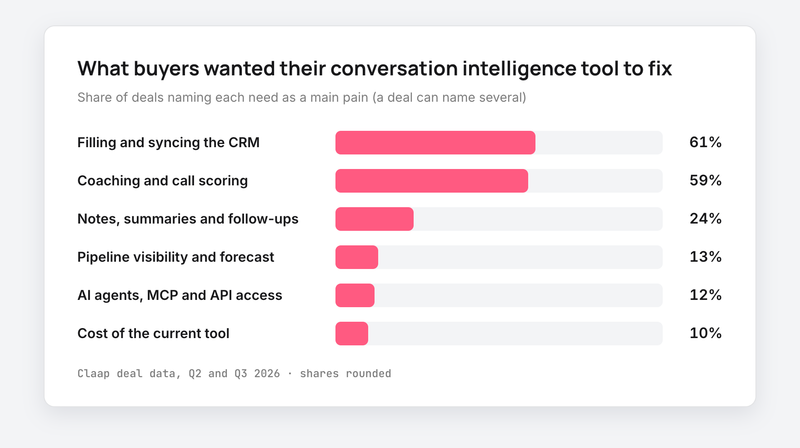
- CRM and coaching dominate. In Claap deals from Q2 and Q3 2026 where the buyer stated a main pain, 61% named filling or syncing the CRM and 59% named coaching and call scoring (Claap deal data, Q2 and Q3 2026).
- The two needs usually come together. 39% of those deals named both the CRM and coaching (Claap deal data, Q2 and Q3 2026).
- Notes come a distant third. Summaries and follow-ups appeared in 24% of deals, pipeline visibility in 13% and AI agent access in 12% (Claap deal data, Q2 and Q3 2026).
- Most teams are small. In 59% of Claap's Q2 and Q3 2026 deals where the sales team size was known, the team had 10 reps or fewer, and 77% had 20 or fewer (Claap deal data, Q2 and Q3 2026).
- Many are buying their first tool. In 44% of the deals where we knew the buyer's current setup, the team had no conversation intelligence tool and took notes by hand (Claap deal data, Q2 and Q3 2026).
- Shortlists are short. Where the buyer's evaluated tools were recorded, Modjo appeared in 45% of deals and Gong in 30%, and 26% of buyers compared Claap with two or more other tools (Claap deal data, Q2 and Q3 2026).
What buyers told us on calls:
- A business owner at a US healthcare company with a two-person sales team, three demos into his search: "The first one would be just what it looks like in HubSpot. It's just that's our source of truth. That's kind of the biggest thing there is. Being able to quickly find it in HubSpot, get summaries in there directly in the contact view."
- An innovation lead at a large logistics group, mapping her sales teams' tools: "If we end up with 100 solutions for the [business developers] that don't integrate well, or with duplicates, it gets complicated. And then the tools won't be used by our salespeople." (translated from French)
- A sales enablement lead at a B2B software scale-up, three tools into an evaluation: "It's all very similar from what I'm seeing, it's extremely similar, it's only going to come down to like the details."
- A RevOps lead weighing a switch from his current tool: "We understand that, probably on our side, some of this stuff that is causing us pain is not necessarily due to a tool. It might be due to us needing better processes, right? [...] And then the tool is like an amplifier, or like an enhancer, right?"
The pattern is clear: the tool that wins is the one reps use without thinking, plugged into the CRM they already live in.
Benefits of conversation intelligence for sales teams
What is the best AI tool for sales reps?
The best AI tool for a sales rep is the one that removes the work after the call: notes, CRM entry and the follow-up email. Conversation intelligence does all three from the recording, then pulls the key information out of each call: needs, objections, competitors named and next steps.
For the manager it adds what a general AI assistant does not: a score for every call against your sales method, and a view across the whole team.
Pick a general assistant like ChatGPT if you only want to write faster. Pick conversation intelligence if you want your calls to feed the CRM and coaching with no typing.
Is conversation intelligence worth it for a 10-person sales team?
Yes, on two conditions: the tool fills your CRM fields with no manual step, and it scores calls against your method without weeks of setup.
At 10 reps nobody has time to administer a platform. The value shows up as data entry you no longer do and follow-ups that go out on time, from the first week.
A sales director at a B2B AI start-up who coaches his own new hires described what he wanted from it: "All the meetings, especially for the new joiners. I coach quite a few of them. So for coaching, that's very good. I'll be able to go into their meeting and see the progress. On discovery especially, and on deals for the risks." (translated from French)
The same leader set the limit: "It has to be an assistant. It must not run things for you. [...] You lose the ownership." (translated from French) The tool prepares the ground; the rep still owns the deal.
This advice is wrong if you run long enterprise cycles with a dedicated RevOps team: there, the forecasting depth of a platform like Gong or Salesloft pays for itself.
How do I analyze my SDR and AE calls automatically?
- Record every call in one place. Video, phone and in-person meetings, with or without a bot depending on what your buyers accept.
- Write your scorecard once. For SDRs, a cold-call scorecard (opener, pitch, next step). For AEs, your qualification method: MEDDPICC, SPICED or BANT. Our call scoring guide shows how to build each one.
- Let the tool score every call. Each criterion gets a score and the line from the call that justifies it.
- Look at the gaps per rep. The manager sees who loses points on which criterion, then replays the two or three calls that matter.
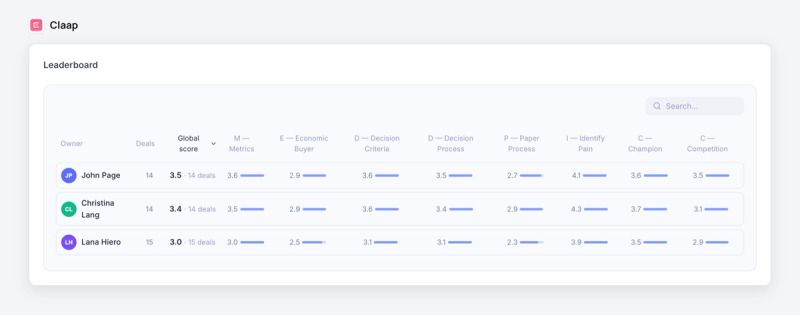
In the example above, the lowest-ranked rep loses most points on the economic buyer and the paper process. That is where the next coaching session goes. Claap's sales coaching scores every call this way, on your own framework.
How to choose conversation intelligence software for a growing team
Compare call analysis tools for a small or mid-size business
- CRM integration. Run 10 real calls through your top two tools and check your HubSpot or Salesforce fields one by one. A field should hold a usable value (an amount, a date, a competitor); a note pasted on the activity is still free text. See how CRM auto-complete writes typed values field by field.
- Deal scoring and qualification. Every deal should get a score per criterion of your method, with the evidence from the call and what is missing. That is what gives you pipeline visibility.
- Automatic summaries and follow-ups. The summary should follow your template and the follow-up email should start from what was said.
- Scalability. Check that you can mix licenses (a full license for reps, a free one for everyone else) and that there is no platform fee before the first seat.
- Fit with your current stack. Dialer, video, CRM, and your AI assistants through an MCP server: the fewer screens reps switch between, the more the tool gets used.
- A trial on your own calls. Ask for a trial on a sample of real calls, in your languages, before you sign.
Which call analysis tool should a team of 20 reps choose?
At 20 reps, coaching can no longer rely on replaying random calls: the manager needs scores per criterion and a team ranking. Choose a tool that scores every call against your method and writes the answers into CRM fields, because those fields are what your pipeline reviews run on.
Price the whole contract: platform fee, seat minimum, add-ons, AI credits and contract length. For European teams, also check where recordings are hosted and test transcription in your languages.
How we built this comparison
- Vendor facts (pricing, plans, MCP, languages, hosting) come from each vendor's own website and documentation.
- G2 ratings and review lines come from each tool's G2 page.
- Buyer data comes from Claap's own HubSpot deals from Q2 and Q3 2026 (main pain, sales team size and evaluated tools recorded on the deal) and recorded sales calls. It leans toward buyers already open to Claap. Only the buyer's own words are quoted, anonymized to the role, with cuts marked [...].
- Conflict of interest: Claap is one of the tools in this list. We have stated Claap's limits as plainly as anyone else's. If you spot an error about any vendor, write to us and we will correct it.
1. Gong, best for enterprise teams with 50+ reps
Gong is the safe pick above 50 reps with a RevOps team and budget; under 20 reps, the platform fee is hard to justify.
Gong overview
Gong, founded in 2015, is the reference in revenue intelligence. It records calls, emails and meetings, scores deals, forecasts the pipeline and coaches reps, with the largest review base in the category.
- Deal boards and pipeline forecasting built on call and email activity
- Trackers that flag when a topic, competitor or next step was discussed
- Coaching scorecards and call libraries for managers
- MCP server for AI assistants, read-only
Gong pricing
Gong says licenses are "priced per user" with "a platform fee based on the number of users supported" (gong.io/pricing). Vendr reports a median contract of $55,359 per year across 593 purchases (Vendr).
Gong pros and cons
Pros:
- The most functionality out of the box in this list
- Mature forecasting and deal boards
- Fast-moving agent roadmap
Cons:
- Opaque pricing with a platform fee before the first seat
- Read-only MCP that returns no raw transcripts (help.gong.io)
- Too much platform for most teams under 20 reps
What G2 reviewers say about Gong
Gong is rated 4.7 on G2 from 6,745 reviews. A recent reviewer: "It's a bit cumbersome to navigate and some features are weirdly fragmented across different menus." For more options, read our Gong alternatives guide.
2. Modjo, best for French and European mid-market teams
Modjo suits European teams that want a local, EU-hosted vendor and are fine buying through a demo.
Modjo overview
Modjo is a Paris company founded in 2019 and the tool buyers compare most often in Claap's own deals. It records and transcribes sales calls, then runs ready-made agents on them for meeting prep, deal review, follow-ups and churn or cross-sell signals. Modjo hosts its data on AWS in Paris and is SOC 2 Type II certified.
- Call recording and transcription in many languages
- Ready-made deal agents
- CRM sync with HubSpot, Salesforce, Dynamics 365, Pipedrive, Sellsy and Zoho
- MCP server, read-only
Modjo pricing
Modjo does not publish prices. Its pricing page says it is "optimal from 3 sales reps" and asks for a demo.
Modjo pros and cons
Pros:
- EU hosting in Paris, SOC 2 Type II and GDPR
- The broadest CRM list in this guide, including Dynamics, Sellsy and Pipedrive
- French-speaking team and interface
Cons:
- No public pricing
- Small review base on G2
- MCP cannot write back
What G2 reviewers say about Modjo
Modjo is rated 4.7 on G2 from 92 reviews. One reviewer noted: "For a smaller organization, the value naturally depends on having enough sales activity and users to make full use of the platform."
What prospects told us about Modjo
Modjo came up often on our calls, mostly with French-speaking teams. A customer-team lead at a French SaaS scale-up and current Modjo user told us: "The fact that it's limited in features also makes it very easy to pick up." A sales lead at a Canadian real-estate company, also a current user, said: "Modjo works well, it's a good product. The only thing is that it isn't a flexible product." On that call, flexibility mostly meant contract terms: he wanted to get away from annual-only licenses. (Both translated from French.)
3. Claap, best for sales teams of 5 to 100 reps
A quick note: Claap is our product. To keep this comparison fair, we described every tool from its own pages and linked the major claims to their source.
Claap is best for teams of 5 to 100 reps that want every call to fill the CRM and score against their own method, at a published per-seat price.
Claap overview
Claap is a conversation intelligence platform by lemlist. It records video calls with or without a bot, phone calls from dialers, in-person meetings and emails, then turns them into deal data: AI fields written into HubSpot or Salesforce, calls scored against your sales method, deal risk and win-loss analysis. Claap's MCP server lets Claude, ChatGPT and other agents read transcripts and CRM data and write back. According to Claap's product pages, it is hosted in the EU, SOC 2 Type II certified and transcribes 99+ languages.
- Recording from the desktop without a bot, or with a visible bot if the team prefers
- Typed values written into your HubSpot or Salesforce fields after each call
- Call scoring and coaching on your own framework (MEDDPICC, SPICED, BANT or custom)
- MCP access that reads and writes, on every plan including the free one
Claap pricing
According to Claap's pricing page, the Basic plan is free (10 videos per user, with the Claap MCP). The same pricing page lists Pro at $32 and Business at $60 per seat per month, billed annually; Business adds CRM auto-complete, AI coaching and deal insights. There is no platform fee, and one workspace can mix all three licenses.
Claap pros and cons
Pros:
- Published pricing with a free plan and no platform fee
- MCP that reads transcripts and writes to the CRM
- EU hosting, SOC 2 Type II, 99+ languages per Claap's product pages, and migration from Gong, Modjo, Fathom and Clari
Cons:
- Smaller review base than Gong
- Forecasting is lighter than Gong or Clari
- AI credits cap usage on Pro and Business
What G2 reviewers say about Claap
Claap is rated 4.6 on G2 from 480 reviews. A fair criticism from a recent review: "The AI-generated summaries sometimes miss context or attribute speaking points to the wrong participant, especially when multiple people are talking quickly."
4. Avoma, best for small teams that want an all-in-one meeting assistant
Avoma fits small and mid-size teams that want a meeting assistant, a scheduler and conversation intelligence in one tool, and don't mind building it from add-ons.
Avoma overview
Avoma is a Palo Alto company founded in 2017. It combines AI notes, a meeting scheduler, a lead router, coaching and forecasting. Conversation intelligence and revenue intelligence are sold as add-ons on top of the base seat.
- AI notes and summaries with a chat over past meetings
- Scheduler and lead router built in
- Conversation and revenue intelligence add-ons
- MCP server that exposes transcripts and notes
Avoma pricing
Startup $19, Organization $24 and Enterprise $39 per recorder seat per month billed annually, plus $29 per seat per month for each of the Conversation Intelligence and Revenue Intelligence add-ons, with a 14-day free trial (avoma.com/pricing).
Avoma pros and cons
Pros:
- Transparent pricing and a real free trial
- Wide CRM list
- Scheduler and router in the same tool
Cons:
- Core conversation intelligence is a paid add-on
- Seat caps per tier
- EU data hosting not documented publicly
What G2 reviewers say about Avoma
Avoma is rated 4.6 on G2 from 1,365 reviews. A small-agency reviewer: "Pricing is a little steep for smaller agencies."
What prospects told us about Avoma
A sales manager at a B2B SaaS scale-up with a large Avoma rollout said: "We use [Avoma] today and have done so for the last, I think three, four years, maybe, but have never really gotten the full value out of it."
5. Attention, best for US teams that automate CRM workflows
Attention suits US revenue teams that want call data to trigger CRM updates and workflows, and have RevOps time to configure them.
Attention overview
Attention is a New York company founded in 2021. It automates follow-ups, CRM filling and call scorecards, and lets teams build custom agents on their call data. Its MCP server has read and write scopes across dozens of tools (docs.attention.com).
- CRM auto-fill and follow-up emails after each call
- Scorecards for coaching
- Custom agents on call data
- Read and write MCP
Attention pricing
Attention does not publish prices.
Attention pros and cons
Pros:
- Read and write MCP
- Strong CRM automation
- Custom agents
Cons:
- No public pricing
- Little public documentation on languages and EU data residency
What G2 reviewers say about Attention
Attention is rated 4.6 on G2 from 78 reviews. A Salesforce user: "Attention occasionally has trouble identifying the correct opportunity to associate a call with in Salesforce."
What prospects told us about Attention
A buyer at a SaaS company that sells to security teams built his comparison around Attention's workflow builder: "The one that like I'm actively comparing you to in my head is Attention, because of that workflow builder concept that I'm really keen on."
6. Jiminny, best for mid-market teams focused on manager coaching
Jiminny is best for UK and US mid-market teams where manager coaching is the main reason to buy.
Jiminny overview
Jiminny is a London company founded in 2016. It records and analyzes calls, and gives managers scorecards, playlists and the option to join live calls and message reps privately. Jiminny is SOC 2 Type II certified and hosted on AWS.
- Call recording with AI chat over the conversation
- Manager scorecards and coaching playlists
- Live call join and private messaging to reps
Jiminny pricing
Jiminny has no pricing page; Vendr reports a median contract of $27,000 per year (Vendr).
Jiminny pros and cons
Pros:
- Coaching workflows built for managers
- Lower median contract than Gong
- Reviewers often praise support
Cons:
- No public pricing page
- No MCP server
- Some reviewers flag AI accuracy
What G2 reviewers say about Jiminny
Jiminny is rated 4.6 on G2 from 931 reviews. One reviewer: "Jiminny gives some AI generated insights or summaries that may need consistent manual review."
7. Salesloft, best for teams already on Salesloft or Clari
Salesloft makes sense when your team already runs Salesloft cadences or Clari forecasting and wants call insights in the same workflow.
Salesloft overview
Salesloft is a sales engagement platform with conversation intelligence built in. It merged with Clari in December 2025, so Clari Copilot and Clari forecasting now sit in the same company, and Salesloft's MCP server covers their data.
- Cadences, dialer and call recording in one platform
- Clari forecasting on the same data
- Real-time battlecards in Clari Copilot
Salesloft pricing
Salesloft does not publish prices; Vendr reports $60 to $170 per user per month by tier (Vendr).
Salesloft pros and cons
Pros:
- Engagement, call intelligence and forecasting under one roof
- Large ecosystem
- MCP available in Claude
Cons:
- Conversation intelligence is an add-on to a premium platform
- You buy the engagement platform to get it
What G2 reviewers say about Salesloft
Salesloft is rated 4.5 on G2 from 9,897 reviews, for the whole platform. A UK reviewer: "Being based in the UK getting support is challenging as their support staff seem to be based in the USA."
8. Chorus by ZoomInfo, best for teams already paying for ZoomInfo
Chorus is worth a look only if your company already pays for ZoomInfo and wants call data next to contact data.
Chorus overview
Chorus is ZoomInfo's conversation intelligence product, acquired in 2021. It covers call recording, review and snippet sharing, and is sold mostly as part of a ZoomInfo contract.
Chorus pricing
Chorus pricing is tied to a ZoomInfo contract and not published.
Chorus pros and cons
Pros:
- Bundles with ZoomInfo data
- Mature call review features
Cons:
- Pricing tied to a ZoomInfo contract
- No native Chorus MCP (ZoomInfo's MCP covers contact and company data)
- No standalone G2 product page
What prospects told us about Chorus
Chorus came up rarely on our calls. A sales transformation lead at a Swiss deep-tech company who evaluated it in 2025 saw it as the safe American choice, but found it "really very expensive" and said "it looks very standardised and not very customisable" (translated from French).
Two generalist note-takers, if you only need notes
Fireflies and Fathom often appear in conversation intelligence roundups. They are general-purpose meeting note-takers built for any team and any meeting: they record, transcribe and summarize well and cost little. Sales call scoring, typed CRM deal fields, deal risk and coaching views are where the platforms above go further. Pick one if notes are all you need.
Fireflies
Fireflies is a general-purpose AI meeting assistant founded in 2016. It records, transcribes and summarizes meetings across Zoom, Meet and Teams, and has an official MCP server. Pricing: free plan, then Pro at $10 per seat per month billed annually (fireflies.ai/pricing). It is rated 4.7 on G2 from 753 reviews.
Fathom
Fathom is a general-purpose AI meeting notetaker founded in 2020. Its free plan includes unlimited recordings and transcriptions; field-level CRM sync to HubSpot and Salesforce is on the Business plan. Pricing: free, then Team at $15 per seat per month billed annually (fathom.ai/pricing). It is rated 5.0 on G2 from 7,064 reviews.
Conversation intelligence software feature comparison
| Gong | Modjo | Claap | Avoma | Attention | Jiminny | Salesloft | Chorus | Fireflies | Fathom | |
|---|---|---|---|---|---|---|---|---|---|---|
| Public pricing | No | No | Yes | Yes | No | No | No | No | Yes | Yes |
| Free plan | No | No | Yes | Trial | No | No | No | No | Yes | Yes |
| Platform fee | Yes | Not documented | No | No | Not documented | Not documented | Bundled | Bundled | No | No |
| MCP server | Read-only | Read-only | Read and write | Yes | Read and write | No | Yes | No | Yes | Paid plans |
| EU data hosting | Option | Yes | Yes | Not documented | Not documented | Not documented | Not documented | Not documented | Not documented | Not documented |
Facts from each vendor's website and documentation. "Not documented" means the vendor's public pages do not say.
Conclusion: which conversation intelligence software to pick
- Pick on two jobs, filling the CRM and scoring calls, because those are the needs buyers name most in Claap's deal data.
- At 10 reps, the tool is worth it when it runs without heavy setup; at 20, also demand scores per criterion and a team ranking.
- Trial two tools on 10 real calls and check your CRM fields one by one before you sign.
- Price the whole contract, platform fee and add-ons included.
- Gong and Salesloft fit enterprise organizations with a RevOps team to run them.
- Modjo fits European teams that want a local vendor; Claap fits teams of 5 to 100 reps that want CRM fields, call scores and a published price.
- If notes are all you need, Fathom or Fireflies will do.
Frequently asked questions
What is the best conversation intelligence software?
It depends on team size and budget. For enterprise teams with 50+ reps and a RevOps function, Gong is the most complete. For European mid-market teams, Modjo and Claap. For teams of 5 to 100 reps that want CRM fields filled and calls scored at a published price, Claap and Avoma. For notes only, Fathom or Fireflies.
What is conversation intelligence software?
Conversation intelligence software records sales calls and meetings, transcribes them, and turns what was said into structured data: call scores, CRM fields, deal risks and coaching insights. Sales managers use it to coach from real calls and to run pipeline reviews on evidence.
How much does conversation intelligence software cost?
Claap is free, $32 or $60 per seat per month billed annually, according to its pricing page. Avoma starts at $19 plus $29 for its conversation intelligence add-on, according to its pricing page. Gong, Modjo, Attention, Jiminny and Salesloft quote on request, and Vendr reports a median Gong contract of $55,359 per year.
Is there free conversation intelligence software?
Yes. Claap has a free plan, and so do the generalist note-takers Fireflies and Fathom. Claap's free Basic plan includes 10 recordings per user, the Chrome extension, a basic AI summary and the Claap MCP, according to its pricing page. CRM auto-complete and call scoring start on Claap's Business plan.
What is the best software for conversation analysis?
For sales conversations, pick a tool that scores every call against your sales method and writes the answers into your CRM, because that is what managers coach and forecast from. Gong, Claap, Modjo and Avoma all score calls; general note-takers summarize them.
What is the difference between conversation intelligence and conversational AI?
Conversation intelligence analyzes conversations between people, such as a rep and a buyer, and turns them into data. Conversational AI is software that holds the conversation itself, like a chatbot or a voice agent. Some vendors sell both, but they solve different problems.
Which conversation intelligence software has an MCP server?
Gong, Modjo, Claap, Avoma, Attention, Salesloft, Fireflies and Fathom all have one. Gong's and Modjo's are read-only. Claap's and Attention's can read call data and write back to the CRM, and Claap's is on every plan, including the free one.