


The 9 best AI sales tools in 2026, by job in the sales cycle
AI-powered sales tools streamline workflows, providing insights and automating tasks like data entry and follow-ups. By enhancing decision-making and efficiency, these tools allow sales teams to focus on high-value deals, ultimately improving performance and driving better sales outcomes.


Prices, ownership and G2 ratings checked on 6 and 7 October 2026.
Article overview
- HubSpot Breeze is best for teams that already run on HubSpot and want AI agents, enrichment and an assistant inside the CRM they use every day.
- Salesforce Agentforce is best for enterprise sales orgs on Salesforce that have the admin team to configure agents and the budget for Enterprise Edition.
- Apollo.io is best for outbound teams that need contact data and sequences in one affordable tool, with a free plan and paid seats from $49 per month on annual billing.
- Lavender is best for reps who write their own cold emails and want a coach that scores every draft before it is sent.
- Gong is best for enterprise revenue teams that want call recording, deal boards and forecasting from one vendor.
- Claap is best for sales teams of 5 to 100 reps that want every sales call turned into CRM fields, scores and follow-up emails at a published price.
Salesforce surveyed more than 4,000 sales professionals for its 2026 State of Sales report.
54% of sellers say they have already used AI agents, and nearly 9 in 10 plan to by 2027 (Salesforce, State of Sales 2026).
This guide sorts the AI sales tools worth a shortlist by the job they do: finding prospects, writing emails, understanding calls, forecasting, and running AI inside the CRM. Each one gets the same review block, with its price and G2 rating.
AI sales tools at a glance
| Tool | Best for | Entry price |
|---|---|---|
| HubSpot Breeze | HubSpot teams that want AI inside the CRM | Included in HubSpot plans; agents use HubSpot Credits. Sales Hub Professional $90 per seat/month (annual) |
| Salesforce Agentforce | Enterprise Salesforce orgs with an admin team | Est. $125 per user/month add-on, on top of Enterprise Edition (est. $165) |
| Apollo.io | Outbound teams on a budget | Free plan. Basic $49 per user/month (annual) |
| Clay | RevOps teams that build their own enrichment | Free plan. Launch $167/month (annual) |
| Lavender | Reps who write their own cold emails | Free (5 emails/month). Starter $27/month (annual) |
| Amplemarket | Small outbound teams that want an AI SDR copilot | $600/month for 2 users (annual) |
| Gong | Enterprise revenue teams with 50+ reps | Not public. Vendr median $55,359/year |
| Claap | Sales teams of 5 to 100 reps | Free plan. Pro $32 per seat/month (annual) |
| Clari Forecast (Salesloft) | Large orgs where forecast accuracy is the main job | Not public. Vendr median $76,000/year |
"Est." marks a third-party estimate. Every other price is the vendor's own list price or a published plan price read on 6 or 7 October 2026.
What changed in AI sales tools since our last version
The previous version of this article listed ten tools. Several of them have changed name or owner since.
- Clearbit is now HubSpot Breeze Intelligence. HubSpot acquired Clearbit in December 2023 and folded its enrichment and buyer intent data into Breeze at INBOUND in September 2024.
- ChatSpot is now part of Breeze. HubSpot moved its AI assistant and its other AI features under the Breeze name in 2024.
- Chorus belongs to ZoomInfo. ZoomInfo bought Chorus.ai for $575 million in July 2021, and it is sold as Chorus by ZoomInfo, usually alongside a ZoomInfo data contract.
- Clari merged with Salesloft. The merger closed on 3 December 2025, and since 2 September 2026 Salesloft is the company brand. Only Clari Forecast keeps the Clari name.
- Salesforce renamed Sales Cloud twice. It became Agentforce Sales in October 2025, then went back to Sales Cloud in autumn 2026, with Agentforce Sales kept as the name of its AI capability.
Crystal and Regie.ai are out of this edition. Fireflies and Avoma are covered in our sales productivity tools guide.
1. HubSpot Breeze, best for teams that already run on HubSpot
Who HubSpot Breeze works best for
Sales teams of any size whose CRM is already HubSpot, and who want AI where reps already log deals, without buying and connecting another data vendor.
HubSpot Breeze overview
Breeze is the name HubSpot gave its AI in September 2024. It has three parts: an assistant that answers questions and drafts content inside HubSpot (the successor to ChatSpot), agents that do tasks such as prospecting or CRM data cleanup, and Breeze Intelligence, the former Clearbit enrichment and buyer intent data. For sales, the Prospecting Agent researches accounts and suggests who to contact, and the Data Agent flags duplicates and missing fields in the CRM. Call recording and conversation intelligence come with Sales Hub Professional and Enterprise.
HubSpot Breeze pricing
- Breeze features are included in HubSpot subscriptions. Most agents need Sales Hub Professional or Enterprise.
- Sales Hub Starter: $20 per seat per month on monthly billing.
- Sales Hub Professional: $90 per seat per month on annual billing, $100 monthly, plus $1,500 onboarding.
- Sales Hub Enterprise: from $150 per seat per month, plus $3,500 onboarding.
- Agents draw on HubSpot Credits, sold at about $10 per 1,000. Since 14 April 2026 the Prospecting Agent uses 100 credits, about $1, per lead it recommends.
HubSpot Breeze pros and cons
- Pro: no integration to build, because the AI reads the CRM it lives in.
- Pro: enrichment, intent data and agents come from one vendor and one bill.
- Pro: G2 reviewers rate Sales Hub highly on ease of use and setup.
- Con: credit-based agents make the monthly cost hard to forecast.
- Con: most AI features sit on Professional and Enterprise seats.
- Con: Breeze only works inside HubSpot.
What G2 reviewers say about HubSpot Breeze
Breeze has no standalone G2 listing. HubSpot Sales Hub is rated 4.4 out of 5 on G2 from more than 13,000 reviews (October 2026). No verbatim review captured for this version.
2. Salesforce Agentforce, best for enterprise sales orgs on Salesforce
Who Salesforce Agentforce works best for
Enterprise sales organizations that run on Salesforce Enterprise Edition or above, with Salesforce admins who can configure agents, data access and guardrails.
Salesforce Agentforce overview
Agentforce is Salesforce's platform for AI agents. In sales, the agents research accounts, prepare meetings and draft outreach inside Sales Cloud, working on the same records and permissions as the reps. Salesforce named its sales product Agentforce Sales in October 2025 and returned to the Sales Cloud name in autumn 2026, keeping Agentforce Sales for the AI capability. Agentforce can also call outside tools: Gong documents how Agentforce reaches Gong data through the Gong MCP server.
Salesforce Agentforce pricing
- Agentforce for Sales add-on: est. $125 per user per month, with unmetered agent use.
- Requires Enterprise Edition or above: est. $165 per user per month before AI.
- Agentforce 1 Sales edition: est. $550 per user per month, billed annually.
- Consumption option: Flex Credits at $500 per 100,000, about $0.10 per standard action.
Salesforce Agentforce pros and cons
- Pro: agents act on the full Salesforce data model and permissions.
- Pro: one platform for sales, service and marketing agents.
- Pro: opens to outside data through MCP and partner connectors.
- Con: the most expensive entry point in this list once Enterprise Edition is counted.
- Con: needs admin time to configure; G2 reviewers mention a learning curve on Sales Cloud.
- Con: the naming changes make it hard to tell which edition includes what, so ask for the edition and add-ons in writing.
What G2 reviewers say about Salesforce Agentforce
Salesforce Sales Cloud, listed on G2 as "Agentforce Sales (formerly Salesforce Sales Cloud)", is rated 4.4 out of 5 on G2 from about 25,400 reviews (2026). No verbatim review captured for this version.
3. Apollo.io, best for outbound teams on a budget
Who Apollo.io works best for
SDR teams and founders who need B2B contact data, email sequences and a dialer in one tool, without an enterprise data contract.
Apollo.io overview
Apollo combines a large B2B contact database with sequences, a dialer and AI features that research accounts and draft emails. Reps search by title, company size or industry, reveal emails and phone numbers with credits, and push contacts into sequences. Its reach as a single, self-serve tool is the reason it is on most outbound shortlists.
Apollo.io pricing
- Free plan with a monthly credit allowance.
- Basic: $49 per user per month on annual billing, $59 monthly.
- Professional: $79 per user per month on annual billing, $94 to $99 monthly depending on the source.
- Organization: $119 per user per month on annual billing, three seats minimum.
- Credits drive the real cost: a mobile number uses 8 credits, a verified email 1 credit.
Apollo.io pros and cons
- Pro: data, sequences and dialer in one tool with a free entry point.
- Pro: G2 reviewers praise time-saving automation and fast contact lookup.
- Con: G2 reviewers report contact data that needs manual checking.
- Con: credit usage can push heavy outbound users well above the seat price.
- Con: G2 reviewers mention a cluttered interface and limited CRM integration options.
What G2 reviewers say about Apollo.io
Apollo.io is rated 4.7 out of 5 on G2 from about 9,690 reviews (July 2026). No verbatim review captured for this version.
4. Clay, best for RevOps teams that build their own enrichment
Who Clay works best for
RevOps and growth teams with someone technical enough to build data workflows, who want to combine many data sources into one prospect list.
Clay overview
Clay is a spreadsheet-like workspace that pulls data from more than 50 providers, scrapes the web and runs AI research on every row. Its best-known feature is waterfall enrichment: Clay asks one provider for an email, then the next if the first has none. Teams use it to build account lists, score them and write a personal first line for each prospect before sending the list to a sequencer.
Clay pricing
- Clay reset its plans on 11 March 2026. Starter ($149), Explorer ($349) and Pro ($800) are closed to new customers.
- Free: 100 Data Credits and 500 Actions per month.
- Launch: $167 per month on annual billing, $185 monthly.
- Growth: $446 per month on annual billing, $495 monthly. CRM sync starts here.
- Enterprise: on quote.
Clay pros and cons
- Pro: many data providers in one table raises match rates.
- Pro: very flexible; almost any research step can be automated.
- Con: steep learning curve for advanced workflows, according to G2 review summaries.
- Con: two credit meters (Data Credits and Actions) make cost planning harder.
- Con: it builds lists and does not send emails or log calls itself.
What G2 reviewers say about Clay
Clay's G2 page could not be read for this version. Third-party pages citing G2 in 2026 report ratings between 4.6 and 4.9, the most recent at 4.9 from 312 reviews (G2 listing). No verbatim review captured for this version.
5. Lavender, best for reps who write their own cold emails
Who Lavender works best for
Account Executives and SDRs who write one-to-one prospecting emails and want feedback on each draft inside Gmail or Outlook.
Lavender overview
Lavender is an AI email coach that runs inside the rep's inbox, for example as a Gmail plug-in. It scores each draft as the rep writes, flags long sentences, jargon and weak subject lines, suggests rewrites and pulls personalization cues about the prospect. Lavender helps reps write their own emails better, which suits teams that want their reps to keep their own voice.
Lavender pricing
- Basic: free, about 5 analyzed emails per month.
- Starter: $27 per month on annual billing, $29 monthly.
- Individual Pro: $45 per month on annual billing, $49 monthly.
- Team: $89 per seat per month on annual billing, $99 monthly.
Lavender pros and cons
- Pro: coaching happens at the moment of writing, in the rep's inbox.
- Pro: cheap to test for a single rep.
- Pro: G2 reviewers say the scoring keeps emails short and quick to write.
- Con: covers email only, with no data, sequencing or call features.
- Con: one G2 reviewer felt the suggestions made writing sound less natural.
What G2 reviewers say about Lavender
Lavender is rated 4.8 out of 5 on G2 from 62 reviews (2026). No verbatim review captured for this version.
6. Amplemarket, best for small outbound teams that want an AI SDR copilot
Who Amplemarket works best for
Small B2B outbound teams that want prospect data, multichannel sequences and an AI assistant that suggests who to contact next, in one contract.
Amplemarket overview
Amplemarket is an outbound platform with an AI copilot for reps. It finds contacts with waterfall enrichment, which asks several data sources in turn, and helps reps build and send multichannel sequences with AI-drafted messages they review before sending. It sits between a data tool like Apollo and a fully autonomous AI SDR.
Amplemarket pricing
- Startup: $600 per month for 2 users, billed annually.
- Growth and Elite: on quote.
- Annual commitment on every plan, with no monthly billing.
Amplemarket pros and cons
- Pro: data, signals and sequences in one tool.
- Pro: G2 reviewers rate it as easy to set up and well supported.
- Con: only the entry plan has a published price.
- Con: credit limits cap how many emails each user can send per month.
What G2 reviewers say about Amplemarket
Amplemarket is rated 4.6 out of 5 on G2 from about 540 reviews (2026). No verbatim review captured for this version.
7. Gong, best for enterprise revenue teams
Who Gong works best for
Enterprise revenue teams with 50 or more reps and a RevOps team, that run deal reviews and the forecast in one platform every week.
Gong overview
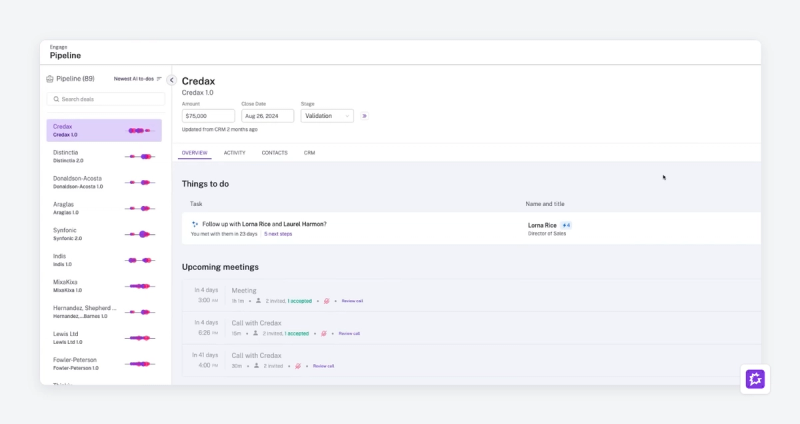
Gong records and transcribes sales calls, then builds deal boards, risk warnings, coaching and forecasting on top of them. Gong Engage adds sequences, and Gong Forecast is sold as a separate product. Gong's MCP server is generally available and read-only, without raw transcripts, so outside AI agents can query Gong data but cannot write back to it. Gong works in more than 70 languages.
Gong pricing
- Not public. Gong prices licenses per user plus a platform fee based on the number of users.
- Vendr reports a median contract of $55,359 per year across 593 purchases.
Gong pros and cons
- Pro: the broadest revenue platform in conversation intelligence: calls, deals, forecast and engagement.
- Pro: mature analytics and a large customer base to benchmark against.
- Con: the highest cost of entry in conversation intelligence, with a platform fee.
- Con: the MCP server is read-only for outside agents.
- Con: G2 reviewers mention navigation that is spread across many menus.
What G2 reviewers say about Gong
Gong is rated 4.7 out of 5 on G2 from 6,745 reviews (6 October 2026). No verbatim review captured for this version.
8. Claap, best for sales teams of 5 to 100 reps
Who Claap works best for
Sales teams of 5 to 100 reps on HubSpot or Salesforce that want every call captured and turned into CRM data and coaching, with a published price.
Claap overview
Claap is a conversation intelligence tool for sales teams. It records every sales call on Zoom, Google Meet, Microsoft Teams, phone (including Aircall) and in person, in more than 99 languages. After each call it fills HubSpot or Salesforce fields with what the buyer said, scores the call on the team's own criteria, and drafts the follow-up email. Managers coach from the scores, and the Claap MCP server opens the same call data to Claude and other AI agents on every plan.
Claap pricing
- Basic: free.
- Pro: $32 per licence per month on annual billing.
- Business: $60 per licence per month on annual billing. AI coaching is on Business.
- Enterprise: on quote. The Claap API is on Enterprise.
Claap pros and cons
- Pro: CRM fields filled from the call, which removes the note-taking after each discovery call.
- Pro: published prices and a free plan.
- Pro: call data open to AI agents through MCP on every plan.
- Con: Claap works after the call and does not prompt reps live during it.
- Con: no prospect database or email sequencing; pair it with a data or outbound tool.
- Con: AI coaching needs the Business plan and the API needs Enterprise.
What G2 reviewers say about Claap
Claap is rated 4.6 out of 5 on G2 from more than 480 reviews (read 5 to 7 October 2026).
- "I like how it summarizes the calls and highlights any key deal signals, helping with quick follow-ups." (Sales Manager, Enterprise, 6 August 2026)
- "This is especially helpful for salespeople because they can learn from real customer conversations instead of relying only on training documents." (Revenue Operations Analyst, Mid-Market, 9 August 2026)
- "While Claap is really good at recording and sharing sales conversations, I think it could do more to give sales leaders the information they need." (Sales Manager, Enterprise, 6 August 2026)
9. Clari Forecast (Salesloft), best for large orgs where the forecast is the main job
Who Clari Forecast works best for
Large B2B sales organizations where the CRO's main question is the number for the quarter, and where a RevOps team owns the forecast process.
Clari Forecast overview
Clari built its name on AI forecasting: it reads CRM activity, emails and calls to predict where each deal and the quarter will land. Clari merged with Salesloft in December 2025, and since September 2026 it is sold under the Salesloft brand, with Clari Forecast as the forecasting product next to Salesloft's cadences and conversation intelligence. In July 2026 the Salesloft MCP server was extended to Clari forecasting data, with write-back announced.
Clari Forecast pricing
- Not public. The old clari.com pricing page leads to a demo form.
- Vendr reports a median contract of $76,000 per year across 291 purchases.
Clari Forecast pros and cons
- Pro: forecasting is the core product, with years of roll-up and inspection features.
- Pro: one vendor for engagement, conversations and forecast after the merger.
- Con: the highest median contract in this list.
- Con: products are still separate apps behind one brand, with separate logins.
- Con: built for large teams with RevOps capacity.
What G2 reviewers say about Clari Forecast
Clari no longer has a standalone G2 product page; its listing redirects to a category page. Salesloft is rated 4.5 out of 5 on G2 from 9,901 reviews (7 October 2026). No verbatim review captured for this version.
AI sales tools compared by job
| Job in the sales cycle | Tools in this guide | What to check first |
|---|---|---|
| Find and enrich prospects | Apollo.io, Clay, Amplemarket, HubSpot Breeze Intelligence | Match rate on your own target list, and credit cost per verified contact |
| Write outreach | Lavender, Amplemarket, Apollo.io | Whether reps keep their own voice, and who reviews AI drafts |
| Understand calls and coach | Claap, Gong | CRM fields filled per call, scoring on your own method, MCP access |
| Forecast | Clari Forecast, Gong | Which signals feed the prediction, and the full contract price |
| AI inside the CRM | HubSpot Breeze, Salesforce Agentforce | Which edition includes agents, and how credits are billed |
Why more AI tools rarely fix a sales process
Claap records its own sales calls, so we hear how buyers talk about their AI stack before they choose a tool. Two patterns came up again and again between October 2025 and October 2026.
Teams already have several AI tools running at once. A founder who runs sales at a French fintech of about 15 people described the past year:
- "Depuis un an, entre les [note-takers], [...] tu as tellement de trucs qu'ils utilisent en même temps, tout le monde les utilise." (In the past year, between all the note-takers, there are so many tools people use at the same time, everyone uses them.)
- On the free note-taker he still used: "C'est vraiment transcript. Il n'y a rien d'intelligent d'IA dessus." (It's really just a transcript. There's nothing intelligent about the AI.)
The tool amplifies the process the team already has. A RevOps lead at a B2B tech company with 8 to 10 sellers, comparing three call tools, put it plainly:
- "We know that just getting a different tool is not going to necessarily solve the underlying issue."
- "What we want to avoid is just trying to solve for a process issue with a tool."
- On the AI already in his CRM: "the useful combination there is [...] both having the deal data that you can analyze on and the data from the interactions."
The lesson for a buyer: write down the process first (the qualification method, the fields that must be filled after a discovery call, the weekly deal review), then pick the one tool per job that feeds it. Our guide to AI sales training shows how managers turn call data into that weekly routine.
Method: semantic search of Claap's recorded sales calls with at least one external speaker, created from 1 October 2025. Only the buyer's own words are quoted, checked against the full transcript and anonymized to the role. Product names inside a quote are replaced with a description in brackets. French quotes are translated in parentheses.
How we built this comparison
- Selection. We kept one or two tools per job in the sales cycle, picked from the tools that appear most often in current "best AI sales tools" rankings and in our own sales calls.
- Facts. Prices come from vendor pricing pages when published and from Vendr's purchase data or named pricing guides when they are not, marked "est.". Ownership changes come from press releases and press coverage. Every fact was checked on 6 or 7 October 2026.
- G2. Ratings come from G2 product pages or from search snippets of those pages, with the review count and month. Verbatim review lines appear only where we captured the exact text and its permalink.
- Limits. Several vendor and G2 pages could not be opened directly from our research environment, so some prices and ratings come from search results and third-party guides. Prices change often; confirm them with the vendor before you sign.
- Conflict of interest. Claap publishes this article and is one of the tools reviewed. We placed it in its own category and gave it the same review block as every other tool.
Frequently asked questions
What are AI sales tools?
AI sales tools are software that use AI to do part of a seller's work: finding and enriching prospects, writing outreach, recording and analyzing calls, filling the CRM, coaching reps and forecasting deals. Most teams use one tool per job and connect them through the CRM.
Which AI sales tool should a small sales team buy first?
Start with the job that costs your reps the most time. For a team that books its own meetings, that is usually a data and outbound tool such as Apollo.io. For a team that already has meetings, a conversation intelligence tool that fills the CRM after each call usually saves the most time.
Are AI sales tools worth the cost?
They pay back when they remove a task reps do every day, such as writing call notes, updating CRM fields or researching accounts. Ask each vendor for usage data at a customer of your size and run a trial on your own calls or lists before signing.
What happened to Clearbit and ChatSpot?
HubSpot acquired Clearbit in December 2023 and renamed its enrichment and intent data Breeze Intelligence in September 2024. ChatSpot, HubSpot's earlier AI assistant, was folded into Breeze at the same time.
Is Chorus still sold on its own?
Chorus belongs to ZoomInfo since July 2021 and is sold as Chorus by ZoomInfo, usually as part of a ZoomInfo contract.
Can AI agents like Claude or Copilot use data from these tools?
Several now publish an MCP server that lets AI assistants read their data. Gong's is read-only, Salesloft's covers Clari forecasting data, and Claap's MCP server is available on every plan. Ask each vendor what an agent can read and whether it can write back.
Do AI sales tools replace sales reps?
The tools in this guide take over research, writing and admin work. Reps still run the discovery call, the negotiation and the relationship, and managers still run the coaching conversation.