


AI sales coaching in 2026: what it is, how sales teams run it, and 8 tools compared
What AI sales coaching is, how sales teams run it week to week, and 8 AI sales coaching tools compared on price, roleplay, call scoring and G2 ratings, with what buyers told us on real calls.


Prices, plans and G2 ratings checked on 6 and 7 October 2026.
Summary
- AI sales coaching uses AI to do the listening a sales manager cannot do alone. It transcribes calls, checks each one against the team's criteria, and points the manager to the rep, the skill and the moment to coach.
- AI sales coaching tools come in three kinds. Practice tools let reps rehearse with an AI buyer before a call. Readiness platforms run courses and certifications. Call coaching tools score real customer calls after they happen.
- Most teams need one kind first, not all three. Roleplay helps new reps who have not taken calls yet. Scoring real calls helps managers who cannot listen to every call their team makes.
- The 8 AI sales coaching tools sales teams compare most in 2026 are Gong, Hyperbound, Modjo, Claap, Second Nature, Mindtickle, Attention and Avoma. Gong and Mindtickle cover practice and real calls in one contract. Hyperbound, Second Nature and Mindtickle lead on roleplay. Modjo, Claap, Attention and Avoma score real calls.
- Few AI sales coaching vendors publish prices. Claap shows its coaching plan at $60 per seat per month and Avoma at $48 with its add-on, both on annual billing. Hyperbound has a free plan for prebuilt roleplays. Gong, Modjo, Second Nature, Mindtickle and Attention quote on request.
- Coaching is the most common reason sales teams buy a call recording tool from Claap. In 28.5% of Claap's Q2 and Q3 2026 deals where the buyer's use case was recorded, coaching and quality review came first, ahead of CRM auto-fill.
- Buyers judge AI scores on whether they can check them. On Claap's sales calls, managers asked for a score that links to the moment in the call, because a rep will dispute a score the manager cannot show.
Gartner surveyed 1,026 B2B sellers in early 2024 and found that sellers who effectively partner with AI tools are 3.7 times more likely to meet quota than those who do not (Gartner, September 2024). Coaching is where most sales teams start that partnership. This guide explains what AI sales coaching is, how sales teams run it week to week, and compares the 8 tools buyers shortlist most, with published prices, G2 ratings and what buyers told us about them on real calls. If you are choosing software for your team, our sales coaching software guide covers the buying criteria in more depth.
AI sales coaching tools at a glance
| Tool | Kind | Best for | Entry price (per seat/month) | Free plan or trial | G2 rating |
|---|---|---|---|---|---|
| Gong | Real calls + roleplay | Enterprise revenue teams that want call coaching and AI roleplay from one vendor, with the budget for it | Not public. Per user + platform fee | No | 4.7 (6,745) |
| Hyperbound | Roleplay + real calls | SDR teams that need to rehearse cold calls and objections before they dial | Paid plans on quote | Free plan (45 prebuilt roleplays) | 4.9 (40) |
| Modjo | Real calls | French and European mid-market teams that want a ready-made scoring model | Not public | Demo | 4.7 (92) |
| Claap | Real calls | Sales teams of 5 to 100 reps that want every real call scored on their own criteria, at a published price | $60 Business (annual) | Free plan, scoring on Business | 4.6 (480) |
| Second Nature | Roleplay | Large enablement teams rolling out roleplay certification through an LMS | Not public. Est. $30 to $40 | Demo | 4.6 (366) |
| Mindtickle | Readiness + roleplay + calls | Enterprises that run onboarding and certification as a formal program | Not public. Est. $30 to $50 | Demo | 4.7 (2,399) |
| Attention | Real calls | US teams that want scorecards to trigger CRM workflows | Not public | Demo | 4.6 (78) |
| Avoma | Real calls | Small teams that want notes, scheduling and scorecards on one budget | $19 + $29 coaching add-on (annual) | 14-day trial | 4.6 (1,365) |
"Est." means a third-party estimate, not a vendor price. G2 ratings read on g2.com on 6 and 7 October 2026.
What AI sales coaching is
Sales coaching is a manager giving a rep specific, regular feedback on how they sell. The bottleneck has always been listening: a manager with eight reps making five calls a day cannot hear 200 calls a week, so coaching runs on the few calls someone happened to join. AI sales coaching takes over the listening part. It transcribes every call, answers the team's coaching questions on each one, and surfaces the patterns a manager would only notice after weeks of shadowing.
The manager still runs the coaching conversation. What changes is the starting point: instead of "how did your week go?", the one-to-one opens on the criterion where the rep trails the team and the call that shows it.
The three kinds of AI sales coaching tools
- Practice (AI roleplay). The rep talks to an AI buyer that plays a persona and raises objections, then gets a score. Useful before the rep has real calls to learn from, or before a launch. Hyperbound and Second Nature started here.
- Readiness. Courses, quizzes, certifications and content, with AI roleplay as one module. The playbook is taught and checked, mostly outside customer calls. Mindtickle is the reference.
- Coaching on real calls. Every recorded customer call is scored on the team's criteria after it ends, and the manager coaches from what actually happened. Modjo, Claap, Attention and Avoma work this way. Gong does both this and practice.
A fourth category is often mixed in: real-time guidance, which shows the rep prompts or battlecards during the call. It is a different job from coaching, and the buyers we spoke to were cautious about it (see the FAQ).
How sales teams run AI sales coaching, week to week
On Claap's own sales calls this year, managers who already coach with AI described the same loop. It has five steps.
- Write the criteria you already coach on. A criterion is a question the AI answers on every call, with a format for the answer: "Did the rep confirm budget? 0 to 5", "Which next step was agreed?". Start from your method (MEDDIC, SPICED, BANT, your demo script) rather than a vendor's generic scorecard.
- Score every call, not a sample. A sales performance lead at a French legal-services company, whose reps take 10 to 20 calls a day, described the problem with sampling: "I have managers who don't have time to look at everything, who pick a few calls [...] I need something that digests all my calls and tells me 'look here'." (translated from French)
- Filter on the low scores, then open the call. The manager starts from the criterion where a rep or the team scores low and opens those calls, not the whole library.
- Coach on the moment, in a fixed slot. A sales leader who runs a one-hour weekly coaching session for nine reps told us what she wants from the tool: "Every week, I want to go to the problem calls and dig into them for my one-hour call coaching with the nine reps." (translated from French)
- Check the trend after you coach. The same criterion, tracked month by month, shows whether the habit changed. If it did not, the criterion or the coaching needs work.
The step teams most often get wrong is the first one. A sales leader at a French finance-software scale-up, whose team already scores calls with AI, was candid about it: "On scoring, since our prompts aren't sharp enough yet [...] the scoring isn't very relevant." (translated from French) Vague criteria give vague scores, whatever the tool.
What buyers told us about AI sales coaching
Claap records its own sales calls. We read the calls from October 2025 to October 2026 where a buyer talked about coaching, and the deal records from Q2 and Q3 2026.
- Coaching is the first reason to buy. In 28.5% of deals where the buyer's main use case was recorded, it was coaching and quality review, the largest single share, ahead of CRM auto-fill (24.4%). Coaching came up in the buyer's stated pain in 47% of the deals where a pain was recorded.
- A third of coaching-led buyers start from nothing. Where the buyer's current setup was known, 33% of coaching-led deals had no call coaching tool at all.
- Roleplay tools rarely compete with call coaching. No AI roleplay vendor appeared in the recorded shortlists of these deals. Modjo and Gong were the tools most often compared.
- Buyers want to check the score. The same sales leader explained why: "If something negative comes up, the rep will say: wait, I never said that. [...] You have to go back through the whole call to justify it." (translated from French) A score that links to the moment is a score the manager can use in a one-to-one.
Method and limits: Claap's pipeline leans toward European SMB and mid-market teams that are already evaluating Claap, so this is not a picture of the whole market. Percentages come from deals where the field was filled; the shortlist figures rest on a small sample. Quotes are checked against the full call transcript and attributed to the seat only.
How to choose an AI sales coaching tool
- Decide which job you are buying. Rehearsal before calls, a readiness program, or coaching on real calls. A roleplay tool will not tell you what happened on yesterday's demo, and a call scoring tool will not let a rep practise before their first call.
- Check you can write your own criteria. Your method, your wording, your answer format, and different criteria for discovery and closing calls.
- Test on calls you have heard. Run the criteria on five calls you know. If you disagree with the scores, your reps will too.
- Click a score. It should open the moment in the call that justifies it.
- Ask what it costs per seat, all in. Platform fees, add-ons and multi-year terms change the real price more than the list price.
- Ask whether your AI tools can read the scores. An MCP server or API lets Claude, ChatGPT or your own agents prepare one-to-ones from scored calls.
For the full buying checklist and how call scoring works, see AI call scoring and our guide to coaching from conversation intelligence.
The 8 best AI sales coaching tools in 2026
1. Gong
Best for: enterprise revenue teams that want call coaching and AI roleplay from one vendor, and have the budget for it.
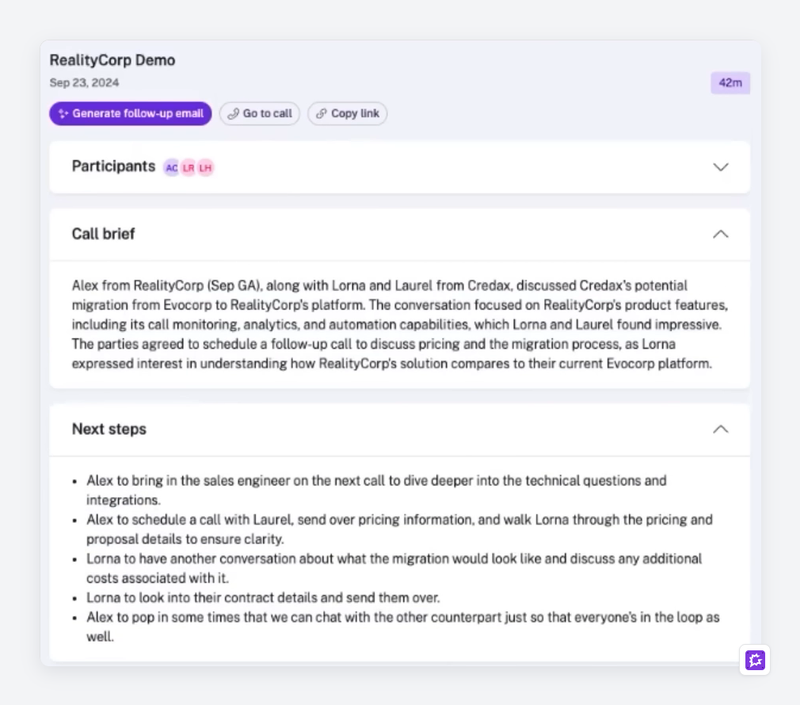
Overview: Gong is the best-known revenue intelligence platform and the most complete on coaching. It scores real calls with AI-assisted scorecards, and since its February 2026 launch (Mission Andromeda), Gong Enable gives reps "realistic practice with guided AI role-play" built from past customer conversations (gong.io).
Top features
- AI-assisted scorecards: Gong's AI reviews the call and suggests the scorecard answers.
- Gong Enable: skill gaps from real calls, targeted training and guided AI roleplay.
- Forecasting and deal boards in the same platform.
Pricing: not published. Licences are priced per user, plus "a platform fee based on the number of users supported" (gong.io/pricing). Vendr's data on 593 purchases puts the median contract at $55,359 per year.
Pros
- Covers practice and real-call coaching in one contract
- Very large G2 base: 4.7 from 6,745 reviews
Cons
- Expensive, with a platform fee on top of seats
- Its MCP server is read-only and does not return raw transcripts
G2: 4.7 (6,745). One reviewer: "It's a bit cumbersome to navigate and some features are weirdly fragmented across different menus." (G2)
Heard on our calls: a revenue leader at a European enterprise software company told us: "Gong has the all-in-one side, there isn't much to do from the start, which is nice, but it's very expensive. Really very expensive." (translated from French)
2. Hyperbound
Best for: SDR teams that need to rehearse cold calls and objections before they dial.
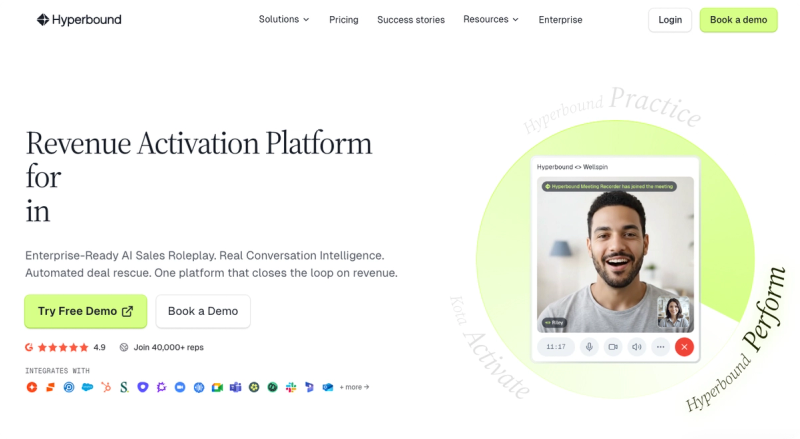
Overview: Hyperbound started as an AI roleplay tool: reps practise against AI buyers built from your personas and your top performers' calls. It now also scores real calls on its top plan, so it sits between practice and call coaching.
Top features
- AI roleplays with custom buyer bots and custom scorecards.
- Real call scoring, deal coaching and conversation intelligence on the Perform plan.
- A free plan with 45 prebuilt roleplays and example scorecards.
Pricing: free plan with prebuilt roleplays. Practice and Perform plans are priced per user on quote, with volume and multi-year discounts (hyperbound.ai/pricing).
Pros
- Reps can start practising for free
- Highest G2 rating in this list, on a smaller base
Cons
- Real-call scoring only on the top plan
- Paid prices not published
G2: 4.9 (40). One reviewer: "I find making bot calls feel more realistic could be improved." (G2)
3. Modjo
Best for: French and European mid-market teams that want a ready-made scoring model.
Overview: Modjo is a Paris-based conversation intelligence platform built for sales teams, hosted in the EU. Its AI call scoring analyses each conversation against your sales method and gives reps a self-assessment after the call, and it is included in the Modjo offer at no extra cost (modjo.ai).
Top features
- AI call scoring on your sales method, with a global score per call.
- Call library and coaching workflows for managers.
- Records without a bot joining the call.
Pricing: not published.
Pros
- Polished and quick to pick up, according to the buyers we spoke to
- Scoring included in the main offer
Cons
- Less room to build your own criteria structure, according to several of its users
- MCP server is read-only
G2: 4.7 (92). One reviewer: "For a smaller organization, the value naturally depends on having enough sales activity and users to make full use of the platform." (G2)
Heard on our calls: Modjo users describe a scoring loop that works, and its limits. A sales team lead at a French finance-software scale-up: "I have a score that goes into Modjo. I can look at the ones with a bad score and then go into them." A sales performance lead at a French legal-services company: "They tell you whether you covered the topic fully, partly or not at all [...] but it's based on something opaque, I don't know how it evaluates it." And a sales leader who chose between Modjo and Claap: "It's an established company and they have very good tools. [...] They have a better UX, with a global score that's quite good." (all translated from French)
4. Claap
Best for: sales teams of 5 to 100 reps that want every real call scored on their own criteria, at a published price.
Overview: Claap records every sales call and turns it into CRM fields, scores and follow-ups. For coaching, it scores every recorded call on criteria you write, shows each rep's average next to the team's, and links every score to the moment in the call. Claap coaches after the call: it has no AI roleplay and no live in-call prompts. Full detail on our sales coaching software page.
Top features
- Criteria you write as a question and an answer format, from MEDDIC, MEDDPICC, BANT or SPICED templates or your own method, tested on calls already in the workspace before rollout.
- Each rep's rating per criterion next to the team average, a monthly trend, and talk ratio, longest monologue and question rate.
- Claude, ChatGPT or your own agents can read the scored calls through the Claap MCP to prepare one-to-ones.
Pricing: call scoring and AI coaching are on Business, $60 per seat per month billed annually. Pro is $32 and Basic is free (10 recordings per user, Claap MCP included), so managers and viewers can stay on free licences.
Pros
- Published price and a free plan
- Scores every call on your own criteria, in 99+ languages
Cons
- No AI roleplay and no real-time prompts
- Custom criteria take setup work before scores are useful
G2: 4.6 (480). One reviewer: "The AI-generated summaries sometimes miss context or attribute speaking points to the wrong participant, especially when multiple people are talking quickly" (G2)
Heard on our calls: the sales leader who chose between Modjo and Claap put the setup cost plainly: "On one side, I feel there's something more built, more finished. On the other, there's still a fair amount of configuration to do." (translated from French)
5. Second Nature
Best for: large enablement teams rolling out roleplay certification through an LMS.
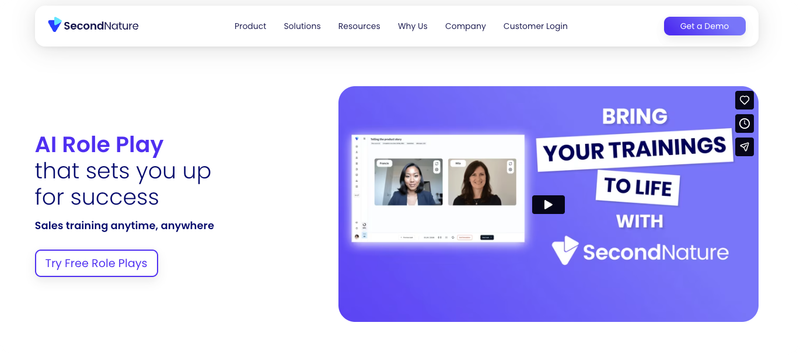
Overview: Second Nature is an AI roleplay platform: reps hold practice conversations with AI avatars on discovery calls, cold calls or objection handling, then get scored feedback. It describes itself as "AI role plays and coaching that turn training into go-to-market execution" (secondnature.ai).
Top features
- AI avatars for practice conversations, scored after each session.
- 30+ languages.
- Plugs into an LMS through SCORM or LTI, plus CRMs and conferencing tools.
Pricing: not published. Third-party reviews estimate $30 to $40 per seat per month with an annual minimum around $20,000 (outdoo.ai).
Pros
- Built for roleplay at scale across large teams
- LMS integration for certification programs
Cons
- Does not score real customer calls
- No public price or free plan
G2: 4.6 (366). G2's own review summary lists voice recognition, bugs and lag as the most common complaints (G2).
6. Mindtickle
Best for: enterprises that run onboarding and certification as a formal program.
Overview: Mindtickle calls itself a revenue enablement platform. It combines a readiness index, training and certification, an AI role play simulator, content management and a conversation intelligence module, so coaching is one part of a wider enablement program (mindtickle.com).
Top features
- Readiness index per rep, from training, certification and call data.
- AI role play simulator.
- Conversation intelligence module for real calls.
Pricing: not published. Third-party estimates put it at $30 to $50 per user per month, often on 36-month contracts with setup fees (JustCall).
Pros
- One platform for training, practice and call review
- Large G2 base: 4.7 from 2,399 reviews
Cons
- Built for enablement teams; heavy for a team without one
- Long contracts, no public price
G2: 4.7 (2,399) (G2).
7. Attention
Best for: US teams that want scorecards to trigger CRM workflows.
Overview: Attention records calls and automates what happens after them. Its coaching page says it can "score your reps with any criteria - whether that's existing frameworks (MEDDIC, BANT), your own sales playbook, or ad-hoc grading for product launches" (attention.com).
Top features
- AI scorecards on any framework or playbook.
- Workflows that push call data to the CRM.
- MCP access with read and write scopes.
Pricing: not published.
Pros
- Flexible scorecards, including one-off grading for launches
- Strong on automation after the call
Cons
- No roleplay on its coaching page
- No public price
G2: 4.6 (78). One reviewer: "Attention occasionally has trouble identifying the correct opportunity to associate a call with in Salesforce." (G2)
8. Avoma
Best for: small teams that want notes, scheduling and scorecards on one budget.
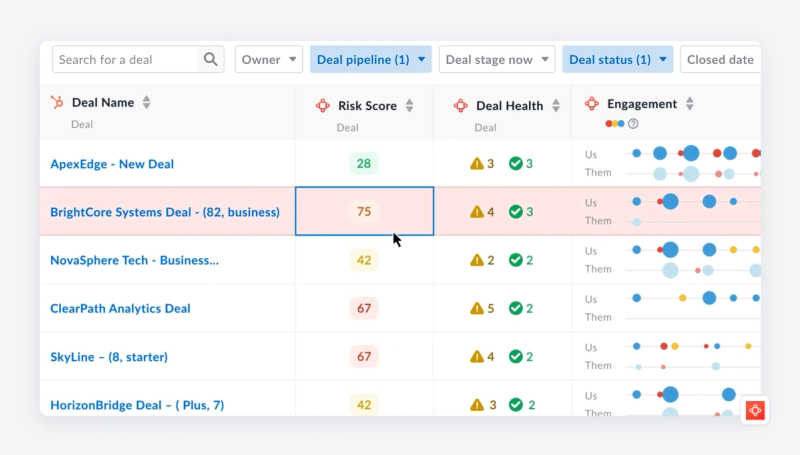
Overview: Avoma is a meeting assistant with a conversation intelligence add-on. The add-on brings "Auto Call Scoring with AI", "Custom AI Scorecards" (SPICED, Sandler, MEDDICC) and "AI Coaching Recommendations" (avoma.com/pricing).
Top features
- Auto call scoring and custom AI scorecards.
- AI coaching recommendations per rep.
- A real-time answer assistant during calls.
Pricing: Startup $19 per recorder seat per month billed annually, plus $29 for the conversation intelligence add-on ($35 monthly). 14-day trial with all add-ons.
Pros
- Published prices
- Notes, scheduling and coaching in one tool
Cons
- Coaching is a paid add-on on top of the seat
- Seat caps on lower plans
G2: 4.6 (1,365). One reviewer: "Pricing is a little steep for smaller agencies." (G2)
AI sales coaching tools compared
| Gong | Hyperbound | Modjo | Claap | Second Nature | Mindtickle | Attention | Avoma | |
|---|---|---|---|---|---|---|---|---|
| Scores real customer calls | Yes | Perform plan | Yes | Yes | No | CI module | Yes | Add-on |
| AI roleplay for practice | Yes (Gong Enable) | Yes | Not stated | No | Yes | Yes | Not stated | Not stated |
| Your own criteria | Yes | Yes | Yes | Yes | Yes | Yes | Yes | Yes |
| Public price | No | Free plan only | No | Yes | No | No | No | Yes |
| Free plan | No | Yes | No | Yes | No | No | No | Trial |
| MCP server | Read-only | Not stated | Read-only | Read and write | Not stated | Not stated | Read and write | Yes |
"Not stated" means we could not confirm it on the vendor's public pages on 6 or 7 October 2026. We will update the table when vendors document it.
How we built this comparison
- Vendor facts (pricing, plans, roleplay, scoring, MCP) come from each vendor's own website, read on 6 and 7 October 2026. Where a vendor does not publish prices, we cite third-party estimates and label them.
- G2 ratings were read on g2.com on 6 and 7 October 2026. Review lines are quoted as written, with a link to the review page.
- What buyers said comes from Claap's own recorded sales calls (October 2025 to October 2026) and deal records (Q2 and Q3 2026). Quotes are checked against the full transcript, anonymised to the seat and translated from French where marked.
- Conflict of interest: Claap is our product. We placed it fourth, listed its cons, and kept tools that do things Claap does not, such as AI roleplay.
Related reading: sales coaching software, free sales coaching software, Claap vs Modjo, Claap vs Gong.
Frequently asked questions
What is AI sales coaching?
AI sales coaching uses AI to analyse sales conversations and tell a manager what each rep should work on. It transcribes calls, scores them against the team's criteria and surfaces patterns across all calls, so coaching is based on every call rather than the few a manager heard. Some tools also let reps practise with an AI buyer.
How does AI sales coaching work?
The team writes its coaching criteria, such as "did the rep confirm the budget?". The AI answers them on every recorded call, from the transcript. The manager filters on low scores, opens the moment in the call behind the score, and uses it in the next one-to-one. Tracking the same criterion month by month shows whether the coaching worked.
Can AI replace a sales manager for coaching?
No. AI does the listening and the scoring; the manager still decides what matters, has the conversation and follows up. Teams that get value from AI coaching keep a fixed coaching slot and use the scores to choose what to talk about in it.
What is the difference between AI roleplay and AI call coaching?
AI roleplay is practice: the rep talks to an AI buyer before a real call and gets scored. AI call coaching works on real customer calls after they happen. Roleplay suits new reps and launches; call coaching suits managers who cannot listen to every call. Gong and Mindtickle do both; Claap, Modjo, Attention and Avoma focus on real calls.
How much does AI sales coaching software cost?
Most vendors do not publish prices. Among those that do, Claap's coaching plan is $60 per seat per month and Avoma's is $19 plus a $29 add-on, both billed annually. Hyperbound has a free plan for prebuilt roleplays. Third-party estimates put Second Nature at $30 to $40 and Mindtickle at $30 to $50 per seat per month, and Vendr reports a median Gong contract of $55,359 a year.
Is there free AI sales coaching software?
Hyperbound offers a free plan with 45 prebuilt roleplays. Claap's free Basic plan records real calls (10 per user) with an AI summary and the Claap MCP, while call scoring starts on Business. Avoma offers a 14-day trial. For more options, see our list of free sales coaching software.
Does AI sales coaching work in real time, during the call?
Some tools show prompts or answers during the call, such as Avoma's real-time answer assistant. Buyers we spoke to were cautious: a sales performance lead told us "it's very hard to take in information live, while you're on the phone". Most coaching value comes after the call, from scored calls and a one-to-one. Claap does not offer live prompts.
Can AI sales coaching be used with our own sales methodology?
Yes, in most of these tools. In Claap you write each criterion as a question with an answer format; MEDDIC, MEDDPICC, BANT and SPICED come as editable templates, and SPIN, Challenger or an in-house method are written the same way. Test new criteria on calls you have already heard before rolling them out.