Hi there! I'm Greg - Sales Manager at lemlist, running a team of 6 AEs and 1 Inside Sales. I've been at lemlist for over two and a half years, first as a rep, now building the system that gets new reps to revenue faster. And here's the situation I was in six months ago.
Two new reps to onboard. No real playbook. Building everything from scratch. AEs expected to bring €500 of new MRR in month one - ramping to €4,500–5,000 by month four, with an average deal size of €600. And in the background, four other reps with open deals who still needed my attention.
Every hour I spent explaining the same thing to a new rep was an hour I wasn't available to the reps already in the field.
I had a Notion. It had everything in it - personas, ICP documentation, discovery frameworks, battlecards. And I realized at some point that I wouldn't want to use it either if I was the new joiner. Docs everywhere. No clear path through it. More Chucky than playbook.
So I asked myself the only question that mattered: how do I build a system that onboards a new rep without making me the bottleneck?
This is what I built.
The real problem: managers confuse transmission with coaching
Most sales onboarding treats both as the same job. The manager explains. The rep listens. The manager answers questions. The rep comes back with the same questions three weeks later. The manager answers again.
That's not coaching. That's transmission on repeat.
Transmission is the act of giving someone knowledge they don't have yet. Coaching is the act of developing judgment they can't learn from a document. These are different skills, different time investments, and different outcomes.
The mistake I was making: I was doing both, badly. Spending hours explaining things that a well-built recording could explain better - and having less time left for the roleplay, the live feedback, the real coaching that only a human can do.
The rebuild was simple in concept: take transmission out of my hands and put it in the system. Free up my time for coaching.
Everything else follows from that.
What the system looks like
I moved the onboarding environment from Notion to a workspace built on Lovable.
The content came from three sources: existing Notion documentation, slides from Pitch, and call recordings from Claap - the AI revenue intelligence platform we chose over Gong a year ago. If you're not familiar with Claap: it records, transcribes, and structures every sales conversation, making it searchable and reusable. More on why that matters later.
The result looks like an intranet for the rep.
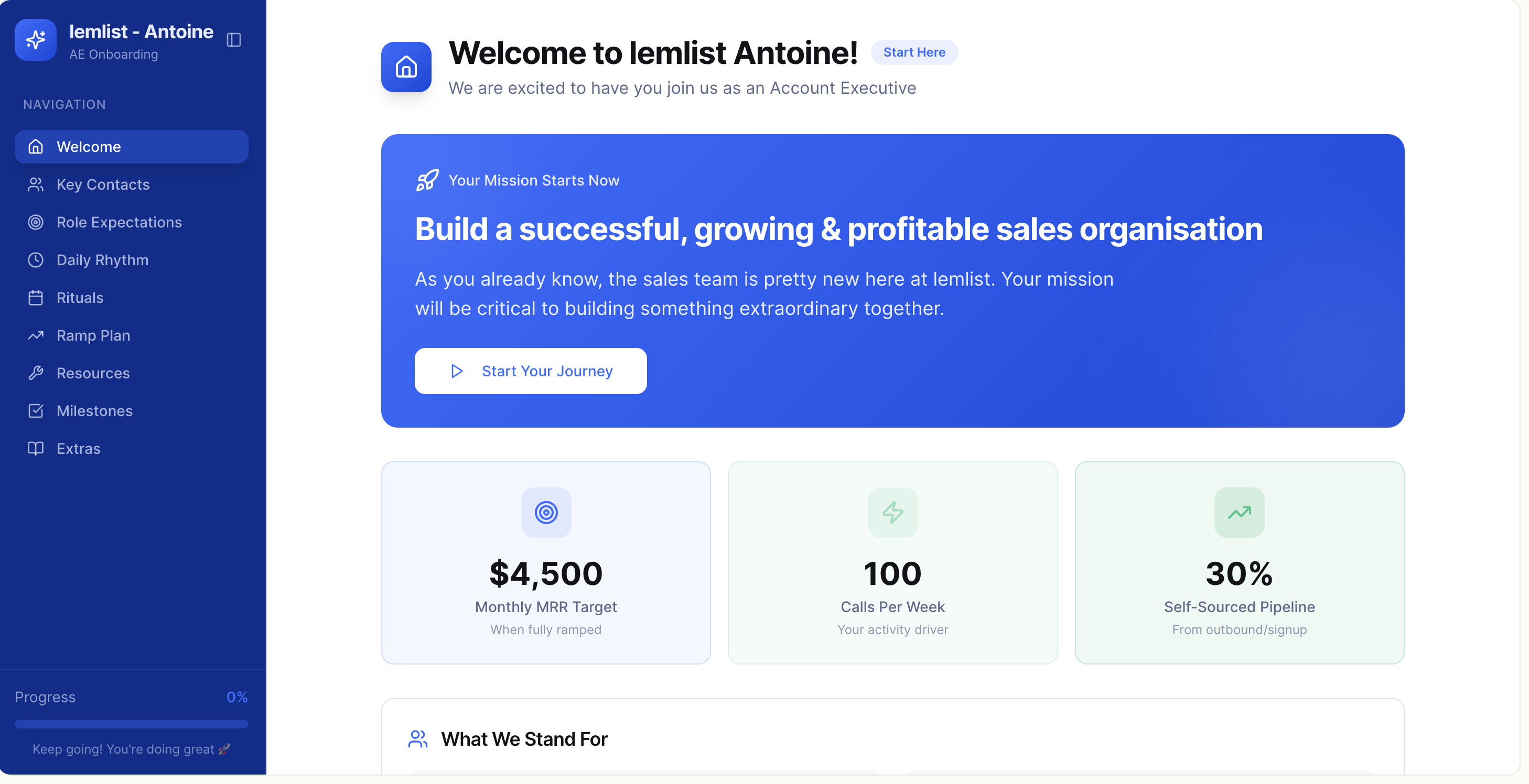
Not a to-do list. A structured environment with clear sections: ramp targets and expectations, team rituals, key contacts across the company, and a week-by-week plan for months one and two.
Each major topic has its own training module - ICPs and personas, our discovery framework (we use SPICED), sales process, product roadmap, battlecards, competitive positioning. Every module follows the same three-step format:
1. Watch the recording. The rep watches a recorded training session on their own schedule - 40 minutes on average.
2. Read the cheat sheet. A cheat sheet synthesizes the key points from the recording. The anti-sèche version of the content. Quick to read, built to be referenced again later, not just consumed once.
3. Book 30 minutes with me. The rep puts time in my calendar. They come with their questions and a summary of what they understood. I ask questions to gauge comprehension. The goal isn't perfection - it's confirming they're on the right track and filling the real gaps.
One rule: the rep owns the scheduling. My calendar is open. When they're ready, they book it. This single shift - ownership on their side - changed the dynamic completely. They come more prepared. The sessions are sharper. I spend less time repeating myself.
Alongside the training modules, every rep gets access to a curated call library. Not every call. Specifically selected Claap recordings - deals closed, strong discovery calls, competitive conversations, objection handling in live situations. The kind of calls where you can hear what good actually sounds like, not just read about it.
The ramp plan: what happens week by week
The system only works if the rep knows exactly what they're supposed to be doing and when. Here's the week-by-week structure we use.
Week one - environment and market
The objective is simple: by end of week one, every tool is set up and working, and the rep understands the market before they touch the product. In practice, setup is usually done by day three. The rest of the week is spent on the training modules for ICPs and personas, and the first rounds of shadowing live calls.
The most counterintuitive instruction I give: don't go into the product yet. Week one is about understanding the problems we solve, not the features. What does a sales team actually struggle with? What does a RevOps care about at a 50-person company versus a 200-person company? What are the real pain points behind each persona? Pain first, product second. If a rep understands the problem deeply, the product makes sense. If they go to the product first, they learn features without context.
Week one also has a people objective: meet the key contacts across the company. Not just the sales team - ops, growth, product managers, marketing. For each person they meet, I ask them to identify one thing that person is exceptionally good at and leave with one actionable piece of advice for their onboarding. For top performers on the team specifically, I ask them to observe closely and extract what makes them different - not just shadow, but analyze.
At lemlist, most of us work remotely. Knowing who knows what - and being able to go directly to the right person without routing everything through me - is a functional skill that pays dividends for months. Building those connections in week one means the rep isn't isolated when they hit their first real blocker.
Week two - product and first roleplay
Week two is where the product training happens - features, use cases, how each persona uses the platform. And immediately alongside it: the first rounds of roleplay.
Discovery roleplay in the morning. Same afternoon: "build me a demo based on the discovery we just ran - you have a few hours." They prepare. The stakes feel real. The feedback lands differently than it does in a theoretical discussion.
The logic of compressing product training and roleplay into the same week is deliberate. They need to understand the product well enough to demo it - but the best way to surface gaps in their product knowledge is to put them in a situation where those gaps hurt. Roleplay accelerates both.
Weeks three and four - deals and live qualification
By week three, reps are sitting in on live deals and starting to handle early-stage qualification calls independently. They're still heavily shadowing, but they're also beginning to operate. I stay close - not by being in every call, but by debriefing every call they handle and running targeted roleplay on whatever surfaced.
The async roleplay format becomes more active here. I send a voice message on Slack playing the role of a prospect - one objection, one situation. The rep has 24 hours to respond. I listen, give feedback, move to the next scenario. Right now I'm doing this every two days with Romain, our intern, specifically on competitive objections. The format scales in ways live roleplay doesn't - and it means coaching happens continuously, not just in scheduled sessions.
Month two - ramp to target
By month two, the rep is running their own pipeline with support. The training modules are reference material now - not content to consume for the first time, but resources to come back to when a specific situation surfaces. The call library gets used the same way: a rep preparing for a deal with a specific persona goes back to the relevant calls before the meeting.
The check-ins with me shift from comprehension-validation to deal coaching. We're not talking about SPICED theory anymore - we're talking about a specific deal, a specific stakeholder, a specific objection that came up yesterday.
Where Claap fits
This is the thing I didn't fully understand until I was in the middle of the rebuild.
I had already run training sessions. The knowledge existed. It had been spoken out loud, explained with examples, answered with real questions from real reps. But it lived in my head, in rough slide decks, in call recordings nobody was going back to watch.
The work wasn't creating new content. It was making what already existed accessible and structured enough that a rep would actually use it.
Here's the concrete workflow:
Step 1 - Record and transcribe with Claap. Every training session, team meeting, and relevant call is recorded on Claap. The transcript is generated automatically and is immediately searchable.
Step 2 - Build the module content from the transcript. I paste the Claap transcript into Claude along with any existing resources - Notion docs, Pitch slides. Using a structured prompt, Claude synthesizes the material into a training module: the key concepts, the cheat sheet, the examples to include. I review, adjust, and add nuance where needed. What used to take a full day of writing takes a couple of hours.
Step 3 - Push to the Lovable workspace. The finalized content goes into the Lovable workspace - updated directly so the rep always sees the current version. No version control nightmare. No outdated PDFs floating around.
When content needs updating - like when we got the Q2 product roadmap last week - the process is fast. The meeting was recorded on Claap. The transcript exists. I feed it into Claude, update the module, push to Lovable. Done in 20 minutes.
The call library works the same way. I go through recordings, select the ones worth learning from, add them to the library. The rep watches on their own schedule. I don't have to be in the room for them to learn from a great call.
Where I actually spend my time now
The training system handles transmission. That frees me for the work that actually develops judgment: roleplay and deal coaching.
The async roleplay format has become one of the highest-leverage things I do. A voice message on Slack takes me two minutes to record. It gives the rep a realistic scenario, time to think, and a format that forces them to articulate their response - not just nod along in a live session. The feedback loop is tight: they respond, I listen, I give one or two specific points, we move to the next scenario.
I'm starting to systematize this across the team based on individual development areas. Not the same scenario for everyone - targeted scenarios for each rep's specific gap. A rep who's weak on competitive objections gets competitive scenarios. A rep who struggles with multi-stakeholder navigation gets scenarios where the champion is pushing but the economic buyer is resistant.
For product questions that don't require coaching, we have Proddy - a Slack channel where reps ask anything and get an AI-generated answer based on our Notion documentation and internal Slack history. 99% of standard product questions are answered there. I'm almost never pulled into product questions unless it's a genuine edge case or workaround.

The principle behind all of this: my availability is a limited resource. A rep who routes every question through me isn't being supported - they're developing a dependency that will hurt them when the pipeline gets busy and I'm not available. The goal is autonomous reps who know where to find answers and come to me for the situations where human judgment actually makes a difference.
What changed
Before the rebuild, onboarding a new rep meant three to four weeks of heavy personal involvement. Workshops, repeated explanations, availability that came at the expense of everyone else on the team. Reps already in the field felt it. I felt it.
Now a new rep goes through the async training modules on their own schedule. The 30-minute check-ins are focused because they come prepared. The call library gives them access to real examples without me curating anything manually each time. The roleplay sessions - live and async - are where I invest my actual coaching time.
The signal that told me it was working: fully ramped reps asking for access to the onboarding resources. Not because they needed to redo the onboarding - because the quality was good enough that they wanted to reference it.
That's the bar. Not "does it get reps through the first month." But "do they want to come back to it?"
If the answer is yes, you've built something worth building.
Conclusion
Most managers I talk to know their onboarding is broken. They just don't have the bandwidth to fix it - because fixing it requires time they're spending on onboarding.
That's the trap. The system that's causing the problem is the same system eating the time you'd need to solve it.
The way out isn't working harder on onboarding. It's building something that works without you. Not a Notion that has everything in it. A system a rep actually wants to open, moves through on their own, and comes back to when they're ramped.
Claap didn't create the knowledge we had at lemlist. It made it usable. That's the distinction that matters. The calls existed. The training sessions existed. The expertise was already there. What was missing was the infrastructure to turn it into something a new rep could consume without me in the room.
Build the infrastructure. Get out of the transmission business. Spend your time on the coaching that only you can do.
That's the whole thing for me.
FAQ
How long does it take to build a system like this? The initial build was significant - but most of the content already existed in some form. The work was aggregation and structure, not creation from scratch. Claap transcripts from past training sessions became the raw material for the modules. Lucile designed the template and the structure; I provided the substance. Once built, maintenance is much lighter: updating a module when the product roadmap changes takes 20 minutes, not a full day of rewriting.
Does async onboarding work for less experienced reps? Yes - and in some ways it works better. Our intern Romain came in with limited commercial experience. The async format means he can move at his own pace on training content - rewatching sections, pausing to take notes - without the pressure of a live session where he might not fully absorb what's being explained. The roleplay layer, especially the async voice challenges, gives him targeted feedback on the skills that actually need live practice. A manager trying to do everything in person with an inexperienced rep will run out of bandwidth fast. The system gives the rep more contact time with quality content than any manager could provide one-on-one.
What if a rep skips the async content and just comes to you directly? It's happened. My response: go watch the module, then book the 30 minutes. The quality of our check-in sessions is directly proportional to the prep work the rep did beforehand. When they come prepared, we spend the 30 minutes on the things that genuinely need discussion. When they haven't done the work, we spend it on things the recording would have covered better. I send them back. It's not a punitive response - it's protecting the quality of the time we do spend together.
How do you measure whether a rep is actually absorbing the content? The 30-minute check-ins are the diagnostic. I don't give answers - I ask questions and listen to how they explain things back to me. The quality of their questions tells me as much as the quality of their answers. A rep who asks "what is SPICED?" hasn't absorbed it. A rep who asks "how do you handle the Impact step when the champion can't quantify the business cost?" is thinking correctly. I also use the async roleplay scenarios as a diagnostic - not just coaching. How a rep handles a competitive objection in week three tells me exactly what gaps to address in week four.
How do you keep the content current as the product and market evolve? Any meeting that changes something relevant - product roadmap, competitive landscape, pricing, ICP shifts - gets recorded on Claap. The transcript exists. Updating a module means adding the new recording, refreshing the cheat sheet, and updating the link. For bigger changes, I rebuild the relevant section from the new transcript. The system is only as good as the content inside it - so keeping it current is a non-negotiable part of the operating rhythm, not an afterthought.
Can you build this without Claap? You can build something. But the training content built from transcripts and the call library are significantly harder to produce without structured conversation data. The recordings exist without Claap. The transcripts exist. What Claap adds is making that content searchable, reusable, and buildable-from - rather than leaving it as video files nobody goes back to watch and knowledge that lives only in the manager's head.
What's the biggest mistake managers make when building an onboarding program? Building it around themselves. The program that requires the manager to be present to work is the program that breaks the moment the manager gets busy, takes a deal, or onboards two reps at the same time. The goal isn't to remove the manager from onboarding - it's to remove the manager as the single point of failure. The check-ins, the roleplay, the deal coaching - these are where a manager adds irreplaceable value. The transmission layer should run without them.