

AI pipeline management: audit deals and spot risk early
A pipeline review that walks through every deal is too slow to catch a slip. AI can audit each open deal every morning, check it against what the buyer said on its calls and surface only the ones drifting. Here is the method, step by step.


Updated October 28, 2026.
AI pipeline management overview
- AI pipeline management means letting a tool connected to your CRM and your calls go through every open deal, so the manager only sees the deals that need action.
- An AI pipeline audit isolates deals with no movement in a month, deals that should have moved yesterday and deals past their close date.
- An at-risk deal shows up in what the buyer said: no decision-maker involved, no next step, a date that keeps moving, a competitor gaining ground.
- A more reliable sales forecast starts with deals filled in from calls, before any forecasting model.
Let AI audit every open deal each morning against what the buyer said on its calls, and spend the pipeline meeting only on the deals it flags.
In the 2024 Sales Forecasting Benchmark Report by Xactly, a forecasting software vendor, 4 in 5 sales and finance leaders said they had missed a quarterly sales forecast in the past year, and over half had missed it two or more times (survey of sales and finance professionals in North America, March 2024).
On our own sales calls, when a buyer describes how their team judges open deals, the answer usually comes down to what the rep says.
This guide shows how to connect AI to your CRM and your calls, audit the pipeline in five steps and catch at-risk deals before the forecast meeting.
Why the rep's word is no longer enough to judge a deal
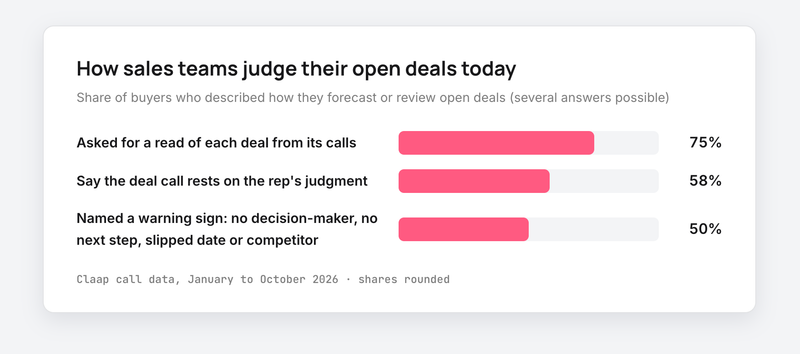
Among buyers who described how they forecast or review open deals on calls with Claap's sales team, 58% said the call on a deal rests on the rep's judgment: a commit, a confidence percentage or criteria the rep fills in (Claap call data, January to October 2026).
In the same group, 75% asked for a read of each deal from what was said on its calls, and 50% named a warning sign on their own deals (Claap call data, January to October 2026).
Two buyers put it this way:
- "I'd also love to get better sentiment and actual interpretation of how a deal is going versus just from the AE's mouth." A sales leader at an education technology company selling across Asia.
- "I would rather kill the number of opportunities we have and show a more accurate close rate than... be falsely optimistic." The same sales leader.
- "This morning, me and [a colleague] were reviewing our pipeline and we realized that really few meetings have a clear like next step." A sales operations lead at a messaging software company.
The rep sees the deal through their hope of closing it, and the CRM holds what they typed after the meeting. AI adds a second read, taken from what the buyer said, that the manager can hold up against the first.
AI pipeline audit: the method in 5 steps
Step 1: connect AI to your CRM and your calls
A useful audit crosses two sources: CRM fields (stage, amount, close date, last activity) and what was said on the deal's calls and emails. The CRM alone tells you where the rep put the deal. The calls tell you where the buyer is.
Pick a tool that attaches each call to the right deal in HubSpot or Salesforce. Without that link, the AI reads orphan conversations and can say nothing about the deal.
Step 2: isolate deals that have not moved in 30 days
Start the audit with silent deals: no activity, no call, no email for a month. It is the simplest way to audit a sales pipeline.
With an AI assistant connected to the CRM, the question takes one sentence: "list open deals with no activity in 30 days, sorted by amount." Claap's MCP lets Claude query the pipeline by stage, amount and dates, then sort by last interaction or deal age.
Step 3: find deals that should have moved yesterday
The second filter targets deals that had a meeting planned yesterday, a proposal due or a close date reached, and where nothing changed in the CRM. Run this filter every morning, because these deals can still be rescued the same day.
Step 4: read each deal's real health in what the buyer said
The signal sits in the conversations: the decision-maker never showed up, the buyer mentioned another tool, the budget has no owner.
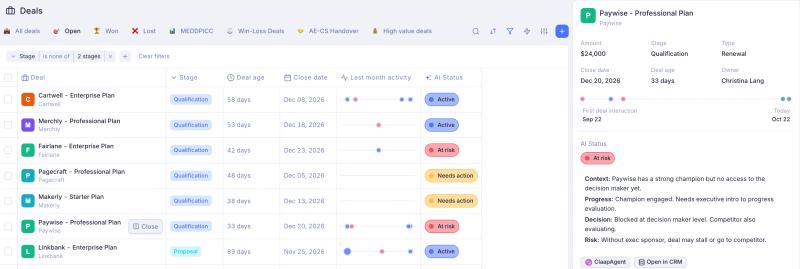
In Claap, each deal gets an AI status and an AI deal summary in four parts (context, progress, decision, risk), written from CRM properties, transcripts, recordings and emails, according to Claap's help center. When information is missing, the summary says so.
Step 5: prioritize today's actions
The audit ends with a short list: the deals to work today, each with its reason and its action.
Claap offers saved views such as "At-risk opportunities" or "Inactive deals", as a table or a Kanban board by stage or AI status, according to Claap's help center. The pipeline management page shows how those views feed the review.
Our recommendation: keep the weekly pipeline review, and use it only for the deals the audit flagged, because those are the deals where the discussion changes something. The review itself is laid out in our guide to sales pipeline management.
Which AI tool spots at-risk deals in my pipeline?
A good at-risk deal tool answers three questions about each deal, with the evidence attached.
- Is the deal moving? Last activity, upcoming meeting, close date held or pushed.
- Are the right people involved? A named decision-maker, a champion with access to them.
- What does the buyer say? Budget, timeline, competitor, open objection.
Only the third needs a tool that reads the deal's calls and emails.
Choose a tool that shows the buyer's sentence behind each alert, because a manager will not push a rep on a score they cannot explain. In Claap, a deal AI field can quote the buyer's words for each answer, and a field that found nothing shows a dash.
How to make your sales forecast more reliable
A forecast gets more reliable one deal at a time, as our guide to AI in sales forecasting shows. If the deals in it carry optimistic stages and dates nobody revisited, no model will fix the total.
Which tool makes a sales forecast more reliable?
Three building blocks make a forecast more reliable, in this order:
- AI deal scoring. It makes the close probability objective, based on criteria the buyer confirmed: decision-maker, budget, timeline.
- Automation that fills the missing data. The fields reps leave empty are filled from calls and emails, then written to the CRM.
- A forecasting tool inside the CRM. Moving from a spreadsheet to the Salesforce or HubSpot forecast view, or to a dedicated platform, gives the team one shared number.
Claap covers the first two blocks. It does not compute the forecast itself: no roll-up, commit or weighted pipeline. It writes each deal's risk, next step and decision process into HubSpot or Salesforce, where your forecast is built, as the AI sales forecasting page describes.
For reporting, Claap has an activity and interactions report, filterable deal views and, depending on workspace configuration, a CSV export of deals for reporting and forecasting, according to Claap's help center. Revenue and quota charts stay in your CRM or BI tool.
AI tools for sales pipeline management, by category
The tools fall into four families.
- The CRM and its built-in AI. Salesforce and HubSpot have their own pipeline views, deal scores and forecasts. It is the starting point, and often enough for activity signals.
- Revenue intelligence and forecasting platforms. Clari (now part of Salesloft) or Gong add a forecasting and deal inspection layer on top of the CRM.
- Conversation intelligence tools. They read each deal's calls and emails and pull out the risk, the qualification criteria and the next step. Claap belongs here.
- AI assistants connected through MCP. Claude or ChatGPT query the CRM and call data in plain language, for an audit on demand or on a schedule.
A quick note: Claap is our product. To keep this fair, we linked every claim about Claap to its product page or help center.
Claap suits teams that already have a CRM and a forecast and lack what was said on each deal. The Deals view, with AI summaries and AI status, is included with Business licenses, at $60 per seat per month billed yearly according to Claap's pricing page.
This method is wrong if your deals close in a single call: with a cycle that short, a daily audit costs more than it returns, and CRM activity tracking is enough.
Takeaways
- If your reps set commit and probability themselves, start with an AI field that quotes the buyer on the decision-maker and the next step.
- If your weekly review runs past an hour, limit it to the deals the audit flags, starting next week.
Frequently asked questions
What is the best AI tool to manage pipeline opportunities?
It depends on what is missing. If the CRM is well filled in, its built-in AI and forecast view are often enough. If deals carry empty or optimistic fields, you need a tool that reads each deal's calls and emails and writes the risk into the CRM, which is what Claap does.
How does AI spot an at-risk deal?
It crosses the deal's CRM activity (last contact, close date) with what the buyer said on calls: no decision-maker, budget without an owner, a competitor mentioned, a vague next step. In Claap, each deal's AI summary names the main risk and the AI status flags it in the Deals view.
Will CRM be replaced by AI?
No. The CRM stays the system of record for deals and the forecast. AI fills its fields from conversations and queries it for you, which makes the CRM more reliable and faster to use.
Does Claap calculate the sales forecast?
No. Claap does not compute a roll-up, a commit or a weighted pipeline. It reads each deal from its calls and emails, flags risks and writes that information into HubSpot or Salesforce, where your forecast is built.
How often should you audit your pipeline with AI?
Daily for silent deals and deals that should have moved yesterday, weekly for the team review. The daily audit takes a few minutes when it covers flagged deals only.