

Leexi alternatives in 2026: 6 tools for CRM and coaching
Leexi is a solid note-taker. Teams replace it when every call has to fill the CRM and feed coaching. 6 alternatives, what they cost and what buyers say.


Updated October 28, 2026.
Leexi alternatives at a glance: the short answer
- Avoma is best for sales teams that want notes, scheduling and call scoring in one tool, with add-ons for CRM and coaching.
- Claap is best for teams of 5 to 100 reps that want every call to fill typed CRM fields and feed coaching and deal-level analysis.
- Fathom is best for small teams that want reliable summaries and a simple CRM sync, with a free plan to start.
- Fireflies is best for companies that record every meeting, sales or not, and want an all-purpose note-taker.
- Noota is best for European teams that want to stay on a note-taker hosted in Europe, with CRM field filling on its Business plan.
- tl;dv is best for teams that coach on a playbook (BANT, SPICED, MEDDPICC) and track objections meeting by meeting.
Leexi is a solid AI note-taker, and the teams we talk to replace it once each call has to fill typed CRM fields and feed deal-level analysis: pick your Leexi alternative by what must happen after the call.
By 2028, AI agents will outnumber sellers 10 to 1, yet fewer than 40% of sellers will say those agents made them more productive, according to Gartner.
For an agent, a CRM field filled from the call teaches it far more than a summary sitting in an inbox.
That is what we hear on our own sales calls when a prospect brings up Leexi. So we read those conversations back, then compared six alternatives on what matters after the call: CRM fields, scoring, deal-level analysis and the real price.
What are the best Leexi alternatives?
The main Leexi alternatives in 2026 are Avoma, Claap, Fathom, Fireflies, Noota and tl;dv, listed here in alphabetical order. Each price is the cheapest setup that fills CRM fields and scores calls, as shown on each vendor's pricing page on October 22, 2026 (billed annually, before tax). Prices stay in the currency each vendor publishes.
| Tool | Best for | Price to do the job |
|---|---|---|
| Leexi (baseline) | Multilingual note-taker for European teams | €55 per license per month: Business €39 + Leexi Coach add-on €16 |
| Avoma | Notes, scheduling and scoring in one tool | $82 per seat per month: Organization $24 + Conversation Intelligence $29 + Revenue Intelligence $29 |
| Claap | Typed CRM fields, coaching and deal-level analysis | $60 per license per month (Business) |
| Fathom | Reliable summaries and simple CRM sync for small teams | $50 per month minimum: Business $25 × 2-user minimum |
| Fireflies | All-purpose note-taker for the whole company | $19 per seat per month (Business) |
| Noota | Note-taker hosted in Europe | €39 per user per month (Business) |
| tl;dv | Playbook coaching, meeting by meeting | €29 per seat per month (Business) |
Sources: the pricing pages of Leexi, Avoma, Claap, Fathom, Fireflies, Noota and tl;dv, linked in each tool's section, read on October 22, 2026.
Where Leexi falls short, according to buyers
We read back the Claap sales calls where a prospect talked about Leexi, and kept the ones where the buyer said in their own words what Leexi was missing.
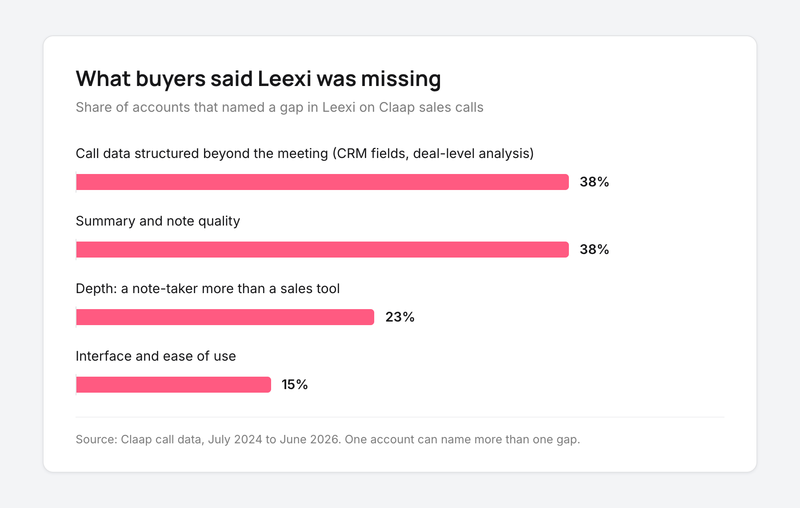
- In Claap call data from July 2024 to June 2026, 38% of the accounts that named a Leexi gap wanted call data structured beyond the meeting: typed CRM fields, a view per deal, analysis across several calls.
- In the same Claap call data, 38% of those accounts named summary and note quality.
- Also in Claap call data, 23% saw Leexi as a note-taker more than a sales tool, and 15% named the interface. One account can name more than one gap.
A well-written summary is still text you reread call by call. The competitor field on the deal, the MEDDPICC score and a comparison from one call to the next all need structured values.
What buyers said, in their own words (translated from French):
- "Leexi, but not really connected. Well, it's fine, it gives you reports, etc. [...] There is so much data you could use beyond that." Head of business development at a B2B software company, June 2026.
- "I'm going to have a mix of fields that are select, a mix of fields that are multi-select. That's harder, and on [Leexi] in particular, it doesn't work." Founder of a SaaS startup who sells himself, May 2025.
- "[Leexi] could do better on user experience. I find the notes in Claap also come through a lot better." Sales lead at an agritech company, January 2025.
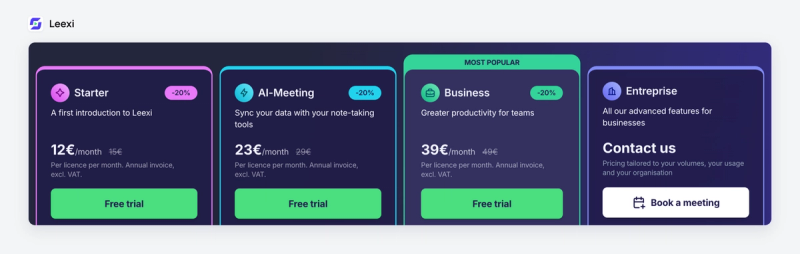
Leexi has since widened its offer. Its pricing page now lists a Leexi Coach add-on with scorecards, AI coaching and automated CRM field population for €16 per license per month billed annually (Leexi's pricing page). Its integrations page lists HubSpot, Salesforce, Pipedrive, Attio and an MCP server.
So the useful question becomes: how many add-ons do you stack before every call fills the CRM and the coaching, and what is still left for your reps to type by hand?
How we built this comparison
- We kept the tools US and European buyers compare with Leexi that can write to a CRM and score calls.
- Prices are for the cheapest setup that does that job, required add-ons included, read on each vendor's pricing page.
- Ratings and review lines come from each tool's G2 page, with a link to every review.
- Our own data comes from Claap's sales calls, anonymized, with the period stated.
- Important note: Leexi has a single review on G2, so G2 says little about it. Our call data fills part of that gap.
- Limit: we make Claap. We reviewed it like the others, with its limits and a critical G2 review.
1. Avoma, best for notes, scheduling and scoring in one place
Avoma is a good pick when your team wants one tool for notes, scheduling and call scoring, and is fine adding paid modules for CRM updates and coaching.
Who Avoma works best for
- Teams of 10 to 100 reps that also want meeting scheduling and lead routing.
- North American teams: most of Avoma's G2 reviewers are based there.
Avoma overview
Avoma records, transcribes and summarizes meetings, then adds call scoring, SPICED or MEDDICC scorecards, deal risk alerts and two-way CRM field updates through add-ons.
Avoma pricing
- The Organization plan costs $24 per recorder seat per month billed annually (Avoma's pricing page).
- The Conversation Intelligence add-on (AI scoring, custom scorecards) and the Revenue Intelligence add-on (CRM field updates, deal risk) cost $29 each per seat per month billed annually, per Avoma's pricing page.
- To fill the CRM and score calls: $82 per seat per month, per Avoma's pricing page. Viewers are free.
Avoma integrations
Salesforce, HubSpot, Pipedrive, Zoho and Copper, the main video conferencing tools and several dialers.
Avoma pros and cons
Pros:
- two-way CRM field updates, with a deal board for pipeline reviews.
- Ready-made scorecards for SPICED, Sandler or MEDDICC.
Cons:
- The price climbs fast: scoring and CRM updates are two separate add-ons.
- A dense interface that takes time to learn.
What G2 reviewers say about Avoma
Avoma is rated 4.6/5 on G2 from 1,365 reviews.
- "Translation and its connection with CRM to make it sync to the particular deal" (Sales Operations, Mid-Market, February 2025)
- "...syncing actionable insights to CRMs like Salesforce. This saves significant time for sales and customer-facing teams..." (LDR lead, Mid-Market, September 2025)
- Critical: "Need more analytics to review sales person report" (same review, February 2025)
2. Claap, best for teams that want every call to fill the CRM
A quick note: Claap is our product. To keep this comparison fair, we relied on third-party reviews and linked every major claim to its source.
Claap is the right pick when your problem starts after the call: empty CRM fields, coaching based on gut feel, and pipeline reviews where nobody can point to what the buyer actually said.
Who Claap works best for
- Teams of 5 to 100 reps on HubSpot or Salesforce.
- Managers who coach on a qualification framework (SPICED, MEDDPICC, BANT) and want a score for every call.
- Teams leaving Leexi that want to keep their history: Claap migrates transcripts, recordings and metadata from Gong, Modjo, Noota and Leexi, per Claap's website.
Claap overview
Claap records calls and meetings (bot-free video calls, VoIP, in-person meetings on mobile), then fills your own CRM fields with typed values: paragraph, select, date, number or rating. One call can fill both the deal and the contact.
Calls become data: coaching and scoring grades each call against your framework, and win-loss analysis reads the calls of every closed deal to name why it was won or lost.
Claap pricing
- Basic is free, Pro costs $32 and Business $60 per license per month billed yearly, per Claap's pricing page.
- CRM auto-complete and AI coaching sit on Business: $60 per license per month billed yearly, per Claap's pricing page.
- Licenses mix in one workspace: Business for reps, free Basic for people who only watch.
Claap integrations
HubSpot and Salesforce are native. Attio, Pipedrive, Zapier, Make, n8n and webhooks are also available. Claap's MCP server opens your calls to Claude and your own agents, on every plan.
Claap pros and cons
Pros:
- Typed values in your own CRM fields, which your reports can filter.
- Deal-level and account-level analysis across every call.
- MCP included on every plan.
Cons:
- Coaching and CRM need the Business plan, which costs more than note-takers.
- Fields and scorecards take some setup at the start.
What G2 reviewers say about Claap
Claap is rated 4.6/5 on G2 from 482 reviews.
- "I like how Claap automatically captures important points from sales conversations, including objections and next steps" (user, Mid-Market, August 2026)
- "I appreciate the automatic recording and summaries, which help me pinpoint objections or important points without rewatching entire calls." (user, Small-Business, October 2026)
- Critical: "I find that the interface can take a little time to get familiar with, especially when I am exploring all the features." (user, Mid-Market, August 2026)
3. Fathom, best for small teams that want reliable summaries
Fathom suits small teams that mostly want good summaries and a CRM sync with no setup.
Who Fathom works best for
- Founders and teams of 2 to 20 reps.
- Teams that want to start for free.
Fathom overview
Fathom records, transcribes and summarizes meetings. Its Business plan adds CRM field sync after each meeting, a deal view, coaching metrics and AI scorecards.
Fathom pricing
- The Business plan costs $25 per user per month billed annually, with a 2-user minimum, so $50 per month at least (Fathom's pricing page).
- A free plan exists for individual use, per Fathom's pricing page.
Fathom integrations
HubSpot, Salesforce, Slack, Zapier, ChatGPT and Claude, plus a public API and an MCP server.
Fathom pros and cons
Pros:
- Summaries reviewers trust, and an instant setup.
- An affordable Business plan for CRM sync and scoring.
Cons:
- Deal-level analysis stays lighter than in specialized tools.
- Search across team calls has a limited lookback depending on the plan.
What G2 reviewers say about Fathom
Fathom is rated 5.0/5 on G2 from 7,091 reviews.
- "They also integrate meeting notes directly into Hubspot which is a big win for us." (SDR Manager, Mid-Market, February 2026)
- "After the meeting, I get a structured summary, key discussion points, follow-ups, and next steps..." (Founder, Small-Business, June 2026)
- Critical: "I don't blindly trust the summaries. They're a starting point but I review actual numbers, etc. before using." (VP Sales, Small-Business, February 2026)
4. Fireflies, best for companies that record every meeting
Fireflies is a good pick when the tool has to serve the whole company, sales included.
Who Fireflies works best for
- Companies equipping several teams: sales, customer success, product, hiring.
- Teams that want a low price per seat.
Fireflies overview
Fireflies transcribes and summarizes meetings, offers an assistant to query them, and adds conversation intelligence and team analytics on its Business plan.
Fireflies pricing
- The Business plan costs $19 per seat per month billed annually, conversation intelligence included (Fireflies' pricing page).
- A free plan exists, with limited storage, per Fireflies' pricing page.
Fireflies integrations
HubSpot, Salesforce and the main video conferencing tools, plus an API on every paid plan.
Fireflies pros and cons
Pros:
- A low price per seat to equip the whole company.
- Notes and tasks sent to the CRM.
Cons:
- A general-purpose tool, less tailored to sales coaching.
- No scorecard against your own qualification framework on its pricing page.
What G2 reviewers say about Fireflies
Fireflies is rated 4.7/5 on G2 from 755 reviews.
- "It's integrated with gmail and hubspot. It's quite accurate with its notes, sharing sentiments of calls, speaker talk time." (Sr. Business Consultant, Mid-Market, July 2025)
- Critical: "I think they could make it more specific to sales conversations but I appreciate they have non sales use cases too" (Advisor, Small-Business, October 2026)
- Critical: "When enabling 'create tasks in hubspot after meeting ends' it creates all the tasks at once in Hubspot." (Owner, Small-Business, March 2025)
5. Noota, best for European teams that want to stay on a note-taker
Noota is the closest alternative to Leexi: a European note-taker, with CRM field filling on its Business plan.
Who Noota works best for
- European teams that want hosting in Europe and French-speaking support.
- Teams that mix sales, consulting and hiring.
Noota overview
Noota records meetings with or without a bot, writes the notes, offers a Scorecard on every plan, and adds automatic CRM field filling, automations and team analytics on Business.
Noota pricing
- The Pro plan costs €19 per user per month billed annually, and Business €39 (Noota's pricing page).
- Automatic CRM field filling sits on Business: €39 per user per month billed annually, per Noota's pricing page.
Noota integrations
The main CRMs and sixteen applicant tracking systems, Zapier, an API and an MCP server on Business.
Noota pros and cons
Pros:
- Hosting in Europe, and no AI training on your data.
- A fast setup from your calendar.
Cons:
- Built for every kind of meeting, with a hiring module: sales coaching stays lighter.
- Little deal-level analysis.
What G2 reviewers say about Noota
Noota is rated 4.7/5 on G2 from 315 reviews.
- "I find the setup process incredibly straightforward, as it requires just plugging in my calendar." (Founder & CEO, Small-Business, October 2025)
- "I also appreciate Noota's ability to customize reports, although this requires initial preparation..." (user, November 2025)
- Critical: "Integration into the IT ecosystem proves to be complicated due to certain security restrictions." (user, Mid-Market, October 2025)
6. tl;dv, best for teams that coach on a playbook
tl;dv is a good pick for a team that coaches on a playbook and wants to track objections meeting by meeting.
Who tl;dv works best for
- Teams that run BANT, SPICED or MEDDPICC and want to check reps follow it.
- European teams that want a reasonable price per seat.
tl;dv overview
tl;dv records and summarizes meetings, and its Business plan adds playbook monitoring, AI objection handling, scheduled reports and team-wide integrations.
tl;dv pricing
- The Business plan costs €29 per seat per month billed annually (tl;dv's pricing page).
- The Pro plan costs €18 per seat per month billed annually, with the MCP server, API and webhooks, per tl;dv's pricing page.
tl;dv integrations
HubSpot, Salesforce and 5,000+ tools through Zapier (tl;dv's pricing page), with CRM field mapping.
tl;dv pros and cons
Pros:
- Ready-made sales frameworks for coaching.
- An MCP server from the Pro plan.
Cons:
- Analysis works meeting by meeting more than at the account level.
- The price per seat adds up when the whole team needs a license.
What G2 reviewers say about tl;dv
tl;dv is rated 4.7/5 on G2 from 546 reviews.
- "Sales-focused: Supports frameworks such as BANT, SPICED, MEDDPICC, and other sales methodologies." (Country Lead, Mid-Market, July 2026)
- Critical: "...it would be awesome if I could ... run automations and summaries at an account level..." (Director of Sales and Business Development, Small-Business, December 2025)
- Critical: "Price is expensive, very problematic for teams unless you want to pay for a bunch of people." (CEO, Small-Business, August 2026)
How to choose a sales conversation platform: the criteria
Automatic CRM enrichment is the deciding criterion
Ask for a demo on a real call and look at what lands in the CRM. A filled competitor field, a dated next step, a numeric MEDDPICC score: those are the values your reports can filter. Choose a tool that writes typed values if your pipeline gets reviewed every week, because the review only reads fields.
Coaching and call analysis are two different needs
Call analysis tells you what happened in one meeting. Coaching compares calls with each other and across reps, on a fixed framework. Pick a coaching tool when you are hiring and need to ramp reps. A note-taker is enough while each rep runs their own deals.
Confirm the current pricing model
Vendors sell the same job in very different ways: one all-in plan at Claap (Business), a plan plus an add-on at Leexi (Business and Leexi Coach), a plan plus two add-ons at Avoma, a seat minimum at Fathom. Compare the price of the setup that does the job, and check the date on the pricing page.
Modjo or Gong: which one should you choose?
Pick Gong above 50 reps, when your forecast and deal reviews already run in it every week. Below that, the question is the same as with Leexi: which tool fills your CRM and your coaching at a fair price? Our comparisons cover both cases.
Alternatives to conversation intelligence platforms: Gong and Modjo
Teams looking for a Leexi alternative often look at Gong and Modjo at the same time.
What are the alternatives to Gong?
Avoma, Claap, Fathom and others replace Gong at a published price: our guide to Gong alternatives covers them.
What are the alternatives to Modjo?
Our guide to Modjo alternatives compares the tools that replace Modjo on price, CRM and coaching.
Key takeaways
- Stay on Leexi if your teams mostly need multilingual meeting notes and nobody runs the pipeline from calls.
- Pick Noota or Fireflies if you want a cheaper or more general note-taker.
- Pick Fathom if you are a small team that wants a simple CRM sync at a low price.
- Pick tl;dv if your coaching runs on a playbook tracked meeting by meeting.
- Pick Avoma or Claap if every call has to fill the CRM and feed coaching; Claap if you want one plan, typed values and deal-level analysis.
- This advice is wrong if your reps only take a few calls a month: a free note-taker is enough then.
Frequently asked questions
What is the best Leexi alternative for a sales team?
It depends on what has to happen after the call. For meeting notes, Noota or Fathom are enough. To fill the CRM and coach on a qualification framework, Avoma and Claap are the most complete, Claap with a single Business plan at $60 per license per month billed yearly, per Claap's pricing page.
How much does Leexi cost?
Leexi costs €12 (Starter), €23 (AI-Meeting) or €39 (Business) per license per month billed yearly, before tax, per Leexi's pricing page. The Leexi Coach add-on, which adds scoring and CRM field population, costs €16 more per license per month billed yearly, per Leexi's pricing page.
What do users say about Leexi?
Leexi has a single review on G2. On Claap's sales calls, buyers who used Leexi mostly named two gaps: data structured beyond the meeting, and summary quality.
Is there a free alternative to Leexi?
For notes, yes: Claap Basic, Fathom, Fireflies, Noota and tl;dv all have a free plan. No free plan fills CRM fields and scores calls against your framework.
Can you leave Leexi without losing your call history?
Yes. Claap migrates transcripts, recordings and metadata from Leexi, so you keep the history of every account and can analyze it from day one.
Does Leexi integrate with HubSpot and Salesforce?
Yes. Leexi lists HubSpot, Salesforce, Pipedrive and Attio. The full CRM sync needs the Business plan, and automated field population needs the Leexi Coach add-on.