


13 Key SaaS Sales Metrics with Examples [2026]
Track SaaS performance with 13 critical metrics. Get formulas for churn, NRR plus stage-specific prioritization frameworks.

![13 Key SaaS Sales Metrics with Examples [2026]](https://cdn.sanity.io/images/gb4upfg4/staging/eace6bea8dabd429a81a0593e2213486e5c194e2-1536x864.jpg?w=1080&h=608&fit=crop&auto=format&q=75)
"We have a growth problem," my CEO said, pointing to a dashboard of stagnant ARR. I spent the next 48 hours dissecting our funnel, only to realize that we were looking at the right numbers with the wrong goggles.
As a sales leader, you’re often the loneliest person in the room. Unless you spend weeks swapping notes with peers, it’s nearly impossible to know if your metrics signal a "ok" quarter versus the market. In 2026, comparing yourself to lookalike companies is harder than ever because the benchmarks have shifted.
The period of "growth-at-all-costs" is over. Today, efficiency and profitability are the gatekeepers of your next meeting. This guide is your 2026 data dictionary, designed to help you benchmark your performance against the new standard of efficient growth.
What are the key SaaS sales metrics in 2026?
A sales leader is only as good as their data. In my experience, most problems in SaaS spreadsheets stem from unclear stages or a lack of visual prioritization. Use this table to benchmark your performance against current 2026 standards.
| Metric | Formula | Benchmark (Good) | Benchmark (Great) |
|---|---|---|---|
| NRR (Net Revenue Retention) | (Starting ARR + Expansion - Churn) / Starting ARR | 108% (Mid-Market) | 130%+ (Enterprise) |
| CAC Payback Period | S&M Spend / (New ARR x Gross Margin %) | 15-18 Months | < 12 Months |
| LTV:CAC Ratio | Lifetime Value / Customer Acquisition Cost | 3:1 | 3:1+ |
| Rule of 40 | Growth Rate % + EBITDA Margin | 20-30 | 40+ |
| Magic Number | (Net New ARR) / (Previous Quarter S&M) | 0.75 | 1.0+ |
How to use this data for strategic decisions
- Identify Interdependencies:
Standalone numbers are often misleading. For example, a high LTV:CAC is excellent, but if your CAC Payback Period is also high (e.g., 24 months), you might have a "cash gap" that limits your ability to reinvest in the next quarter. Always look at these two metrics together to judge the health of your acquisition engine. - Segment Your Benchmarks:
SaaS is not monolithic. If you are an SMB-focused founder, hitting a 105% NRR is a "Great" result. However, if you are selling into the Enterprise space, that same 105% signals a retention crisis. Always apply these benchmarks against your specific customer segment to avoid wrong conclusions. - Move from Lagging to Leading:
MRR and NRR are critical but they are lagging indicators. They tell you what happened in the past. To influence these numbers, focus on leading indicators like your MQL-to-SQL conversion rate. Improving this single bottleneck is often the fastest way to repair a declining Magic Number.
Why did SaaS sales metrics change in 2026?
Nowadays, the "growth-at-all-costs" has ended. Back in 2021, if you grew 100% year-over-year, the market didn't care if you were burning cash like a furnace. In 2026, the mantra for SaaS sales metrics has shifted to ‘Efficient Growth’.
As Josh Aharonoff, a leading voice in efficiency metrics, puts it: "Investors are no longer prioritizing growth at all costs; efficiency is key".
This "Efficiency Inversion" means that hypergrowth no longer hides poor unit economics. A company growing at 25% with high retention and short payback periods is now more valuable than a growth-hungry startup losing customers at the back door.
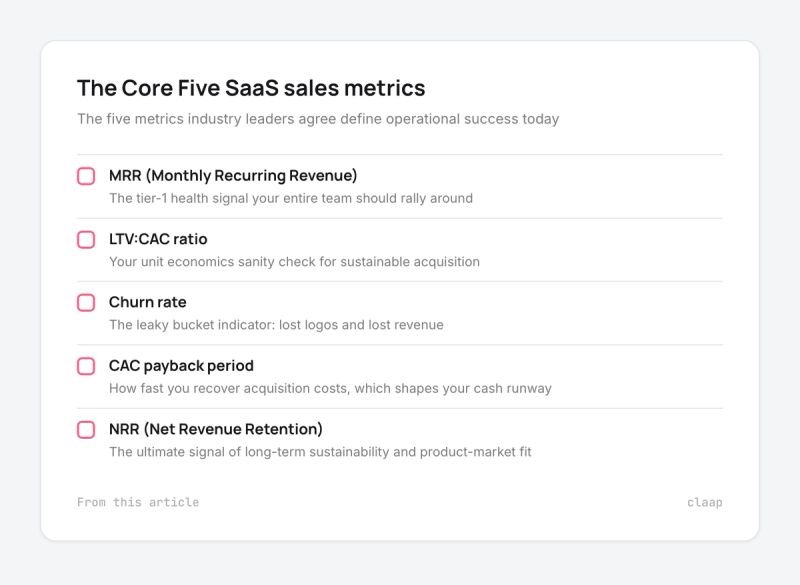
To navigate this landscape, industry leaders have reached a consensus on the "Core Five" metrics that define operational success today:
- MRR (Monthly Recurring Revenue): The tier-1 health signal and success measure your entire team should rally around.
- LTV:CAC Ratio: Your unit economics sanity check to ensure you are acquiring customers sustainably.
- Churn Rate: The "leaky bucket" indicator that tracks both lost logos and lost revenue.
- CAC Payback Period: A direct measure of how fast you recover acquisition costs, impacting your cash runway.
- NRR (Net Revenue Retention): The ultimate signal of long-term sustainability and product-market fit.
Efficiency & Acquisition Metrics (The New Priority)
Acquisition is the primary hurdle for my team in 2026. As I've watched these markets mature, the cost to capture new revenue has risen while conversion rates decline. This is exactly why efficiency metrics have moved from the "finance tab" to the center of my sales leadership meetings.
What is the CAC payback period?
The Customer Acquisition Cost (CAC) Payback Period measures the number of months required for a customer’s gross margin to pay back the cost of their own acquisition.
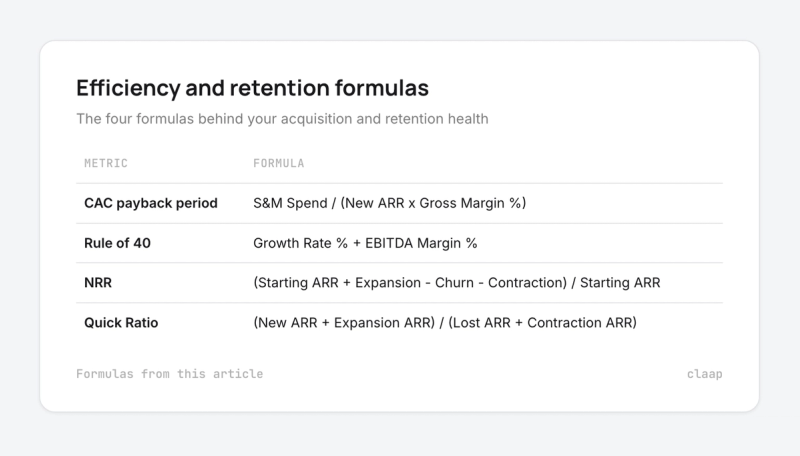
- The Formula: S&M Spend / (New ARR x Gross Margin %).
- Current benchmarks put the median CAC Payback Period at 15 to 18 months in 2026.
- Why It Matters: This jump creates significant working capital pressure. Every additional month of payback limits your cash runway and reduces your capacity to reinvest in growth.
CAC Ratio (New vs. Expansion)
In 2026, high-performing teams no longer treat all acquisition costs the same. We now distinguish between the cost of a new logo and the cost of growing an existing account.
- The New Reality: It currently costs a median of $2.00 in sales and marketing to gain $1 of ARR from new customers.
- The Expansion Advantage: Gaining $1 of ARR from expansion costs roughly $1.00, exactly half the price.
- Actionable Tip: Rebalance your budget. Top performers are shifting 60% of their S&M spending toward customer success and expansion teams to drive revenue at a lower unit cost.
The Rule of 40
The Rule of 40 remains the ultimate health score for balancing ambition with profitability.
- The Formula: Growth Rate % + EBITDA Margin % .
- The "Healthy" Benchmark: A score of 40 is the current market standard for a healthy business.
- Strategic Context: If you have 30% growth and a 10% EBITDA margin, you hit the 40 mark. This balance ensures that your growth isn't coming at the expense of long-term financial viability.
Retention & Growth Metrics (Sustainability)
In 2026, the market has shifted its focus to the "quality" of revenue over the raw volume of acquisition. We no longer value growth that leaks out of the back of the funnel. Today, sustainable SaaS businesses are built on the ability to keep and grow existing accounts.
NRR (Net Revenue Retention)
NRR is the "quality" metric that investors now prioritize over simple growth rate. It measures your ability to generate more revenue from your existing customer base.
- The Formula: (Starting ARR + Expansion - Churn - Contraction) / Starting ARR.
- The Valuation Predictor: A McKinsey analysis found that top-quartile NRR performers sustain higher valuations through both bull and bear markets because NRR predicts valuation better than pure growth.
- Segment Benchmarks: Median NRR is 97% for SMB, 108% for mid-market, and 118% for enterprise companies; the top quartile exceeds 130% in every segment.
Look at Lemlist as a prime example of this strategic shift. They have set a 110% NRR target for their Key Account Management (KAM) team. To achieve this, they are executing an upmarket strategy, moving from small businesses to mid-market to capture more stable revenue, while aiming to drop their churn rate from 7% in 2025 down to 5% in 2026.
Solving "Churn Blindness"
If you only track logo churn, you are flying blind. You must distinguish between Logo Churn (customers leaving) and Revenue Churn (dollars leaving).
Most teams suffer from "Churn Blindness" because they fail to track contraction separately. If your customers aren't leaving but are reducing their seat count or usage, your business is leaking ARR faster than your dashboard suggests.
Separating these drivers allows you to assign ownership: Churn is a Sales/CS retention issue, while contraction is often a Product/Value realization issue.
The Quick Ratio
The Quick Ratio is the ultimate pulse check for your revenue health. It tells you if you are adding revenue faster than you are losing it.
- The Formula: (New ARR + Expansion ARR) / (Lost ARR + Contraction ARR).
- The Benchmark: Bessemer’s standard for top performers is 4.0. If your ratio is below 2.0, you have a contraction crisis that will stall your growth.
Revenue Foundation Metrics
While advanced ratios dominate board meetings, I've found that your baseline SaaS sales metrics must be accurate to maintain any level of forecast confidence. Miscalculating these fundamentals is a primary symptom of operational dysfunction.
ARR and MRR: The Baseline
Annual Recurring Revenue (ARR) and Monthly Recurring Revenue (MRR) establish your predictable revenue flows.
- MRR: This is the tier-1 health signal that Matthew Johnson (Userback CEO) calls the "success measure the entire team can rally around".
- Integrity: Always calculate these based on billing data rather than CRM projections to ensure your numbers reflect actual cash flow rather than optimistic sales entries.
LTV/CLV: The "3x CAC" Rule is Only the Start
Customer Lifetime Value (LTV) synthesizes revenue and duration into a single strategic number.
- Research Insight: Industry consensus holds that LTV should be at least 3x Customer Acquisition Cost (CAC) for a sustainable business model.
- The 2026 Shift: In the current market, 3x is the minimum for survival, not the target for success. With rising acquisition costs, top-quartile companies prove unit economics far above this baseline to demonstrate superior capital efficiency.
ARPU/ARPA: Signaling Unit Economics Quality
Average Revenue Per User (ARPU) or Account (ARPA) indicates the quality of your customer base .
- The Strategic Signal: When your ARPA grows while your customer count stays flat or shrinks, you have successfully improved customer value.
- Moving Upmarket: This metric is a critical indicator of an upmarket strategy. By targeting larger accounts with higher ARPA, you naturally drive higher NRR and lower the pressure on your acquisition teams.
By grounding your strategy in these foundation metrics, you ensure that insights from sales conversations become actionable business intelligence.
The Pipeline Bottleneck: Leading Indicators
If you only track lagging indicators like MRR or NRR, I’ve found you’re essentially performing an autopsy on your sales process. To drive predictable growth in 2026, I believe you must identify pipeline friction points before they hit your quarterly results.
The MQL → SQL Conversion Crisis
The most critical blockage in the current SaaS funnel is the transition from a Marketing Qualified Lead (MQL) to a Sales Qualified Lead (SQL). Current B2B SaaS benchmarks show that MQL to SQL conversion averages 18-22%.
This means roughly 80% of marketing-qualified leads do not become sales-qualified leads. The root cause is rarely lead quality alone; it is almost always a lack of shared definition.
Marketing often qualifies based on demographics, while Sales qualifies based on intent and technical fit.
The 18% Revenue Lift Calculation
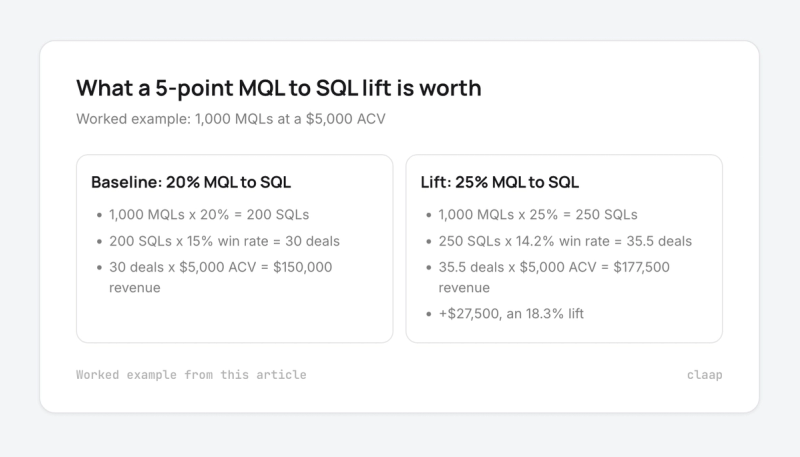
We compare a baseline 20% MQL→SQL conversion against a 25% conversion (a 5-point lift) to show the compounding impact on revenue.
1. The Baseline (20% MQL→SQL)
- 1,000 MQLs × 20% conversion = 200 SQLs
- 200 SQLs × 15% Win Rate = 30 Deals
- 30 Deals × $5,000 ACV = $150,000 Revenue
2. The 5-Point Lift (25% MQL→SQL)
- 1,000 MQLs × 25% conversion = 250 SQLs
- 250 SQLs × 14.2% Win Rate* = 35.5 Deals
- 35.5 Deals × $5,000 ACV = $177,500 Revenue
*Win rate is adjusted from 15% to 14.2% to account for reduced rep capacity and lead dilution.
3. The Result
- Total Revenue Increase: $27,500
- Percentage Lift: 18.3%
For a company with $50M in ARR, applying this 18% lift across the board unlocks $9M in incremental revenue without any additional marketing spend.
What is a good SaaS Magic Number in 2026?
The Magic Number measures your sales efficiency, specifically, how much new recurring revenue you generate for every dollar spent on sales and marketing.
- The Formula: (Current Quarter Net New ARR) / (Previous Quarter S&M Spend).
- The Standard: The largest 2026 benchmark puts the median at 1.37 across 342 companies, up from 0.94 in 2024. Private and early-stage SaaS trackers still commonly report 0.7 to 0.9.
- What this means: A Magic Number of 0.75 is the accepted efficiency floor. Below that level, inspect acquisition costs; above 1.0, consider whether the engine can support more investment.
Diagnosing the "Why": Improving Metrics with Conversation Intelligence
Your dashboard reveals that your win rate is down, but it doesn't explain the cause. You can see the red line on the graph, but you cannot hear the specific objection, the poor competitor positioning, or the feature gap that triggered the loss. This is the Data Gap, the space between quantitative metrics and the qualitative reality of what happens on sales calls.
While standard Sales Performance Dashboards track the "what," they lack the context needed to drive behavioral change. To fix underperforming numbers, you need a way to look past the spreadsheet and into the room where the deal actually happened.
The Solution: Closing the Data Gap with Claap
Claap serves as the diagnostic engine for your SaaS sales metrics. As an AI-powered conversation intelligence platform, Claap records, transcribes, and analyzes sales conversations to uncover the root causes of metric fluctuations. Every conversation is searchable, structured notes are pushed to the CRM, and the full record is available to built-in AI agents or your own through Claap MCP.
Instead of analyzing why a metric is trending downward, I’ve found you can extract insights directly from the voice of the customer. This changes your reporting from a passive review into a proactive strategy session.
Specific Use Cases to Repair Your Revenue Engine
- To improve win rates, look for patterns in "Closed-Lost" calls. Analyzing these lost opportunities makes it possible to see exactly where sales reps missed a step in handling objections or qualifying the lead. By spotting common trends, like a competitor’s new prices or a frequent misunderstanding of what the product does, you can fix the team's sales pitch and give reps updated playbooks to follow.
- To reduce ramp time, build a "Best of" video library in Claap. Ramp time is a silent killer of sales efficiency because new reps often struggle with a lack of field knowledge. By creating this library, you allow new hires to mimic top performers. Instead of reading a manual, they watch real-time discovery techniques and objection handling. This speeds up their onboarding and improves the productivity of the entire team.
- Fix the funnel by auditing discovery calls. The 18-22% MQL-to-SQL conversion rate often points to a qualification problem, not a lead problem. Claap helps you spot qualification errors during discovery that inflate MQL counts but hurt your SQL conversion rates. By making sure reps follow frameworks like BANT, SPICED or MEDDIC, you ensure only high-intent deals move into the pipeline. This protects the accuracy of your sales forecast.
The 2026 SaaS landscape has fundamentally redefined what "good" looks like. In a market where investors prioritize efficiency and unit economics over raw growth, your metrics must tell a story of sustainability. Simply tracking MRR is no longer enough; you must master the leading indicators like the MQL-to-SQL conversion rate to proactively manage your revenue.
If you should remember one thing, it is this: numbers identify the problem, but conversations reveal the solution. Improving your win rates and accelerating your sales cycle requires more than a dashboard, it requires deep visibility into the field knowledge trapped in your sales calls. By bridging the gap between quantitative metrics and qualitative call insights, you move from reactive reporting to high-impact coaching that actually closes deals.
Remember: Claap is a solution to capture every insight, update your CRM automatically, and provide your team with the actionable coaching they need to hit their quota.
FAQ
What is the Rule of 40 in SaaS?
In 2026, the Rule of 40 is the primary filter for sustainable valuation. If you grow at 30% with a 10% margin, you hit the mark. This score signals to investors that your expansion is sustainable and your unit economics are sound, rather than pursuing growth at any cost.
What is a good CAC payback period in 2026?
A good CAC payback period is 12 to 18 months for mid-market B2B SaaS. Current 2026 benchmarks put the overall median at 15 to 18 months.
Any payback period exceeding 18 months signals a unit economics problem that limits your cash runway. Strategic leaders use this to cut underperforming channels. For instance, shifting budget from a 24-month payback channel to a 6-month referral program dramatically increases reinvestment speed.
What is the difference between NRR and GRR?
NRR (Net Revenue Retention) includes expansion revenue like upsells and seat additions, while GRR (Gross Revenue Retention) only tracks the retention of the original contract value.
GRR is your "floor". It shows how well your product fulfills its basic promise and cannot exceed 100%. NRR is your "growth ceiling" and can exceed 100%. If your GRR is low but NRR is high, you are likely masking a churn problem with heavy upsells to a few power users.
What are the most important metrics for early-stage SaaS?
Early-stage SaaS must prioritize the LTV:CAC Ratio and CAC Payback Period. At this stage, capital efficiency and a repeatable sales model are more important than raw ARR.
Focusing on these metrics ensures you are acquiring customers sustainably. For a sustainable business model, your LTV should be at least 3x your CAC. Additionally, keeping your CAC Payback Period between 12 and 18 months ensures you recover costs fast enough to keep your cash runway healthy.