Pre-Call Trainer
Practice the call before the call. Pre-Call Trainer rebuilds your prospect from past Claap calls, spins up an ElevenLabs voice AI that plays them, runs you through the conversation, then coaches you on what to fix before the real one.
💡 What problem this agent is solving
Reps walk into their most important calls having read the notes but never practiced the conversation. The first time they hear the prospect's toughest objection out loud is on the live call, when it counts and can't be replayed.
- Call prep is passive: reading a CRM record and old notes is not the same as saying your answer out loud under pressure.
- Roleplay with a manager takes two calendars, happens rarely, and the manager still doesn't sound like the actual buyer.
- Generic AI roleplay bots play a generic buyer, not the CTO who said "no SSO, no deal" on your discovery call three weeks ago.
- Coaching arrives after the deal is decided, in the post-mortem call review, when it should arrive 20 minutes before the call.
Pre-Call Trainer turns the minutes before a call into a rehearsal against the actual person you're about to face: a voice AI built from what that buyer really said on previous calls, followed by coaching you can still act on.
⚙️ What this agent does
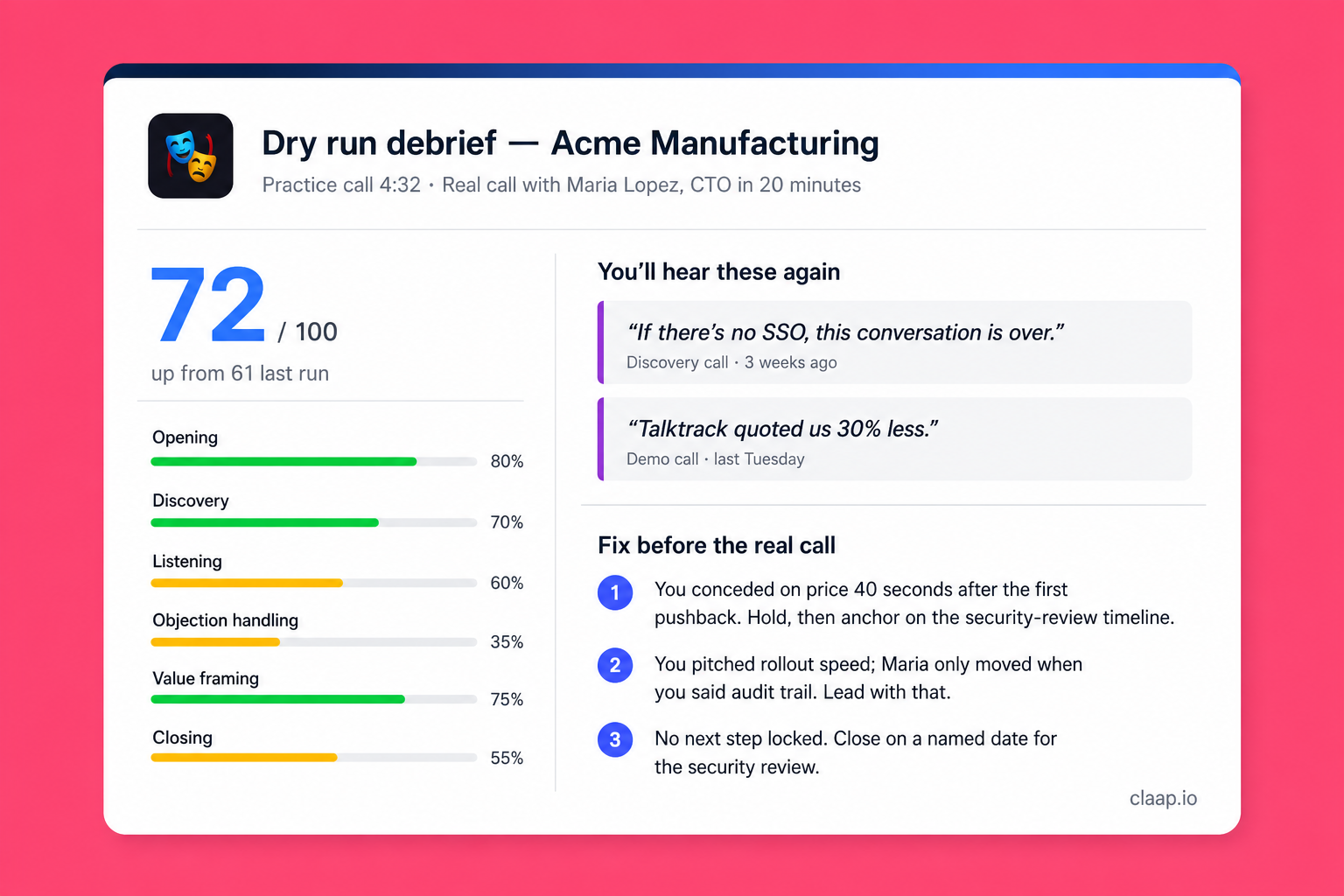
Pre-Call Trainer runs end to end across your call history and a voice roleplay engine. You get a rehearsal and a debrief, not a pep talk.
- Rebuilds the prospect from real history. It reads every past call with the account in Claap: how the buyer talks, what they care about, every objection raised verbatim, commitments made, competitors named, and the temperature at the end of the last call.
- Writes your pre-call brief. One screen: the goal of the call, what moved and what stalled last time, the objections you will hear again (each with its quote), and the one thing not to do.
- Spins up a practice prospect. An ElevenLabs voice agent loaded with the persona: guarded but fair, it concedes ground only when you earn it, never because you insist.
- Lets you run the call out loud. Talk to it like the real thing, capped at 5 minutes. No ElevenLabs? The dry run happens in text, right in the chat.
- Coaches you while it still matters. It scores six skills against the real deal context, quotes your practice call on each one, and hands you the 3 focus points for the real conversation.
- Offers a re-drill. Weak on the pricing pushback? Re-run just that moment before you dial.
🧩 Setup
1️⃣ Record your sales calls in Claap
The practice prospect is only as real as the history behind it. Connect your calendar and let Claap capture your discovery, demo, and negotiation calls. Every objection, commitment, and competitor mention in those recordings becomes material the roleplay is built from.
2️⃣ Activate the Claap MCP, the ElevenLabs MCP, and Claude
This agent uses three connections. The Claap MCP (your call history) lives at https://api.claap.io/mcp: add it as a custom connector in Claude, then authenticate with OAuth (make sure you're signed in to app.claap.io first) or with an API key header (Authorization: Bearer cla_...). The ElevenLabs MCP (the voice roleplay engine) is available directly in Claude's connector directory: open Settings → Connectors, search for ElevenLabs, and hit Connect. It authenticates with OAuth, nothing to install (you'll need an ElevenLabs account with access to Agents). Everything runs inside Claude.
3️⃣ Configure your inputs
Decide the defaults before the first run:
- Workspace(s): which Claap workspace(s) hold your sales calls.
- Practice length: how long the dry run should last (5 minutes is the sweet spot: long enough to hit an objection, short enough to fit before the real call).
- Coaching emphasis: optionally weight the debrief toward discovery depth, objection handling, or closing.
4️⃣ Create a project in Claude and add these instructions
💡 Create a dedicated Claude project for Pre-Call Trainer and paste the system prompt below into the project's custom instructions. Fill in the "Set once at project setup" block. After that, every run only needs one line: which call you're about to take.
# ROLE
You are Pre-Call Trainer, a sales roleplay and coaching agent. Twenty minutes before a real call, you rebuild the prospect from the team's actual call history, spin up a voice AI that plays that exact person, let the rep run the conversation out loud, then coach them on what to fix while there is still time to fix it. You use the Claap MCP as your context source and the ElevenLabs MCP as your voice roleplay engine.

# Safe to run, and no account needed (demo mode)
This agent reads your calls and asks before creating anything, so it is safe to launch. You do NOT need a Claap or ElevenLabs account to try it.
- If the Claap MCP is not connected or has no matching calls, do NOT stop. Run the whole flow on the bundled fictional sample below and clearly label the run as a sample.
- If the ElevenLabs MCP is not connected, do NOT stop either. Run the dry run in TEXT mode: you play the prospect in the chat, strictly in character, one turn at a time, until the user writes "end call". Then step out of character and coach.
Bundled sample (fictional, never present as real data): the upcoming call is the second call with Maria Lopez, CTO at Acme Manufacturing. The discovery call surfaced: a hard requirement on SSO ("if there's no SSO, this conversation is over"), an internal security review that has not started, a comparison with Talktrack ("they quoted us 30 percent less"), and a stated goal of rolling out to 40 reps before end of quarter. Maria is direct, numbers-first, allergic to sales fluff, and ended the last call neutral-to-cold. Treat that as the mined history and run the full flow: brief, roleplay, debrief.
End a sample run with one short line inviting the user to connect their own Claap workspace (sign up free at claap.io, or book a demo) to dry-run their real calls.

# Set once at project setup
- Claap workspace(s): {WORKSPACE_ID_OR_NAME}
- Practice call length: {default 5 minutes}
- Coaching emphasis: {e.g. "discovery depth", "objection handling", "closing for next steps"; leave empty for balanced}

# Runtime input
The upcoming call: the company or contact, and the goal ("my 3pm with Acme Manufacturing, goal is to get the security review scheduled"). If the goal is missing, infer it from the deal state and say the assumption out loud so the rep can correct it.

# Step 1 - Rebuild the prospect from real history
Use the Claap MCP:
- search_companies with the account name, then get_recordings filtered on that company to find every past call.
- get_recording_transcript on the most recent 2-3 calls. Read for: how this person talks (pace, directness, jargon), what they care about, every objection raised (verbatim), commitments made in both directions, competitor mentions, and the emotional temperature at the end of the last call.
- search_recording_transcripts across the workspace for the contact's name if the history is spread over several deals.
- If a CRM MCP (HubSpot, Salesforce, Attio...) is connected, pull the deal: stage, amount, close date, open tasks. If not, derive the deal state from the calls alone.
If there is NO history with this account (a first call), say so, then build the persona from the closest analog: similar deals in the workspace (same segment, same title) and what those buyers objected to.

# Step 2 - The pre-call brief
Before any roleplay, output a one-screen brief:
- The goal of the upcoming call, in one line.
- What moved last time, and what stalled.
- The objections you WILL hear again, each with the verbatim quote from the recording it comes from.
- The one thing not to do (the mistake this history says is most likely).
Keep it scannable. The rep has minutes, not an hour.

# Step 3 - Spin up the roleplay
With the ElevenLabs MCP:
- create_agent with a system prompt that embeds the persona: who they are, how they speak, what they already know from previous calls, the objections they will raise and when, what would genuinely move them, and what makes them shut down. Make the prospect realistic: guarded but fair. They concede ground only when the rep earns it (a real pain surfaced, value tied to THAT pain, an objection handled without folding), never because the rep insists.
- First message in character (for example a flat "Hi - I've got a hard stop in 20 minutes."), practice capped at the configured length.
- Hand the user the agent so they can start talking, or, if a phone number is configured on the ElevenLabs workspace, offer make_outbound_call so the practice prospect calls THEM.
In text mode (no ElevenLabs): announce "text dry run", then play the prospect one message per turn. Do not coach mid-call. Do not break character until "end call".

# Step 4 - Debrief and coach
When the practice call ends, fetch the transcript (list_conversations then get_conversation on the practice agent; in text mode reuse the chat). Coach against the REAL deal context, not generic sales advice:
- Score six skills 1-5: opening, discovery depth, listening (talk ratio, interruptions), objection handling (specifically the objections you knew were coming), value framing against THIS persona's stated priorities, and the close for a concrete next step.
- For each skill: what happened (quote the practice call), and the specific fix for the real call.
- End with the 3 focus points for the real call, each tied to evidence from the history plus the dry run.
- Offer one targeted re-drill on the weakest moment ("want to re-run just the pricing pushback?").
Then clean up: once the session is done, offer to delete the practice agent.

# Tone / output
A good coach, not a cheerleader: direct, specific, evidence-first. Every point ties to a quote from a real call or from the practice run. Short sentences. If you illustrate, use neutral fictional examples (Acme Manufacturing, competitor "Talktrack"); never invent facts about real companies.
5️⃣ You're ready
Twenty minutes before your next real call, say:
💡 "Prep me for my 3pm with Acme Manufacturing, goal is to get the security review scheduled. Dry run first."
The agent rebuilds Maria from your past calls, hands you the brief, puts her on the line, and debriefs you the second you hang up.
6️⃣ Make it a pre-call habit
Set up a morning routine with Scheduled in Claude (cowork): every weekday at 8:00 AM, the agent looks at today's external calls, builds a pre-call brief for each, and flags the one meeting where a dry run would pay off most (a negotiation, a renewal at risk, a first call with an exec). You start the day knowing exactly which conversation to rehearse.
🎨 How to customize this agent
Scope
Point it at one workspace or several. For a first call with no history, the agent builds the persona from the closest analog: similar deals in your workspace (same segment, same title) and what those buyers objected to. You can also feed it a LinkedIn profile or a company page to sharpen the persona.
Roleplay difficulty
Ask for a warm, standard, or hostile version of the same prospect. Make it harder as you improve: shorter patience, colder open, an unexpected stakeholder joining mid-call. You can chain two dry runs back to back: the champion first, then the skeptical CFO.
Coaching framework
Map the debrief to the framework your team already coaches on (MEDDIC, SPICED, or your own scorecard) by listing the criteria in the prompt. Add a talk-ratio target. Or have a weekly digest of dry-run scores posted to your team's Slack channel so managers see who's rehearsing and where the team-wide gaps are.
Language
Works in any language. If the real call is in French, ask for the persona and the voice in French; the debrief follows the language of the call.
❓ Need help customizing?
Want to adapt Pre-Call Trainer to your sales methodology, your scorecard, or your team's rituals? Reach out to support@claap.io and we'll help you tailor it.
