


Sales onboarding: how to cut a new rep's ramp time
New reps ramp faster on their own calls, scored from week one on the criteria the team already sells by, than on a month of reading and passive shadowing.


Updated November 3, 2026.
Sales onboarding at a glance
- Fast sales onboarding starts with the team's best calls: the new rep hears your real buyers before talking to them.
- A new rep's first calls get scored on the same criteria as the senior reps' calls, from the first week.
- Ramp is tracked criterion by criterion, month by month, and that tracking tells you when a new rep is ready.
- Onboarding tools fall into three groups: learning platforms (courses, quizzes), AI roleplay with a simulated buyer, and tools that analyze real calls, such as Claap.
The fastest way to cut a new rep's ramp time is to score their own calls from the first week, on the criteria your senior reps are held to. The gaps only show up in front of real buyers, and a manager cannot sit in on every meeting.
Most sales onboarding programs do the opposite: a month of reading, product training and shadowing, then first calls with no precise feedback.
The cost is well known. The Bridge Group's 2026 AE research, based on 158 B2B companies, puts average AE ramp time at 6.2 months, the highest in the study's history.
This guide starts from what sales teams tell us about their onboarding on our own sales calls, then walks through a four-step plan, how to measure ramp time, and which tools help at each step.
What slows down sales rep onboarding, from our sales calls
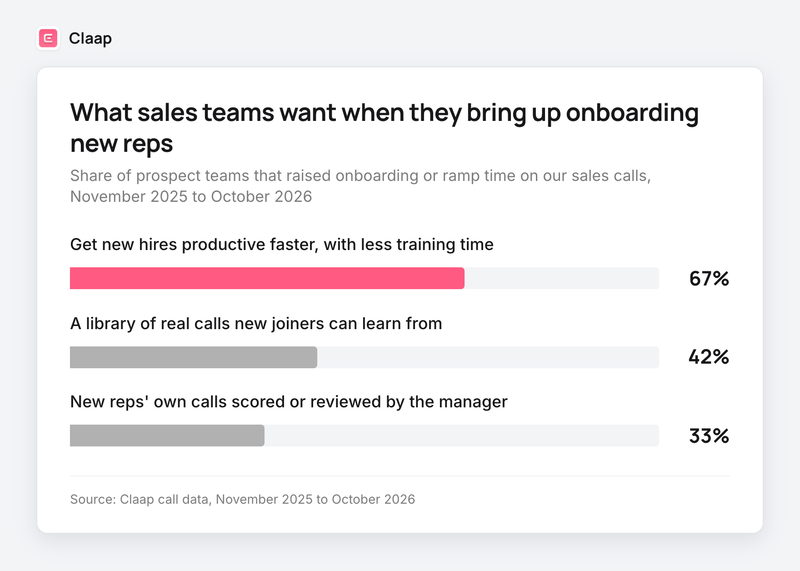
When a prospect team brings up onboarding on our sales calls, they talk about time first. In Claap call data from November 2025 to October 2026, two thirds of the teams that raised onboarding or ramp time wanted new hires productive faster, with fewer hours of training. A sales leader at a B2B software company:
- "I do have several new starters at the moment. [...] Anything we can do to accelerate the ramp up is definitely helpful."
The two other asks say how. About four teams in ten wanted a library of real calls for new joiners, and a third wanted new reps' calls scored or reviewed by the manager (Claap call data, same period).
The underlying problem comes back in the same words: the manager does not see the new rep's calls. A go-to-market lead at a B2B software start-up that had just hired two sales managers (translated from French):
- "They won't be able to attend every meeting. So they need an overview. To know where a rep is good, where they're a bit weaker, where they need help [...] so the sales manager can assess the ramp-up of a new rep, as their onboarding goes."
Our takeaway: onboarding slows down most between a new rep's first call and the first precise feedback on that call. The longer that gap lasts, the more the rep repeats the same mistakes on real deals.
A four-step sales onboarding plan
The timings in this plan are a guide: a long sales cycle stretches each step.
Before day one: build a library of your best calls
Pick five to ten recent calls that moved a deal forward: a strong discovery, a demo that convinced, a price objection handled well, a closing call. Keep only the useful passages, each with a title that says what the rep will hear.
Start with calls from the last three months, because they reflect your current offer and the competitors your prospects name today.
Weeks 1 and 2: hear real buyers, stage by stage
The new rep listens to the library in the order of your sales cycle and joins a few live calls, alongside their own first calls. For each call, ask for three things in writing: the prospect's pain, the main objection, the next step agreed.
Avoid listening sessions with no brief, because a new rep who hears a one-hour call without knowing what to look for remembers the mood and forgets the lines that matter.
From the first call: score every new rep call on the team's criteria
From the first week, each call the new rep runs is scored on the same scorecard as the senior reps: MEDDPICC, SPICED, BANT or your own criteria.
Use the same scorecard for everyone, because a new rep scored on a simplified grid learns a job the team does not do. The manager does not replay everything: they read the scores, open the calls where a criterion is low, and comment on the exact line.
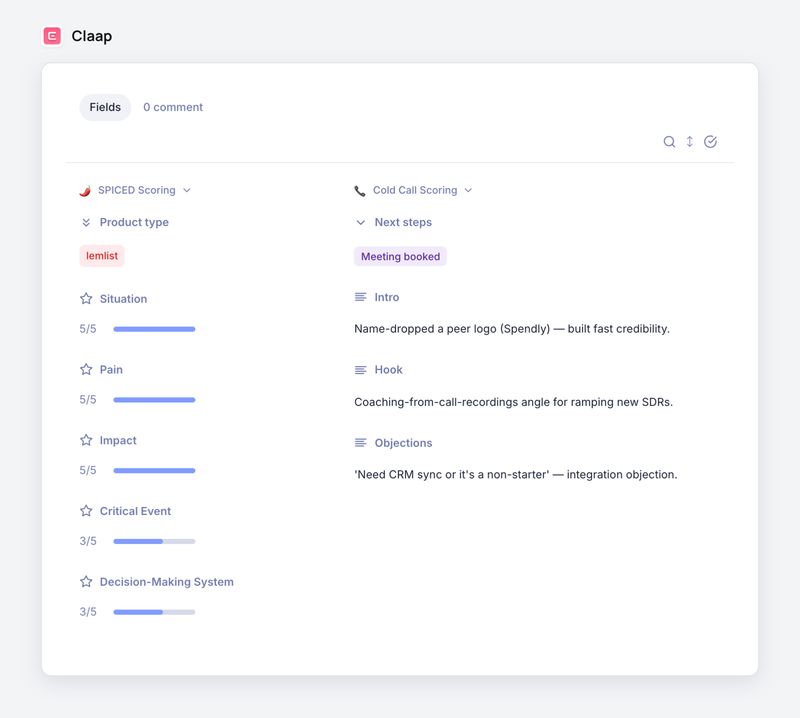
A comment on one line gets fixed on the next call. "Here you gave the price before you knew the budget" is something a rep can act on tomorrow.
Months 2 and 3: measure the ramp and decide when the rep is ready
From the second month, track the new rep's score month by month and criterion by criterion. A rising overall score can hide one criterion that stays low, and that is often where their deals are lost.
Set a bar before handing over a full territory, for example a minimum average score on your criteria with no criterion below a floor.
How to measure sales ramp time
Ramp time runs from the day a rep starts to the day they hit full quota. Three indicators make it readable before revenue does:
- Time to the first call run alone, then to the first closed deal.
- The new rep's average call score on your criteria, against the team's, month by month.
- The new rep's weakest criterion, and whether it moves up from one month to the next.
The score and the weakest criterion move within weeks, long before revenue does.
Which tools help reduce sales ramp time
Three groups of tools share sales onboarding, each built for one step of the plan, and many teams combine two of them.
- Learning platform (LMS, enablement). Courses, quizzes, learning paths and completion tracking, as in Mindtickle or Allego. Pick one when your problem is product knowledge or a training catalog to roll out to many reps.
- AI roleplay with a simulated buyer. The new rep rehearses out loud against an AI playing the prospect, as in Hyperbound. Useful before the first calls, when the rep needs to say the pitch and the objection answers without risking a real deal.
- Real-call analysis (conversation intelligence). It records calls, scores them on your criteria and shows each rep's progress. Choose it when your problem is the gap between what the new rep learned and what they do in front of buyers.
Claap, our product, sits in the third group. Here is what it does for onboarding, from our product pages.
- Your best moments in one onboarding video. You assemble clips from several calls into a single video, with chapters and a thumbnail (Claap sales training software).
- Every new rep call scored on your criteria. AI call scoring starts from a MEDDIC, MEDDPICC, BANT or SPICED template, or your own criteria, and runs on each new call.
- A comment on the exact line. The manager highlights a transcript line and tags the new rep, who opens the call at that moment.
- The ramp visible month by month. The coaching report follows each rep's rating by criterion against the team average.
Claap has no courses, quizzes or built-in roleplay. For rehearsal, the Ramp Trainer agent in our gallery runs in Claude with the Claap MCP and the ElevenLabs MCP: it turns your won and lost deals into voice roleplays, scores every drill and says when a new rep is ready for a live call.
Call scoring and AI coaching are included in the Business plan, at $60 per seat per month billed yearly, according to Claap pricing. Transcript comments and video stitching start on Pro, at $32 per seat per month billed yearly (Claap pricing).
Sales onboarding mistakes that stretch ramp time
- A month of theory before the first call. The new rep walks into meetings with a head full of slides and no feedback on how they actually talk.
- A different scorecard for new reps. The day they move to the team's scorecard, everything has to be relearned.
- Spoken feedback with no link to the call. "You need to qualify better" does not say which question was missing, or when.
- No exit bar. With no clear criterion, the new rep stays "in onboarding" too long, or gets a full territory too early.
This plan is wrong if your reps run very few calls, for example in enterprise sales with a handful of meetings a month. Scoring each call then matters less than coaching the new rep deal by deal, and a manager in the room is still the best method.
To see how one team put this kind of onboarding in place, read how we cut sales ramp time at lemlist. For the coaching side, our guide to sales call coaching covers how to give feedback on a call.
Key takeaways
- The delay that matters is between a new rep's first call and the first precise feedback on it: shorten that before anything else.
- Keep one scorecard for the whole team, and an exit bar the new rep knows from day one.
- A learning platform and roleplay prepare the first calls; real-call analysis measures what the new rep then does in front of buyers.
Frequently asked questions
What is sales onboarding?
Sales onboarding is the period in which a new rep learns your offer, your buyers and your sales method, until they reach full quota. It covers product training, listening to calls, first meetings and follow-up by the manager.
How long does it take to onboard a new sales rep?
The Bridge Group's 2026 AE research measures an average of 6.2 months for an Account Executive to fully ramp.
How do you reduce sales ramp time?
Give new reps a library of your best recent calls before day one, score their own calls from the first week on the team's criteria, and comment on the exact line that needs work. Then track their score by criterion each month and set a bar for when they take a full territory.
What tools help onboard new sales reps faster?
To score a new rep's real calls on your criteria and follow their progress month by month, a call analysis tool such as Claap. To rehearse before the first calls, an AI roleplay, for example the Ramp Trainer agent built on your won and lost deals. For product knowledge, a learning platform.
How do you know a new sales rep is ready?
Set a bar at the start of onboarding: a minimum average score on your sales criteria, with no criterion below a floor, across several calls. When they reach it on real calls, they can take a full territory.
Should new reps listen to recorded sales calls?
Yes, as long as the calls are recent and the rep listens with a brief: the prospect's pain, the main objection, the next step. Short clips sorted by stage of the sales cycle work better than a full one-hour call.