


Sales call coaching: how to coach reps from their calls

Updated 12 October 2026.
Sales call coaching overview
- Sales call coaching is a manager reviewing a rep's recorded calls with them to improve how they sell. The session works on specific moments of real conversations: the discovery questions, the objection, the ask for a next step.
- A good sales call coaching session works on one or two behaviors at a time. Reps change a habit faster when the feedback is narrow and tied to a moment they can replay.
- Sales call coaching runs on a scorecard the whole team shares. The same criteria on every call let a manager compare a rep with the team average and see which skill to coach first.
- The rep assesses the call before the manager does. Asking "what would you do differently?" first turns the session into a conversation the rep owns.
- Sales call coaching works as a weekly habit. A short session every week, with a commitment checked on the next calls, beats a long review once a quarter.
- Call recording and AI scoring tools cut the review time. They show managers which calls and which moments to open, so coaching time goes to the conversation with the rep.
Why sales call coaching matters
Frontline sales managers spend about 9% of their time coaching their direct reports, according to Gartner research cited by Challenger (Challenger). The same research finds that effective sales managers drive a 25% higher seller win rate than the average manager.
That small slice of time has to count. A manager who coaches from impressions ("your discovery felt rushed") gives feedback the rep can't act on. A manager who coaches from the call itself can point at the exact minute where the deal turned.
This guide explains what sales call coaching is, how to run a session step by step, what to listen for on a call and which mistakes to avoid. It ends with the tools that make call reviews faster for managers with several reps to cover.
Sales call coaching at a glance
| Question | Short answer |
|---|---|
| What it is | A manager and a rep reviewing moments of the rep's recorded calls together |
| Who runs it | The frontline sales manager, sometimes a peer or an enablement lead |
| How often | A short session every week per rep |
| What it covers | One or two behaviors per session, taken from real calls |
| What it needs | Recorded calls, a shared scorecard, time to review before the session |
| How you know it works | The behavior shows up on the rep's next calls and the score moves |
What is sales call coaching?
Sales call coaching is a structured review of a rep's real sales calls, led by a manager, with the goal of improving one skill at a time. The manager picks the calls and the moments worth discussing, the rep replays them, and the two agree on what to try differently on the next call.
It is the most direct form of sales coaching because the evidence is the conversation itself. The rep hears exactly what the buyer said and exactly how they answered.
Sales call coaching vs sales training
- Sales training teaches the whole team a method or a product in a classroom, a workshop or an online course. It sets the standard.
- Sales call coaching checks how each rep applies that standard on live calls and closes the gap for that rep. It makes the standard stick.
Training without coaching fades quickly. Coaching without a shared standard turns into personal opinion.
Sales call coaching vs deal coaching
Call coaching works on the rep's skills across all their deals: how they run discovery, handle objections or close a call. Deal coaching works on one live opportunity and the next move that keeps it moving. Most managers run both, and a pattern spotted in deal reviews (a rep who never reaches the economic buyer) often becomes the next call coaching topic.
How to coach sales calls, step by step
Here is a six-step format that works for most B2B sales teams, from picking the calls to checking that the coaching landed.
Step 1: pick the calls worth reviewing
A manager can't listen to every call. Choose calls where the coaching will change the most:
- Calls at the stage the rep struggles with, often discovery or the first demo.
- Calls where the deal stalled or was lost, where a specific moment may explain why.
- One call the rep is proud of, so the session also reinforces what works.
Ask reps to nominate one call they found hard each week. It saves review time and tells you where they feel stuck.
Step 2: score the call on a shared scorecard
Use the same criteria for every rep so scores can be compared. A practical call coaching scorecard has five to eight criteria, each tied to your sales method:
- Did the rep confirm the agenda and the buyer's goal for the call?
- Did they uncover the pain and its cost before showing anything?
- Did they ask about the decision process and who else is involved?
- Did they handle objections before moving on?
- Did they agree a dated next step with the buyer?
Gong's own coaching guide suggests starting by scoring one call per rep each week, then increasing the frequency once coaching becomes a habit (Gong help center). If you need a starting point, adapt a sales coaching template to your method.
Step 3: review the moments, then the whole call
Skim the transcript and jump to the moments that matter: the first five minutes, the pain discussion, the objection, the close. Note the timestamp of each moment you want the rep to replay.
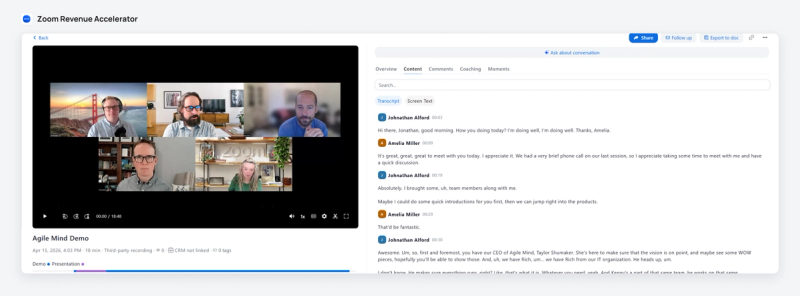
A searchable, speaker-labelled transcript is what makes this step fast. Reading the buyer's own words also stops the review from turning into a debate about who remembers the call better.
Step 4: let the rep assess the call first
Open the session with questions before giving your view:
- "What went well on this call?"
- "Where did you feel the call slip?"
- "If you ran it again tomorrow, what would you change?"
Then play the moment you picked. Most reps spot the problem themselves when they hear it, and a lesson they find on their own sticks longer than one they are told.
Step 5: coach one behavior and practice it
Pick one behavior for the week, two at most. Name it precisely ("ask what the problem costs before demoing"), show an example from a strong call, then practice it right away: the manager plays the buyer and the rep reruns the moment.
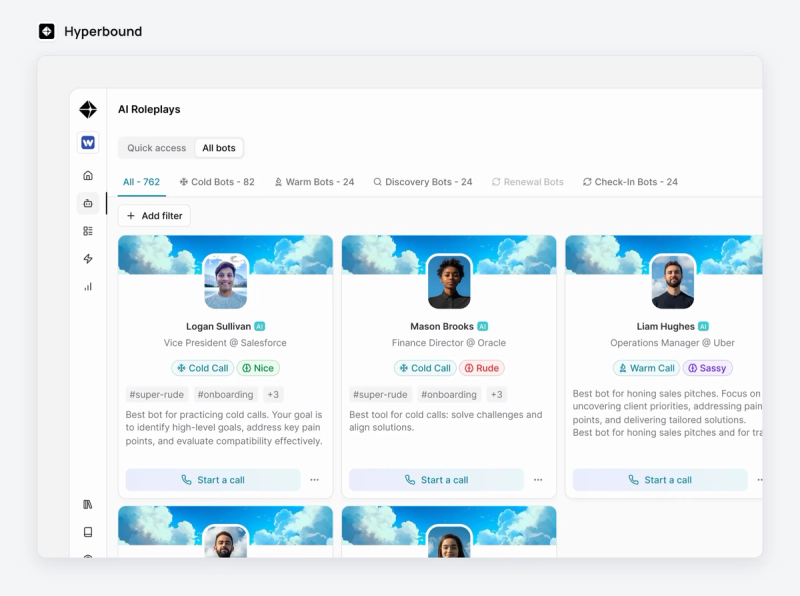
AI roleplay tools let reps keep practicing between sessions against a simulated buyer, which helps for cold calls and objection handling.
Step 6: agree a commitment and check the next calls
End with one commitment the rep owns, written down with the date of the next session. At that session, open two or three of the rep's newer calls and check whether the behavior shows up. When the score on that criterion moves for a few weeks in a row, pick the next behavior.
What to listen for on a sales call
These are the signals managers check most often, with the benchmarks behind them:
- Talk-to-listen ratio. Gong's research on B2B sales calls found the highest-converting ratio sits around 43% rep talk and 57% buyer talk (Gong Labs). A rep who talks for most of a discovery call is pitching before they understand the problem.
- Monologues. Gong recommends that reps keep monologues to 2:30 at most (Gong help center). Long monologues usually mean the buyer stopped engaging.
- Questions that go deeper. Count the follow-up questions after the buyer names a problem. "What does that cost you?" and "who else feels it?" separate discovery from a checklist.
- Objection handling. Listen for whether the rep acknowledges the objection, asks what sits behind it and answers it before moving on.
- The ask for a next step. Check that every call ends with a dated next step the buyer agreed to, and who else will join.
Where manual call reviews fall short
Recording calls is the easy part. On our own sales calls, managers describe the same problem: the reviews they want to run take more time than they have.
- A sales manager of seven reps at a US lead-conversion services company described the review they wanted to run on every call: "I want to be able to listen to calls, maybe do some scoring, or just be able to quickly read through the transcript, make sure my reps are, you know, hitting the points that they should... asking the right questions, asking for the sale."
- A sales leader at a Canadian unified-communications provider wanted the recordings for one-to-one coaching: "I would want to look at those recordings so that I can sit down with an AE and do some training, right? Maybe they're, you know, maybe they're not as good at asking questions around budget."
- A revenue leader at a fully remote US company explained why ride-alongs were off the table: "we're not like a call center or physical or something like that, where I can go and sit by the rep for an hour and listen to their calls. So we need to have remote monitoring capabilities."
- A revenue operations manager at a UK climate-data company summed up the cost of reviewing calls one by one: "Individual deals sales directors going through call recordings on a one-to-one basis. Um, but it, it's not enough, it's too much effort required, it's too slow."
The pattern is consistent: managers know what to coach, and the bottleneck is finding the right calls and moments across a whole team.
Tools that support sales call coaching
Three kinds of tools help, and many teams use more than one:
- Conversation intelligence tools record and transcribe calls, then score them or surface key moments. Gong, Zoom Revenue Accelerator and Claap sit here.
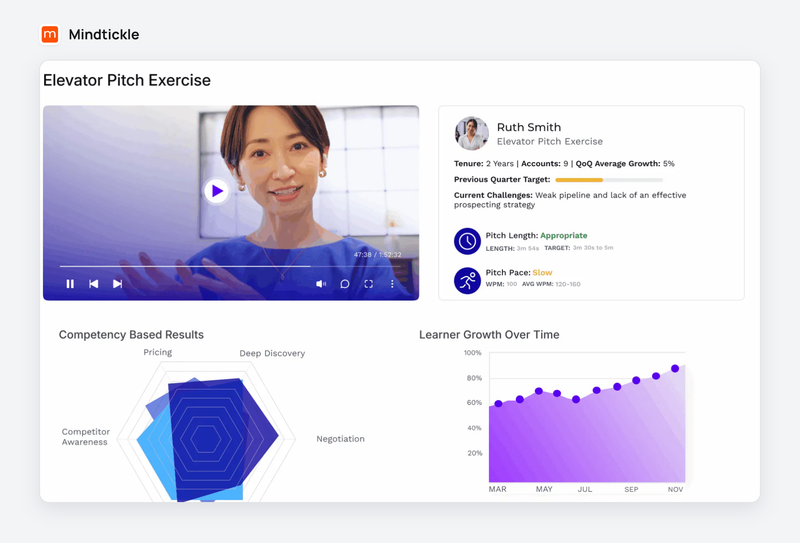
- Roleplay and readiness tools let reps practice a pitch or an objection before a live call and get scored on it. Hyperbound and Mindtickle sit here.
- Your CRM holds the deal context, so a call review can start from the deal that needs it.
How Claap helps managers coach sales calls
A quick note: Claap is our product. To keep this guide fair, we linked every major claim to its source.
Claap scores every recorded sales call on the criteria your team already coaches on. You can start from a MEDDIC, MEDDPICC, BANT or SPICED template, or write criteria for your own method, and each criterion returns a 0 to 5 rating or a value from your own list (Claap sales coaching software).
- Know which rep to coach on what. Each rep's average rating sits next to the team average, criterion by criterion.
- Coach on the moment. Clicking a score jumps the player to the moment behind it, and you can share that moment with the rep.
- Coach habits too. Talk ratio, longest monologue and question rate are compared with the team average, and the monthly trend shows whether a criterion moved after you coached it.
- One scorecard per role. Account Executives, Sales Engineers and Customer Success Managers can each be scored on criteria written for their own calls (Claap coaching and scoring).
AI coaching is part of the Business plan, at $60 per seat per month billed yearly. A free Basic plan and a Pro plan at $32 per seat per month billed yearly cover recording and AI summaries (Claap pricing).
Sales call coaching mistakes to avoid
- Coaching ten things at once. A list of every flaw on the call overwhelms the rep. Pick one behavior.
- Only reviewing lost deals. Reps learn as much from hearing what worked on a strong call.
- Skipping the follow-up. Without checking the next calls, nobody knows whether the coaching landed.
- Turning reviews into surveillance. Tell the team why calls are reviewed and let reps nominate their own calls. Coaching works when reps ask for it.
- Coaching from memory. Feedback without a timestamp is an opinion. Play the moment.
Key takeaways
- Sales call coaching improves one behavior at a time, using moments from the rep's real calls.
- A shared scorecard makes calls comparable and shows each manager which skill to coach first.
- Let the rep assess the call before giving feedback, then practice the behavior in the session.
- End every session with one commitment and check it on the rep's next calls.
- Use talk-to-listen ratio, monologue length, follow-up questions and the next-step ask as your first listening checklist.
- Conversation intelligence and roleplay tools cut the review time, so the manager's few coaching hours go to the conversation with the rep.
Frequently asked questions
What is sales call coaching?
Sales call coaching is a manager reviewing a rep's recorded sales calls with them to improve one skill at a time. The session uses specific moments of real calls, such as discovery questions, objection handling or the ask for a next step, and ends with a commitment the rep tries on the next calls.
How do you coach a sales rep using call recordings?
Pick one or two calls at the stage the rep struggles with, score them on a shared scorecard and note the timestamps worth replaying. In the session, let the rep assess the call first, play the moment, coach one behavior, practice it and agree a commitment to check on the next calls.
How often should you coach sales reps on their calls?
A short session every week per rep works for most teams. Gong's coaching guide suggests starting with one scored call per rep each week and increasing the frequency once coaching becomes a routine.
What goes on a sales call coaching scorecard?
Five to eight criteria tied to your sales method: confirming the agenda, uncovering the pain and its cost, mapping the decision process, handling objections and agreeing a dated next step. Use the same scorecard for every rep in a role so scores can be compared with the team average.
What is a good talk-to-listen ratio on a sales call?
Gong's research on B2B sales calls found the highest-converting ratio sits around 43% rep talk and 57% buyer talk. On discovery calls, a rep who talks for most of the call is usually pitching before they understand the problem.
What is the difference between sales training and sales coaching?
Sales training teaches the whole team a method or a product and sets the standard. Sales coaching works with each rep on their own calls to apply that standard, one behavior at a time.

![12 Best Sales Analytics Tools [2026 Guide]](https://cdn.sanity.io/images/gb4upfg4/staging/59221cfcae21512b0b0bde517adf7081261d780c-1536x864.jpg?w=800&h=450&fit=crop&auto=format&q=75)