

Real-time sales coaching: what live AI prompts fix, and what still needs a coach after the call
Live prompts help a rep in the moment with facts and objection answers. The habits that make reps better show up across many calls, and those get coached after the call.


Updated November 4, 2026.
Real-time sales coaching overview
- Real-time sales coaching is software that listens to a live sales call and shows the rep guidance while the buyer is still on the line.
- The guidance is usually an on-screen card: an objection answer, a product fact, a battlecard line or a pace and talk-time cue.
- It is best for high-volume phone teams, new reps on scripted calls and calls where one missing fact stalls the deal.
- Post-call coaching is best for the habits that repeat across calls: weak discovery, talking too much, vague next steps.
Real-time coaching helps a rep in the moment with facts, objection answers and script steps, but the habits that make a rep better are coached after the call, from recordings scored against your sales method.
Live coaching tools promise to fix the call while it is still happening. That promise holds for some moments of a call, and it is one of the things buyers ask about when they talk to us about coaching.
On our own sales calls, the coaching problem buyers describe is mostly about what happens after the call: who listens, who scores, and when the manager finds the time.
This guide shows where live prompts help, where they distract, and how to set up both so your reps improve from one week to the next.
What buyers ask for when they talk about coaching reps
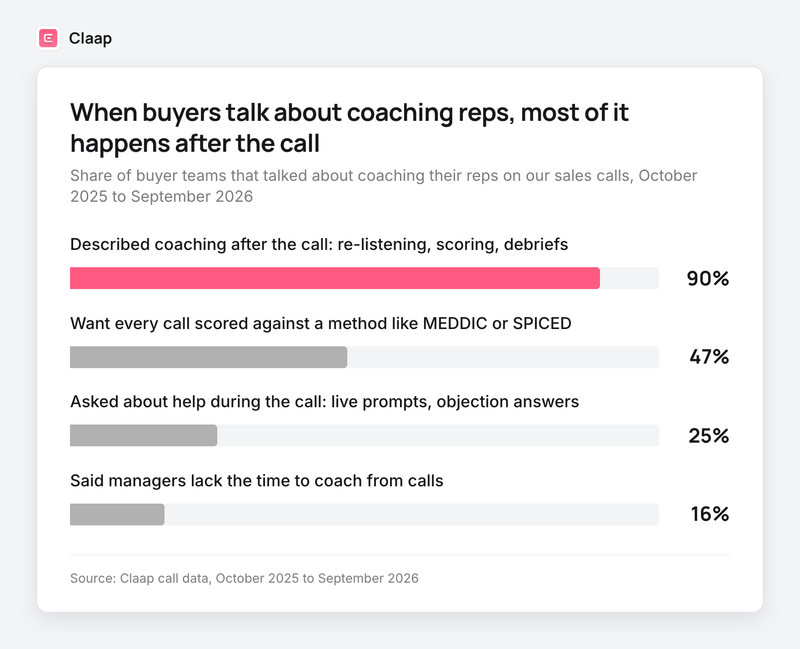
We looked at every buyer team that talked about coaching their reps on Claap's own sales calls. In Claap call data from October 2025 to September 2026, 90% of those teams described coaching that happens after the call: re-listening, scoring and debriefs. Many teams raised several of these themes, so the shares below overlap.
About a quarter asked about help during the call, such as live prompts or objection answers (25%, Claap call data, same period). That share is on the high side: some of those buyers only asked whether a tool could do it live after we described scoring.
Nearly half wanted every call scored against a method like MEDDIC or SPICED (47%, Claap call data, same period). Of the buyers who asked for live help, about 7 in 10 also described reviewing calls afterwards (Claap call data, same period). And 16% said their managers lack the time to coach from calls (Claap call data, same period).
A sales manager at a device-leasing startup described the live help he wanted:
- "It's really a kind of guide. During your meeting you can pull the information you need straight away, in your meeting template, based on the objections you're facing. It's a plus if we have that kind of feature." (translated from French)
On manager time, a sales manager running a small team at a B2B SaaS company:
- "Even with three or four people to follow. I do other things on the side too. I'm not dedicated to just that, but at first I re-listened to everything." (translated from French)
And a sales leader at a company where most staff sell put the goal this way:
- "Score calls really at scale, but without basically needing to re-listen to every single call." (translated from French)
These are our own sales calls, so the sample leans toward teams already looking at call recording and scoring.
Where real-time coaching helps a rep
Live prompts work when the right answer exists before the call and the rep only needs it at the right second.
- Objection answers the team already agreed on. A buyer says "we already use a competitor" and the card shows the two lines your best reps use. Dialpad's AI Live Coach works this way: cards with messaging, objection tips or product details, triggered by phrases on the call.
- Facts a rep cannot memorize. Pricing rules, integrations, security answers. A missed fact turns into a follow-up email.
- Script steps on high-volume phone calls. SDR teams on a dialer run the same call fifty times a day, and a live checklist keeps the opener, the qualification questions and the meeting ask in order.
- New reps in their first weeks. They do not know the answers yet, and a card on screen is there on every call, where a manager can only listen in on a few.
Use live prompts when your calls are short, repeatable and run from a script, because that is where a card can show up in time to be useful.
Where live prompts fall short during a call
A card hands the rep a sentence. Why the call went wrong shows up later, in the recording.
- The habits that lose deals repeat across calls. A rep who skips the pain question, talks for two minutes straight or leaves without a dated next step does it on most calls. That pattern shows up only when you compare many calls against the same criteria.
- Reading and listening compete. A rep reading a card is half listening to the buyer. A sales operations lead at a large B2B media group described the live tools they had tested: "We saw it wasn't practical for the job at all. It kind of confused the rep during the call. We're not big fans." (translated from French)
- Complex deals have no script. On a discovery or a negotiation with three stakeholders, the next best question depends on what was said ten minutes earlier and in the last call. A prompt tuned on keywords sees one sentence at a time.
- Nobody reviews the prompts. A live tool tells the rep what to say. It does not tell the manager whether the rep improved this month.
The founder of a presentation design agency summed up the doubt after looking at live tools: "I found it nice, but maybe a bit gimmicky." (translated from French). His real need was checking objection handling against the playbook after the call, for his junior reps.
Skip live coaching as a first purchase when your team runs long, consultative deals, because the coaching those reps need comes from reviewing whole calls.
How to combine live prompts and post-call coaching
We recommend fixing the review loop first, then adding live help where the calls are repeatable, in this order.
- Write the criteria first. Pick the method your team already sells with, MEDDIC, SPICED or your own, and turn each part into one question a manager would ask while listening. These criteria drive both the live checklist and the post-call score.
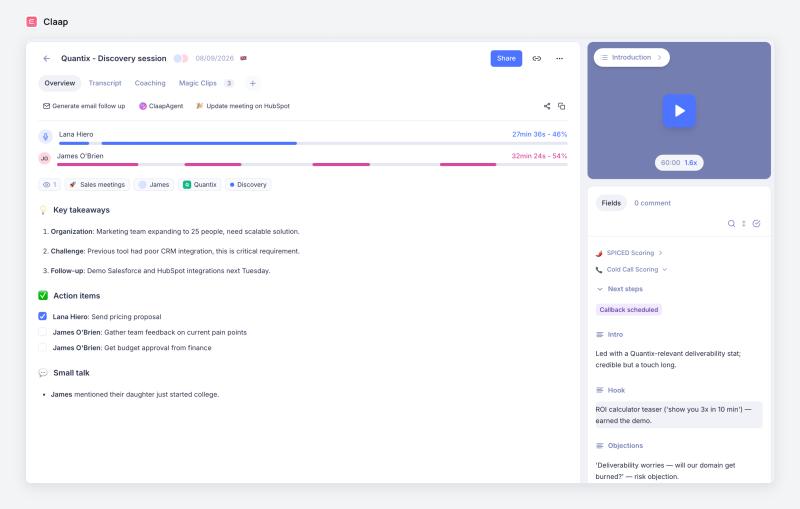
- Score every call after it ends. A manager can listen to a handful of calls a week. Automatic scoring covers all of them, so you see which criterion each rep misses most often.
- Coach on the moment, with the recording. Open the call where the rep missed the criterion, jump to that point in the transcript and share that clip.
- Add live prompts for the gaps that are about facts. If reps keep missing the same pricing answer or the same competitor reply, that is the job for a live card. If they keep skipping the pain question, live help will not fix it.
- Check the scores a month later. The score on that criterion should move. If it does not, change how you coach that criterion.
This advice is wrong if your team runs a contact center or a scripted inbound desk: there, the call is the script, and live guidance with a checklist is the main coaching tool.
Tools for real-time sales coaching
Real-time coaching tools sit where the call happens: in the dialer, next to the CRM or in the video meeting.
- Live coaching inside the phone system. Dialers that coach while the rep dials. Aircall describes real-time coaching that detects keywords and surfaces battle cards and talk tracks during live calls. Pick this kind when most of your selling happens on the phone, because the coach sits where the call already is.
- Live coaching next to the CRM. Trellus runs beside calls in the CRM with a live transcript, the newest suggestion on top and pace and talk-time cues, and managers write the guidance.
- Live coaching in video meetings. Cirrus Insight's Live Meeting Coach whispers the next best question or an objection cue while the meeting is still live.
- Post-call coaching and scoring. Conversation intelligence tools that record calls, score them on your criteria and give managers the moments to coach. Gong runs scorecards on recorded calls, and Claap scores every call on your own method.
A quick note: Claap is our product. Claap works after the call and does not prompt reps during it. Its sales coaching software records every call, scores it on the criteria you write, MEDDIC and SPICED included, and puts each score next to the timestamped transcript so a manager can coach on that exact moment. Call scoring is on the Business plan, $60 per seat per month billed yearly (Claap pricing).
For the step-by-step version of coaching from recordings, read our guide to sales call coaching. For roleplay and practice tools, see our comparison of AI sales coaching tools.
Key takeaways
- Use live prompts for facts, objection answers and script steps when calls are short and repeatable, because that is where a card can be right in time.
- Coach skills after the call: write your criteria, score every call, and coach on the moment the rep missed.
- On our own sales calls, 90% of buyer teams that talked about coaching described post-call review, and about a quarter asked about live help (Claap call data, October 2025 to September 2026).
Frequently asked questions
What is real-time sales coaching?
Real-time sales coaching is software that listens to a live sales call and shows the rep guidance while the buyer is still talking. The guidance is usually an on-screen card with an objection answer, a product fact or a pace cue. Post-call coaching reviews and scores the recording after the call ends.
How can AI support real-time sales coaching?
AI transcribes the call as it happens, detects phrases such as a competitor name or a price objection, and pulls the matching answer from your battlecards or playbook. After the call, AI can also score the recording against your sales method, so managers know which moments to coach.
Is real-time sales coaching worth it?
It is worth it for high-volume phone teams and new reps on scripted calls, where the right answer exists before the call. For long, consultative deals, most coaching value comes from scoring whole calls afterwards.
Does live coaching distract reps during calls?
It can. A rep reading a card is not fully listening to the buyer, and some teams that tested live tools found it confused their reps. Keep live cards short, limit them to facts and objection answers, and leave skill coaching to the post-call review.
What is live in-ear AI sales coaching?
In-ear coaching means guidance the rep hears in the headset during the call, the way a manager whispers to a rep in a call center. Most AI coaching tools show text cards on screen instead, because a voice in the ear competes with the buyer's voice.
Does Claap do real-time sales coaching?
No. Claap coaches after the call: it records the call, scores it on your criteria and shows the manager the exact moments to work on. During the call, the Claap desktop app opens a notepad that timestamps the rep's own notes.