

Upsell conversation: how to upsell existing customers
An upsell conversation goes well when the customer opened it. On most account calls they do, well before anyone talks about price. The signals, the timing, a script and the objections.


Updated November 5, 2026.
Most account managers treat the upsell as a pitch, and spend their energy looking for the right moment to slip it in.
An upsell conversation goes well when the customer opened it, and on most account calls they do, well before anyone talks about price.
So the job is to hear that opening, write it down, and come back with a clear proposal on the next call.
This guide gives you the five signals to listen for, when to bring the upsell up, a call script you can reuse, and answers to the objections you will hear.
The upsell conversation at a glance
- An upsell is more of what the customer already buys: more seats, a higher plan, a wider scope. A cross-sell adds a different product next to it.
- The signal comes before the ask. A new use case, another team, a budget date, a seat count, new hires: customers mention them on routine calls.
- Make the commercial move on the next call, with the customer's own words and a number.
- Hold the upsell while current users are still short of value. Seats added on weak adoption put the renewal at risk.
- Write each signal where the whole account team can find it, on the deal or the company record.
Five expansion signals to listen for on account calls
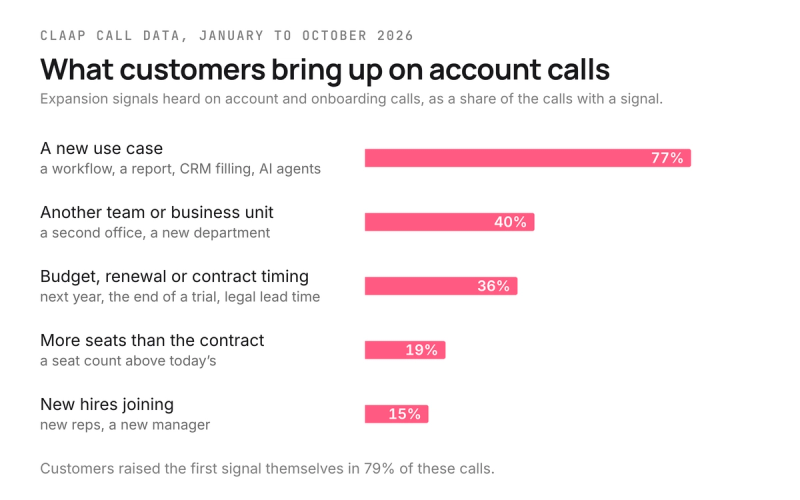
On account and onboarding calls, 62% carried at least one expansion signal, and in 79% of those the customer raised the first one without being asked (Claap call data, January to October 2026).
Here is how often each signal came up on the calls that had one (Claap call data, January to October 2026):
- A new use case, 77%. The customer asks whether the product can do a job it does not do for them yet: a report for leadership, filling the CRM, feeding an AI agent. It is the most frequent signal, and on its own it says little about seats, so write down who wants it and what it would replace.
- Another team or business unit, 40%. "Our support team could use this." It points straight at seats, because it names people who do not pay yet. Ask who runs that team and whether you can meet them.
- Budget, renewal or contract timing, 36%. Next year's budget, the end of a trial, the time legal needs to sign. It gives you the calendar. What to offer comes from the other signals.
- More seats than the contract, 19%. The customer says the number for you. Answer with a written proposal the same week.
- New hires joining, 15%. New reps, a new manager. A new manager also re-checks every tool the team pays for, so meet them in their first month.
Hiring often arrives as a passing remark. An operations lead at an AI cybersecurity startup, on an onboarding call: "it's a new BDR manager who joined us, like 10 days ago. And a sales manager who manages the AES who joined us a little over a month ago."
That sentence is two new people to onboard and one budget owner to meet.
These are one account team's calls, so read the shares as orders of magnitude.
When to bring up the upsell
The commercial move belongs on the call after the signal, because by then you can come back with a scope, a price and a date.
Good moments to raise it:
- Right after the customer states a result out loud. "The team stopped writing call notes" is the opening for "Who else on your side spends time on that?"
- Three months before the renewal. Use the renewal date as the deadline when procurement or legal is involved, because their lead time is longer than yours.
- In the first month of a new manager. They are rebuilding the tool list anyway. Show them what the team already gets.
- When a new team is being set up. Onboarding a second team is a seat conversation, so price it before the invitations go out.
Moments to avoid: during an open support issue, and in the first weeks of an onboarding, before the first users have seen a result.
When a call carries no signal, ask one open question before you hang up: "What changes for your team next quarter?" On accounts you only speak to once a quarter, start with seat usage and a short usage review, because waiting for the next routine call can cost you three months.
The upsell call script
- Replay what they said. "Last time you mentioned the support team could use the call transcripts. Is that still on the table?"
- Ask the scope question. "If you rolled it out to them, how many people would that be, and by when?" A head of pre-sale operations at a fast-growing US fintech, asked exactly that on a check-in, answered: "we plan on on having 20 more, 20 to 25 more in the next couple of of months."
- Tie it to a result they already have. Use their numbers: the hours the first team saved, the deals it reviewed, the onboarding time of the last hire. Skip generic benefits, because the customer already knows the product.
- Propose one option with a number and a date. "For 20 more seats on your current plan, here is the price, valid until the end of the quarter." Start with one option when the scope is clear, because a single option keeps the talk on the scope the customer gave you.
- Agree the next step and who else signs. "Who needs to see this before you can say yes: finance, IT, your manager?" Book that meeting before you hang up.
The script works only if step 1 has material, so the signal from the last call has to be somewhere you can read it before this one.
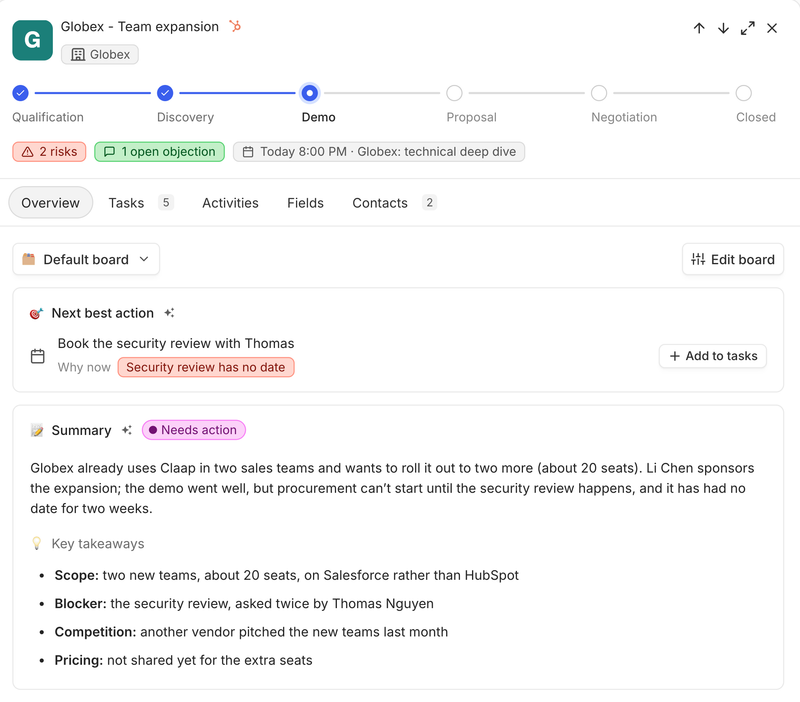
A quick note: Claap is our product, so read this paragraph knowing that. Claap records the account calls and writes a summary on the deal with the scope, the blocker and the next step, so the account manager walks into the upsell call with the customer's words in front of them. Claap's CRM auto-complete can push those values into HubSpot or Salesforce fields, and ClaapAgent answers questions such as "which accounts mentioned another team this month?" across every call.
Upsell objections and how to answer them
"We don't have budget this year." Ask when next year's budget is set and who sets it. Then offer to start the new team now and bill the extra seats from the next budget year, and send a one-page case with the first team's results before that budget meeting.
"We need to check the market first." Help them run the check. Send usage per team, what the first team gets out of it, and what moving would cost them in setup and lost history.
"Let's see how the current team uses it first." This one is often fair. Agree on a usage target and a date to look at it together, and put that date in the calendar on the call.
"We already pay for seats nobody uses." Fix that before you sell more. Reassign the idle seats to the new team first, then price only the gap.
For the wider set of answers, see how to handle objections on sales calls. A cross-sell to a new buyer runs closer to a new sale, with its own call script.
When not to push the upsell
Wrong if: the people already paying are not getting value yet. When adoption is low, an upsell call turns into a renewal risk, and the right conversation is a usage review with the champion.
Skip it too when the customer is in the middle of a support escalation, a reorganisation or a budget freeze announced from the top. Note the signal, set a reminder, and come back when the situation has settled.
Frequently asked questions
What is the difference between an upsell and a cross-sell?
An upsell sells more of the same product: more seats, a higher plan or more usage. A cross-sell adds a different product next to the one the customer already has. In B2B software, account managers mostly upsell seats and plans, and a cross-sell often involves a new buyer.
Is upselling good or bad for the customer?
It is good when it answers a need the customer already stated, such as a new team to equip or a use case the current plan does not cover. It is bad when it adds seats nobody will use. That is why the upsell waits until current users get value.
What is an example of an upsell in B2B?
A customer equips its sales team with a call-recording tool, then mentions on a check-in that the support team could use the transcripts too. The account manager comes back the next week with a proposal for the support team's seats. That is an upsell: same product, wider scope.
What is the main rule of upselling?
Sell what the customer has already said they need. The expansion signal (a new team, new hires, a new use case, a budget date) usually comes from the customer on a routine call, and the proposal should quote it back.
How do you upsell without being pushy?
Replay the customer's own words, ask how many people and by when, and propose one option with a number and a date. The conversation then follows the customer's plan, and the customer can say no or not yet without friction.
When should a CSM bring up an upsell?
On the call after an expansion signal, once there is a scope and a price to show. Good moments are after the customer states a result, about three months before renewal, and in a new manager's first month. Avoid open support issues and the first weeks of onboarding.