

Closing techniques: 8 ways to close a sale, and what to say
The strongest close is a dated next step the buyer agrees to before the call ends. Eight closing techniques, each with the phrase to say, and the one habit that makes them work.


Updated November 5, 2026.
The strongest close is a dated next step the buyer agrees to before the call ends.
You know the moment. The demo went well, the buyer nods, and the call ends on "send me something and we'll get back to you". Two weeks later the deal is quiet.
What decides the deal is whether the buyer left the call with a step, an owner and a date they said out loud.
Below are eight closing techniques that build that step, each with the phrase to say, plus the moments when you should not try to close at all.
Closing techniques at a glance
- Next-step close. "Before we hang up, can we put the next step in the calendar?"
- Buyer's date close. "What has to be true, and by when, for this to work on your side?"
- Summary close. "You told me X, Y and Z. Does that still sum it up?"
- Trial close. "On a scale of 1 to 10, where are you today?"
- Paper-process close. "Who else signs, and what do they need to see?"
- Assumptive close. "Shall we plan the kickoff for the 14th or the 21st?"
- Direct close. "Is anything stopping us from signing this week?"
- Give-get close. "If we start on the 1st, can you sign the annual plan by Friday?"
1. The next-step close: agree the step, the owner and the date
Start with this one, because every other technique on this list ends here. The next-step close turns "let's keep in touch" into a calendar entry with a name on it.
Say it before the last five minutes of the call, while there is still time to book it:
"Before we hang up, can we put the next step in the calendar? I'd suggest a 30-minute review with your CFO on Thursday. Does that work, or is another day better?"
The gap shows on the last call before a decision. In deals that moved forward, 90% of those calls ended on a next step the buyer accepted, against 52% in deals that were later lost (Claap call data, April to October 2026). The same split holds for a step with a day attached: 76% against 43% (Claap call data, April to October 2026).
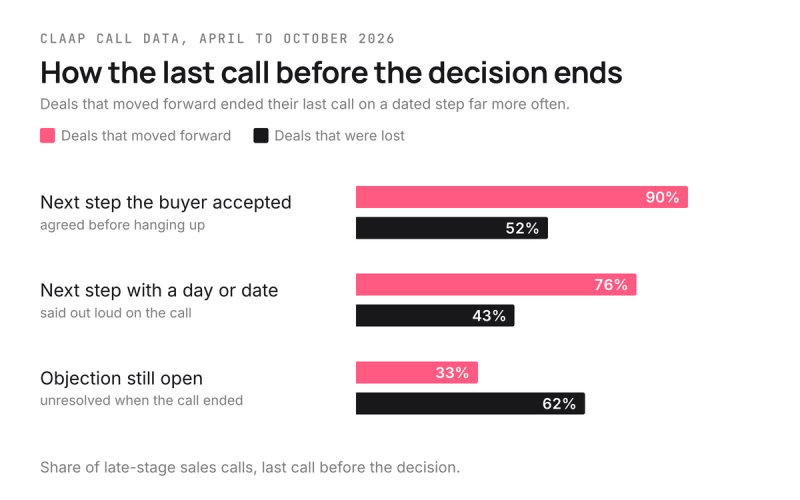
These are late-stage calls from one sales team, so read the shares as orders of magnitude.
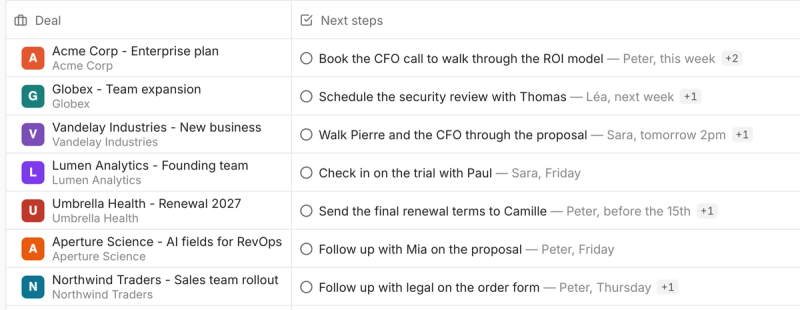
A next step only works if the whole team can see it. Write the step, the owner and the date on the deal itself, the same day.
2. The buyer's date close: let the buyer say the deadline
When the buyer names the date, it becomes their commitment. Ask for the reason behind the timing, and the buyer will usually give you the deadline with it:
"What has to be true, and by when, for this to work on your side?"
Listen for an event: a renewal notice, a new hire, a board meeting, the end of a quarter. Here is how one buyer laid it out after a trial, a revenue operations lead at a B2B data software company:
- "So if we get them on Friday, then we'll evaluate them with [the CRO], probably Monday or Tuesday. [...] And I would love to sign end of that week."
When the buyer stated a date themselves, the call ended on a dated next step 78% of the time, against 46% when they did not (Claap call data, April to October 2026). Use this question early in the last call, because the answer sets every other step.
3. The summary close: replay the buyer's own words
The summary close works when the buyer has said what they need but has not connected it to a decision yet. Replay their words, then ask for the step:
"You told me three things: reps lose an hour a day on CRM notes, your managers can't coach calls they don't hear, and you want this live before the new hires start. Does that still sum it up? Then the next step is the security review."
Use their exact words, so the summary sounds like their own plan.
4. The trial close: check the temperature before you ask
A trial close tests how ready the buyer is without asking for the signature. It surfaces the objection while you can still answer it:
"On a scale of 1 to 10, where are you today? What would make it a 10?"
The point is the second question. In deals that were lost, an objection was still open at the end of the last call in 62% of cases, against 33% in deals that moved forward (Claap call data, April to October 2026). Run a trial close in the middle of the call, because an objection found at the end goes home with the buyer.
For a full list of questions to ask at this stage, see our sales closing questions.
5. The paper-process close: map who signs before you ask
Many deals that "go quiet" are waiting on a person the seller has not met. Ask about the paper process as soon as the buyer says yes in principle:
"Who else signs, and what do they need to see from us before they do?"
A good answer names the budget owner, the signer and the order of the steps. A head of sales operations at an HR software company answered it in one line:
- "The budget sits with ops. The quote will be signed directly by the CEO." (translated from French)
Then offer to prepare what each of those people reads: a one-page summary for the CFO, the security documents for IT, the contract draft for legal.
6. The assumptive close: offer two dates, both of them yes
The assumptive close treats the decision as made and asks about the details. It works once the buyer has stated a deadline and the paper process is clear:
"Shall we plan the kickoff for the 14th or the 21st?"
Skip it if the buyer has not given you a date yet, because then it reads as pressure. Used too early, it gets a polite "let me check internally" and you have lost the next step.
7. The direct close: ask for the decision
Ask it plainly:
"Is anything stopping us from signing this week?"
The explicit ask for the decision came up on 7% of late-stage calls (Claap call data, April to October 2026). Most deals moved through a next step the buyer agreed to. Use the direct close when the buyer has run out of questions, and stay quiet after you ask.
8. The give-get close: trade a concession for a commitment
When the buyer asks for a discount or extra terms, give it only in exchange for something that moves the deal:
"If we start on the 1st, can you sign the annual plan by Friday?"
Start with a timing trade, because a date is the cheapest thing a buyer can give and the most useful for you. We cover the trades in detail in our guide to negotiation tactics.
When not to close
Some calls should end without a closing attempt. Hold off when:
- The buyer cannot name the decision maker. Book a call with that person first.
- The buyer has no date and no event driving one. Ask the buyer's date question, then wait.
- An objection is still open. Answer it, or agree on how it gets answered, before you ask for anything.
Here is what an ending without a step sounds like, from an innovation project lead at a large media company, on a deal that was later lost:
- "Our next steps: we'll keep going with our benchmark, discuss it among ourselves, with our management and our leadership, and we'll come back to you." (translated from French)
When you hear this, skip the closing line and ask for one thing: a date to hear the result of the benchmark, with the person who decides on the call.
This advice is wrong if you sell in a single call (a low-price, self-serve or transactional sale). There the assumptive and direct closes do most of the work, and a next step can slow the buyer down.
Keep the next step where the team can see it
A next step agreed on a call that nobody writes down is gone by the next pipeline review. The habit that makes these techniques work is boring: after every late-stage call, the step, its owner and its date go on the deal.
A quick note: Claap is our product, so read this paragraph knowing that. Claap records the call and writes what was agreed into the deal, so the next step shows up in the pipeline view without anyone typing it. With CRM auto-complete, it also lands in the HubSpot or Salesforce field you choose.
If your calls happen over video, our guide to closing deals remotely covers the remote side of the same moment.
Frequently asked questions
What do you say when closing a deal?
Ask for a next step with a date before the call ends: "Before we hang up, can we put the next step in the calendar?" Then confirm who else needs to be in that meeting. The best closing line is the one that leaves the call with a step, an owner and a date.
What are the three main types of closing a sale?
Most closing techniques fall into three families. Direct closes ask for the decision. Assumptive closes treat the decision as made and ask about details, such as a start date. Soft or trial closes test readiness without asking for the signature. Pick the family based on how much the buyer has already committed to.
How do you close more deals?
End every late-stage call on a next step the buyer accepts, with a day said out loud, and find the open objection before the call ends. Map who signs early so the deal does not stall waiting for someone you have not met.
How do you close a sale without being pushy?
Let the buyer set the date. Ask what has to be true by when, then build the next step around their answer. A deadline the buyer chose feels like their own plan.
When should you not try to close?
Hold off when the buyer cannot name the decision maker, has no date driving the decision, or still has an open objection. Book the meeting that removes the blocker first.
What is a trial close in sales?
A trial close checks how ready the buyer is without asking for the signature, for example "On a scale of 1 to 10, where are you today?". The follow-up, "What would make it a 10?", surfaces the objection you still need to answer.