


Best SDR tools: 8 tools compared for outbound teams
Most SDR stacks measure every email and review almost no calls. Here are eight SDR tools by job, from list building to the call itself, with prices and who each one suits.


Updated 3 November 2026.
SDR tools overview
- lemlist is best for most SDR teams: contact data, email, LinkedIn and phone sequences, and deliverability in one tool.
- Apollo.io is best for testing outbound on a free plan before paying for a tool.
- LinkedIn Sales Navigator is best for researching accounts and buyers before the first touch.
- Outreach is best for large SDR teams that run on Salesforce.
- Clay is best for building custom, enriched lead lists.
- Instantly is best for high-volume cold email on a small budget.
- Claap is best for reviewing SDR calls and filling the CRM after them.
The SDR tool most stacks are missing
Most SDR stacks are built to send more, and the part that decides whether a meeting turns into pipeline, the call itself, is the one part nobody reviews.
Ramp is short and expensive: the average SDR takes 3.0 months to ramp, according to The Bridge Group's 2025 SDR report.
That leaves a manager a few weeks to hear how a new rep opens a cold call, handles the first objection and qualifies a meeting. Sequencers report opens and replies to the click. The calls those sequences book mostly go unheard.
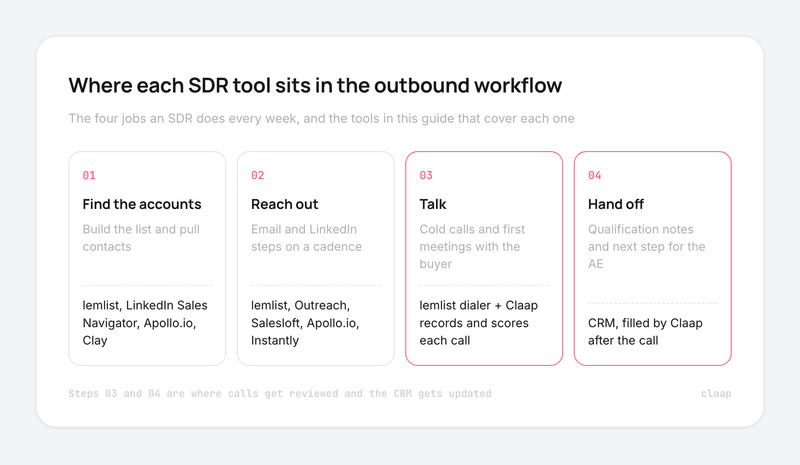
So this guide sorts SDR tools by the job they do in a rep's week: finding accounts, reaching out, talking to buyers and handing the deal to an AE.
SDR tools at a glance
| Tool | Workflow step | Price model | G2 rating |
|---|---|---|---|
| lemlist | 01, 02 and 03 | Per team (Email) or per user (Multichannel) | 4.6 |
| Apollo.io | 01 and 02 | Per user, free plan | 4.7 |
| LinkedIn Sales Navigator | 01 | Per license | 4.4 |
| Outreach | 02 | On request | 4.3 |
| Salesloft | 02 and 03 | On request | 4.5 |
| Clay | 01 | Per workspace | 4.7 |
| Instantly | 02 | Per account | 4.8 |
| Claap | 03 and 04 | Per seat, free plan | 4.6 |
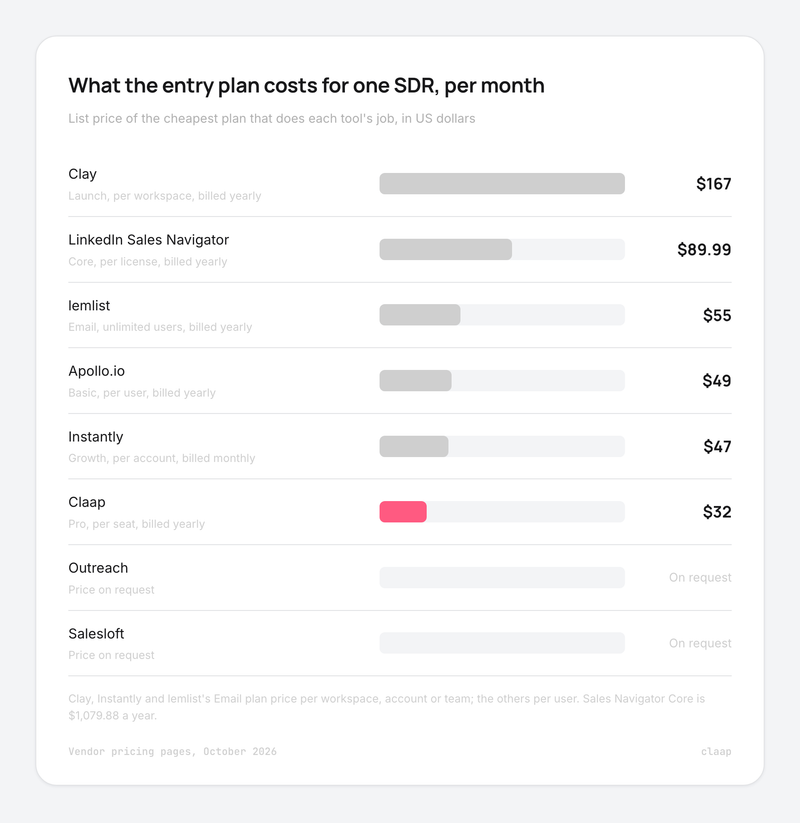
Ratings come from G2, and the steps match the workflow diagram below. The chart shows each entry price from the vendor pricing page, October 2026.
Where SDR stacks fall short: the calls nobody reviews
On Claap's own sales calls from 2025 and 2026, buyers who run SDR teams describe the same split: the outreach side is tooled and measured, the call side is reviewed by hand, when someone has the time.
At a four-person sales team, the CRO told us their single SDR owns the whole outreach stack, and the team runs its cold calls from that same tool with nothing reviewing them. Their ask:
- "If it could also do something similar with the cold calls themselves to actually be able to analyze those and then help us to really keep consistent there as well." (recording vGwvpn4xYSU8)
Larger teams review calls, but by hand. A sales leader at a hospitality software company described the routine:
- "We use [our dialer] for the BDR. Do a phone call, [our coach] logs into the phone call, listens to it, and then right after, they debrief with all the BDRs." (recording KXAc2OsjXwvP)
And a sales leader at a staffing company said the review happens only some of the time:
- "We do kind of have a coaching process that our team leads would go through with our sales members, even our recruiters, where they would sit in or listen to sales calls at times. It's not done universally." (recording E5Gs17DItNJR)
The fix is a tool that records every cold call and first meeting, scores it the same way for every rep and writes what the buyer said into the CRM. Start with it once your SDRs book more calls than a manager can sit in on.
How we built this comparison
We kept the tools US sales teams most often shortlist for SDR work, then judged each one on four points:
- The job it does in an SDR's week: finding accounts, reaching out, talking or handing off.
- Price for one SDR: the cheapest plan that does that job, from the vendor's own pricing page.
- CRM and dialer integrations: an SDR tool that does not write back to the CRM creates work for the AE.
- Reviews: the G2 rating and its review count.
Important note: Artisan, the AI SDR behind "Ava", is often named for this search, but it holds 4.0 out of 5 on G2 across 24 reviews, a thin base next to the tools below, so we left it out of this selection.
1. lemlist, best for most SDR teams
A quick note: Claap is part of lemlist, so lemlist and Claap are both our products. To keep this comparison fair, we relied on third-party reviews and public pricing pages, and linked every major claim to its source.
lemlist is the tool we recommend first to an SDR team: contact data, sequences across email, LinkedIn and phone, and deliverability in one tool, where Apollo.io charges per user and Clay needs a separate tool to send.
Who lemlist works best for
- SDR teams that want one tool to find, contact and follow up.
- SDRs who prospect by email, LinkedIn and phone in the same sequence.
lemlist overview
lemlist gives access to a database of more than 650 million B2B leads according to its pricing page, finds emails and phone numbers, then runs sequences: email on every plan, plus LinkedIn visits and messages, calls from the built-in dialer and SMS on the Multichannel plan. lemwarm warm-up and deliverability protection come with every plan, according to the same page.
lemlist pricing
Prices from lemlist's pricing page:
- Email: $55 per month billed yearly ($69 monthly), unlimited users and senders, up to 50,000 emails a month.
- Multichannel: $87 per user per month billed yearly ($109 monthly), with LinkedIn automation, SMS and the dialer.
- Enterprise: on quote.
lemlist vs Apollo.io and Clay
- Against Apollo.io, on email and data: lemlist's Email plan costs $55 a month for the whole team, while Apollo.io Basic costs $49 per user, according to their pricing pages, so lemlist is cheaper from the second SDR. Adding LinkedIn and calls to the same sequence takes lemlist's Multichannel plan at $87 per user.
- Against Clay: Clay builds and enriches the list, then sends it to a sequencer; lemlist finds the contacts and sends the sequence in the same tool.
lemlist integrations
- HubSpot, Salesforce and Pipedrive.
- Gmail and LinkedIn, with a Chrome extension.
- The lemlist MCP, to run campaigns from Claude or ChatGPT.
lemlist pros and cons
Pros
- Email, LinkedIn and call steps for one prospect live in one sequence.
- Deliverability is handled without a separate warm-up tool.
Cons
- LinkedIn automation and the dialer need the Multichannel plan.
- Email and phone lookup credits come on top of the subscription.
What G2 reviewers say about lemlist
lemlist holds 4.6 out of 5 on G2 across more than 1,200 reviews (G2).
2. Apollo.io, best for testing outbound on a free plan
Apollo.io suits a team that wants to test outbound on a free plan; once the team pays, its per-user price weighs more than lemlist's Email plan.
Who Apollo.io works best for
- Startups with a single SDR and no data provider yet.
- Founders who still prospect themselves.
Apollo.io overview
Apollo.io combines a B2B contact database with email sequences, a dialer and a Chrome extension that works on LinkedIn. A rep builds a list, enriches it and launches a sequence without leaving the tool.
Apollo.io pricing
Apollo.io has a free plan; Basic costs $49 per user per month billed yearly, according to Apollo.io's pricing page.
Apollo.io integrations
- Salesforce and HubSpot.
- Gmail and Outlook for sending.
- A Chrome extension for LinkedIn and webmail.
Apollo.io pros and cons
Pros
- The free plan lets a founder test the data on real accounts before paying.
- A rep goes from list to first email in one session.
Cons
- Paid plans run on credits for exports and phone numbers, so heavy list builders pay more than the seat price.
- Data quality varies by region, so check a sample of your own accounts during the trial.
What G2 reviewers say about Apollo.io
Apollo.io holds 4.7 out of 5 on G2 across 9,652 reviews (G2).
3. LinkedIn Sales Navigator, best for account research
Sales Navigator is the research tool most SDRs end up paying for, because the buyer's job, team and recent activity sit on LinkedIn first.
Who LinkedIn Sales Navigator works best for
- SDRs selling to named accounts where the buying committee matters.
- Teams that open with LinkedIn before email.
LinkedIn Sales Navigator overview
Sales Navigator adds advanced lead and account search, saved lists, alerts on job changes and InMail to a LinkedIn seat.
LinkedIn Sales Navigator pricing
Core costs $119.99 per month billed monthly, or $1,079.88 a year (about $89.99 a month), according to LinkedIn's plan comparison page. Advanced costs $159.99 per month billed monthly on the same page.
LinkedIn Sales Navigator integrations
- Salesforce, HubSpot and Microsoft Dynamics.
LinkedIn Sales Navigator pros and cons
Pros
- Job and company data that buyers keep current themselves.
- Job-change alerts give an SDR a timely reason to reach out.
Cons
- No email sequences or dialer, so it always needs a second tool.
- CRM sync only comes with the higher plans.
What G2 reviewers say about LinkedIn Sales Navigator
LinkedIn Sales Navigator holds 4.4 out of 5 on G2 across 2,207 reviews (G2).
4. Outreach, best for large SDR teams on Salesforce
Outreach is the pick when SDR managers need to run many reps on the same sequences with tight Salesforce reporting; under ten reps, it is more platform than you need.
Who Outreach works best for
- SDR teams of 20 reps or more on Salesforce.
- RevOps teams that want one engagement platform for SDRs and AEs.
Outreach overview
Outreach runs multichannel sequences (email, calls, LinkedIn tasks) with a built-in dialer, call recording and deal views.
Outreach pricing
Outreach has no public price: its pricing page lists packages with a "Request pricing" button.
Outreach integrations
- Salesforce and Microsoft Dynamics, with HubSpot also supported.
- Zoom, Google Meet and Microsoft Teams for meetings.
Outreach pros and cons
Pros
- Managers compare reply rates across reps on the same sequence.
- Salesforce sync deep enough for RevOps reporting.
Cons
- Contracts run yearly.
- Setup and admin take a RevOps owner.
What G2 reviewers say about Outreach
Outreach holds 4.3 out of 5 on G2 across 3,569 reviews (G2).
5. Salesloft, best for cadences and calls in mid-market teams
Salesloft does the same core job as Outreach and suits mid-market teams that want cadences, a dialer and call recording under one contract.
Who Salesloft works best for
- SDR teams of 10 to 50 reps.
- Teams on Salesforce or HubSpot that want SDR and AE activity in one place.
Salesloft overview
Salesloft builds cadences across email, phone and LinkedIn, with a dialer, call recording and a deals view.
Salesloft pricing
Salesloft does not publish prices: its pricing page routes to sales.
Salesloft integrations
- Salesforce, HubSpot and Microsoft Dynamics.
- Zoom, Google Meet and Microsoft Teams.
Salesloft pros and cons
Pros
- Each call recording sits next to the cadence that booked it.
Cons
- Coaching depth depends on the package you buy.
- Close to Outreach in scope, so the choice often comes down to the quote.
What G2 reviewers say about Salesloft
Salesloft holds 4.5 out of 5 on G2 across 4,287 reviews (G2).
6. Clay, best for custom enriched lead lists
Clay is the tool for SDR teams whose edge is a better list: it pulls from many data providers and lets you write your own research steps.
Who Clay works best for
- Teams with a RevOps or growth engineer to build tables.
- SDRs who target a narrow ICP with signals (hiring, funding, tech used).
Clay overview
Clay works like a spreadsheet where each column is a data source or an AI research step. It runs a waterfall across providers to find emails and phone numbers, then sends the rows to your sequencer or CRM.
Clay pricing
Launch costs $167 per month billed yearly, with 15,000 actions a month, according to Clay's pricing page. Data credits are counted on top of actions.
Clay integrations
- HubSpot and Salesforce.
- Outreach, Salesloft, Instantly and most sequencers.
Clay pros and cons
Pros
- Each research step is reusable across campaigns.
Cons
- A learning curve: someone has to build and maintain the tables.
- Credit use is hard to forecast at first.
What G2 reviewers say about Clay
Clay holds 4.7 out of 5 on G2 across 218 reviews (G2).
7. Instantly, best for high-volume cold email
Instantly suits teams whose outbound is mostly cold email at volume and who want deliverability handled for a flat monthly fee.
Who Instantly works best for
- Agencies and small teams that send from many mailboxes.
- SDRs who already have a list from Apollo.io or Clay.
Instantly overview
Instantly connects many sending accounts and spreads sending across them, with a lead database and a reply inbox.
Instantly pricing
The Growth plan costs $47 per month billed monthly, according to Instantly's pricing page.
Instantly integrations
- HubSpot, Salesforce and Pipedrive.
- Zapier and webhooks for the rest of the stack.
Instantly pros and cons
Pros
- Adding mailboxes does not raise the Growth price.
- Warmup is built in.
Cons
- Calls and LinkedIn need other tools.
- Lead data is billed separately in credits.
What G2 reviewers say about Instantly
Instantly holds 4.8 out of 5 on G2 (G2).
8. Claap, best for reviewing SDR calls and filling the CRM
Claap is the call layer of this list: the other seven tools book SDR calls, and Claap is where those calls get reviewed.
Who Claap works best for
- SDR managers who coach reps on their cold calls and first meetings every week.
- Teams where the AE rereads the SDR's notes before every handed-off meeting.
Claap overview
Claap records Zoom, Google Meet and Microsoft Teams meetings, and calls placed through a dialer such as Aircall (calls and VoIP), then scores each one on the criteria you set for the SDR role (sales coaching software).
After the call, Claap fills the CRM fields you choose, such as the pain, the next step or the qualification status, so the AE starts the meeting with the SDR's notes.
Claap pricing
Prices from Claap's pricing page:
- Basic: free.
- Pro: $32 per seat per month billed yearly.
- Business: $60 per seat per month billed yearly.
- Enterprise: on quote.
Claap integrations
- HubSpot, Salesforce, Attio and Pipedrive.
- Zoom, Google Meet, Microsoft Teams and Aircall.
- The Claap MCP, so Claude or ChatGPT can read your calls.
Claap pros and cons
Pros
- Managers see where each rep loses buyers without listening to every call.
Cons
- No contact data or sequences: it sits next to the tools above.
- AI coaching and CRM auto-complete need the Business plan.
What G2 reviewers say about Claap
Claap holds 4.6 out of 5 on G2 across more than 400 reviews (G2).
Our verdict: how to choose the right SDR tool
Buy by job, in the order your SDRs hit the problem:
- The base of your outbound: start with lemlist as soon as you pay for a prospecting tool, because it covers data, sequences and deliverability, its Email plan covers the whole team for one price and Multichannel adds LinkedIn and calls.
- No budget yet: test Apollo.io on its free plan, then move to lemlist once you pay for a tool.
- Very specific lists: add Clay to lemlist when your ICP is narrow and someone can build the tables, because Clay enriches the list and lemlist sends it.
- Many reps on one playbook: choose Outreach or Salesloft when you pass 20 reps, because managers need the same sequences and reporting for everyone.
- Calls booked but not reviewed: use Claap when a manager can no longer sit in on every SDR call, because the coaching then has to come from recordings.
- AI SDRs: skip a fully autonomous AI SDR when your deal needs discovery, because the first call still decides whether the meeting turns into pipeline.
This advice is wrong if your SDRs only send email and never get on the phone: then a sequencer and a data source are the whole stack, and call review can wait.
For a wider view of outbound software, see our guide to sales automation tools, and for the two big engagement platforms, Salesloft vs Outreach.
Frequently asked questions
What are the top AI SDR tools?
The AI SDR tools named most often are Artisan and AiSDR. They write and send outreach on their own. Most sales teams get more from AI inside a sequencer such as lemlist, with a human SDR on the calls.
What does SDR stand for?
Sales development representative: the rep who qualifies prospects and books the first meeting for an account executive.
What is the best SDR tool for a first SDR hire?
lemlist once you pay for a tool: for email and data, its Email plan keeps the same price when a second SDR joins, and Multichannel adds LinkedIn and calls per user. To test with no budget, Apollo.io's free plan is enough.
How much does an SDR tool stack cost per rep?
A lean stack of lemlist's Email plan and Sales Navigator Core costs about $145 a month for one SDR on yearly billing, according to the two vendors' pricing pages, and each extra SDR only adds a Sales Navigator license. Outreach and Salesloft quote their prices on request.
Do SDR teams need a call recorder?
Not on day one: the verdict above says when it starts to pay off.
Can an AI SDR replace a human SDR?
Not when the sale needs discovery: see the AI SDR line in our verdict.