


MEDDIC vs MEDDPICC: what the two extra letters catch
MEDDPICC adds paper process and competition to MEDDIC. On our own sales calls buyers raised one or the other in most deals, so we argue MEDDPICC should be the default and MEDDIC the exception.


Updated November 5, 2026.
MEDDIC vs MEDDPICC overview
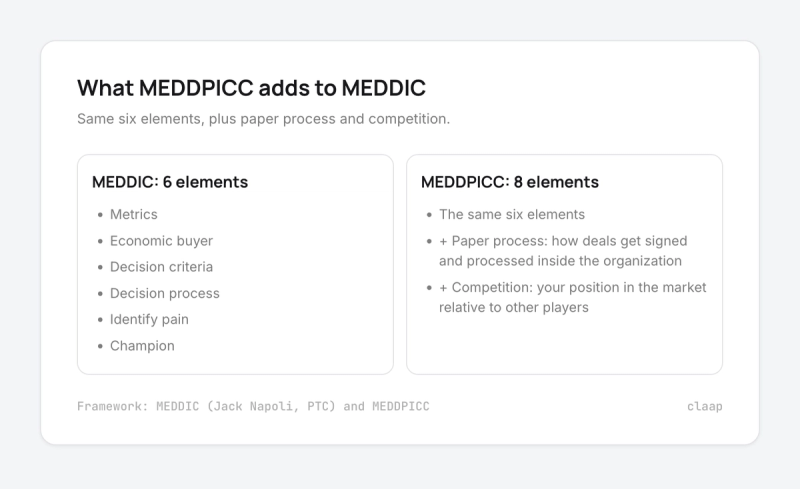
MEDDIC is a B2B sales qualification framework with six elements: metrics, economic buyer, decision criteria, decision process, identify pain and champion.
MEDDPICC keeps those six elements and adds two: paper process and competition.
MEDDIC fits short sales cycles with one signer and no formal vendor review.
MEDDPICC fits deals that go through legal, security or purchasing, or where the buyer is comparing several vendors.
Why we default to MEDDPICC
Plain MEDDIC is the wrong default for most B2B teams selling software today: the two letters it leaves out, paper process and competition, are the ones buyers bring up on their own.
Gartner puts the typical buying group for a complex B2B solution at six to 10 decision makers.
More people means more sign-offs, more reviews and more vendors on the shortlist. That is exactly what the "P" and the second "C" track.
MEDDIC vs MEDDPICC at a glance
| MEDDIC | MEDDPICC | |
|---|---|---|
| Elements | Six | Eight |
| Adds | Nothing, it is the base | Paper process, competition |
| Best for | Short cycles, one signer, few competitors | Mid-market and enterprise deals with reviews and shortlists |
| Main risk | Deals stall in legal or lose to a rival nobody tracked | More fields for reps to fill |
| Typical owner | AE alone | AE with sales manager reviews |
What paper process and competition look like on real sales calls
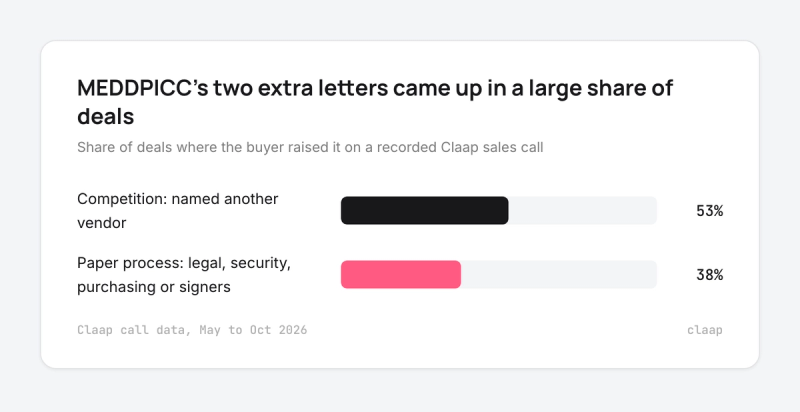
We looked at our own recorded sales calls (intros, demos, debriefs and proposals) to see how often buyers raise the two elements MEDDPICC adds.
- Buyers named another vendor in 53% of the deals in our sample (Claap call data, May to October 2026).
- Buyers raised the paper process (legal review, security or data questions, purchasing, who signs) in 38% of the deals (Claap call data, May to October 2026).
- A revenue leader at a private-equity-backed software company, on a pricing call: "The decision isn't mine alone. It will have to go through the purchasing, IT and legal process."
- A sales manager at a French media group, before renewing: "I know how long and slow our legal team is, so I need to raise it with them now."
- The same revenue leader, on the first call: "I've seen [another vendor], I'm going to see five or six, maybe even more than before. So it's getting hard to see the differences."
None of these came up because a rep asked a MEDDPICC question. A team qualifying with plain MEDDIC has no field to put them in, so they sit in someone's notes until the deal slips.
The six elements both frameworks share
- Metrics: the measurable result the buyer expects, such as hours saved per rep or ramp time cut.
- Economic buyer: the person who can approve the budget, often above your contact.
- Decision criteria: what the buyer will judge vendors on, from CRM sync to data residency.
- Decision process: the steps and people between "we like it" and "we choose you".
- Identify pain: the problem that makes the purchase urgent now.
- Champion: the person inside the account who sells for you when you are not in the room.
MEDDIC was born in the sales team at PTC in the 1990s, according to the MEDDICC organization's history. For a deeper walk-through of each element, see what is MEDDIC.
What paper process adds
Paper process is everything between a verbal yes and a signed contract: legal redlines, security questionnaires, data protection agreements, purchasing approval and the signature order.
MEDDIC's decision process covers how the buyer chooses. Paper process covers how they buy once they have chosen. The gap matters because a deal can be won on decision process and still miss the quarter in legal.
Ask it early, on the first or second call:
- "Once you decide, who else needs to sign off, and in what order?"
- "Does a tool like this go through a security or legal review on your side?"
- "How long did the last software purchase take from yes to signature?"
What competition adds
Competition tracks who else the buyer is looking at, including the option to build in-house or do nothing.
MEDDIC's decision criteria tell you what the buyer cares about. Competition tells you who you are measured against on those criteria. Without it, a rep can tick every MEDDIC box and still lose to a rival that matched the same criteria at a lower price.
Good competition questions are plain: "Who else are you looking at?", "What did you like about them?" and "What happens if you do nothing this quarter?"
MEDDIC or MEDDPICC: which one to pick
Use MEDDIC when your deals close in a few weeks with one signer, because the extra fields would cost reps more time than they save.
Pick MEDDPICC when buyers mention security, legal or purchasing, because those steps add weeks you need to see in the forecast.
Choose MEDDPICC when you sell into a crowded category, because tracking the rival lets managers coach the deal before the final call.
Start with MEDDIC if your team has never used a qualification framework, and add the two letters after one quarter, because six fields are easier to adopt than eight.
This advice is wrong if you sell low-cost self-serve plans where nobody runs a review: there, even MEDDIC may be more process than the deal needs.
How to roll out MEDDPICC without slowing your reps
The usual failure is a CRM full of empty MEDDPICC fields.
- Turn each letter into one or two discovery questions reps can ask out loud (our MEDDIC discovery questions are a starting point).
- Review one deal per week in your pipeline meeting letter by letter, starting with paper process and competition.
- Fill the fields from what was said on the call, so the score reflects the buyer's words.
A quick note: Claap is our product. Claap's conversation intelligence records sales calls and fills MEDDPICC fields in the CRM from what the buyer said, and its sales coaching software scores each call against the framework so managers see which letters a rep skipped. Plans start free; Pro is $32 and Business is $60 per seat per month billed yearly, on Claap's pricing page.
How we built this comparison
The definitions come from the frameworks' published descriptions. The call figures come from our own sales team's recorded calls with prospects and customers between May and October 2026, grouped by deal. A deal counts once, whichever call the topic came up on. Quotes are translated where the call was in French, and names of people, companies and other vendors are removed.
Key takeaways
- Track the paper process from the first call: ask who signs and whether a security or legal review applies.
- Comparing frameworks beyond these two? See BANT vs MEDDIC and MEDDPICC vs SPIN.
Frequently asked questions
What is the difference between MEDDIC and MEDDPICC?
MEDDIC tells you the buyer has picked you; MEDDPICC also tells you whether legal and purchasing will let them sign this quarter, and who could still take the deal.
Is MEDDPICC better than MEDDIC?
It is better whenever a deal needs more than one signature, which covers most mid-market and enterprise software sales.
What does the P in MEDDPICC stand for?
Paper process. A quick way to qualify it: ask how long the buyer's last software purchase took from yes to signature, and set your close date from that answer.
What is MEDDICC?
MEDDICC is MEDDIC with one extra C for competition, without the paper process. It sits between the two: useful when rivals matter but buying is simple.
Can you switch from MEDDIC to MEDDPICC later?
Yes. Start with competition, which reps already hear on many calls, then add paper process once your deals regularly reach the proposal stage.