


MEDDIC vs SPICED: when to use each framework
MEDDIC and SPICED answer different questions. Score discovery calls on SPICED, inspect every deal on MEDDIC before it reaches the forecast, and drop MEDDIC when your deals close in two calls.


Updated 19 October 2026.
MEDDIC vs SPICED overview
- MEDDIC is best for checking a large deal with several decision makers before it goes into the forecast.
- SPICED is best for running a discovery call that pins down the buyer's pain, its impact and the date that makes it urgent.
- MEDDPICC is best for enterprise deals with a procurement step, because it adds Paper Process and Competition to MEDDIC.
Choose the framework by call type: score discovery calls on SPICED, and inspect every deal on MEDDIC before it reaches the forecast.
Winning by Design, which created SPICED, draws the line the same way: MEDDIC explains what needs to happen in a deal, and SPICED shows how to make it happen.
Of the buyer teams that named their framework on calls with Claap's sales team, about 6 in 10 ran MEDDIC or MEDDPICC, about 3 in 10 ran SPICED, and about 1 in 10 ran both (rounded; Claap call data, January to October 2026).
Which framework sales teams run, from our own calls
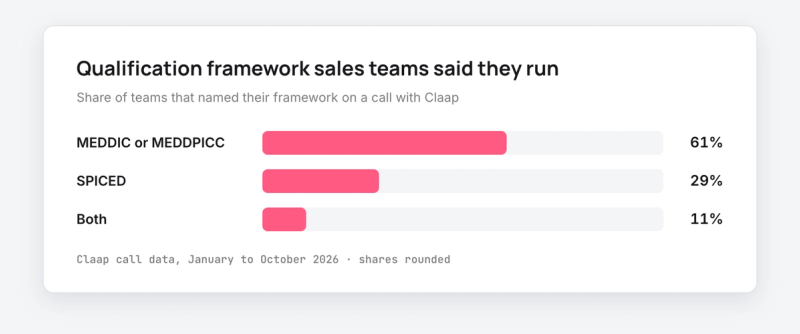
- MEDDIC teams often keep it for the big deals. A sales leader at a data storage company: "We use the MEDDIC process for some of our deals. So any of the major deals will use MEDDIC."
- Teams that run both split by account size. A sales enablement lead at a hospitality software company: "[We] use both, so SPICED and MEDDIC, depending on the size of the account."
- Short cycles push MEDDIC out. A sales manager at an employer branding company (translated from French): "MEDDIC, I don't think it applies [...] because our sales cycles aren't as complicated and long as MEDDIC."
Our own sales team runs SPICED in two layers. Every rep writes a SPICED note by hand on each deal and updates it after every call, because writing it forces the rep to think about what is still missing. Claap fills the matching CRM fields from the call, so managers report on those.
MEDDIC vs SPICED at a glance
| MEDDIC | SPICED | |
|---|---|---|
| Created | 1996, at PTC | 2012, by Winning by Design |
| Built for | Perpetual software deals | Recurring revenue (SaaS) |
| Question it answers | Can we win this deal, and is it real? | Why would this buyer change, and by when? |
| Best moment | Deal review and forecast call | Discovery call |
| Letters | 6 (8 in MEDDPICC) | 5 |
| Weak spot | Says little about how to run discovery | Light on paperwork and competition |
Sources: MEDDICC's own site for MEDDIC, Winning by Design for SPICED.
What MEDDIC covers
MEDDIC is a deal checklist: it tells a manager whether a deal is real and what is still unknown.
- Metrics: the numbers the buyer will use to judge success.
- Economic Buyer: the person who can sign off the budget.
- Decision Criteria: what the buyer will compare vendors on.
- Decision Process: the steps and people between today and a signature.
- Identify Pain: the problem that makes the deal worth doing.
- Champion: the person inside the account who sells for you when you are not in the room.
MEDDPICC adds Paper Process (legal, security and procurement steps) and Competition. Use MEDDPICC when your deals go through procurement, because MEDDIC has no letter for those steps.
What SPICED covers
SPICED is a discovery framework: it tells the rep what to learn on the call so the buyer sees the cost of doing nothing. Winning by Design created it for recurring revenue businesses.
- Situation: the buyer's current context and what triggered the conversation.
- Pain: the specific friction or risk, in concrete terms.
- Impact: what solving the pain changes for the business, and for the person.
- Critical Event: the deadline or milestone that sets when a decision must happen.
- Decision: who decides, on what criteria, through which process.
MEDDIC and SPICED pros and cons
MEDDIC pros
- It makes a forecast call concrete: each letter is known or unknown.
- The Economic Buyer and Champion letters catch single-threaded deals early.
MEDDIC cons
- It gives reps no structure for the discovery call itself.
- On deals that close in one or two calls, most letters stay empty for good reasons.
- Reps can treat it as a form to fill for the manager.
SPICED pros
- Impact and Critical Event give the buyer a reason to decide now.
- It maps to a single discovery call, the call reps already run.
- It works after the sale too, for renewals and expansion.
SPICED cons
- Decision is one letter where MEDDIC uses three, so complex buying committees get less scrutiny.
- It has no letter for competition or procurement.
- Without a scoring habit, it stays a list of questions.
How to run MEDDIC and SPICED together
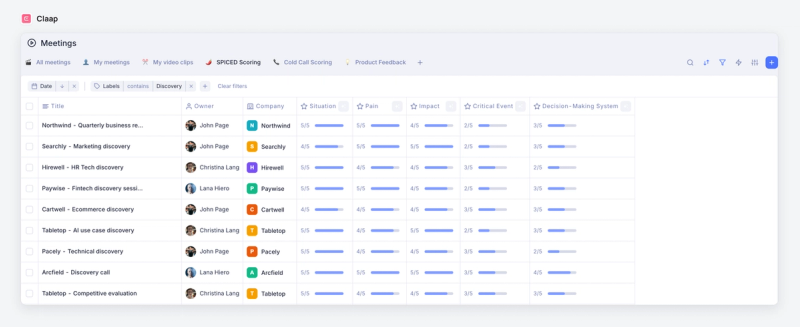
- Score every discovery call on SPICED. Each call gets a score per letter, so a manager sees which calls skipped Critical Event without listening to them.
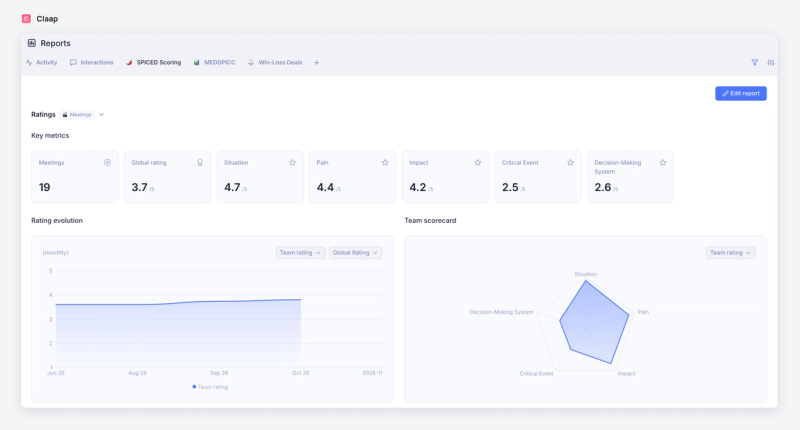
- Coach on the letter the team skips. Average the SPICED scores per letter across the team: the lowest letter is next week's coaching topic.
- Inspect the deal on MEDDIC before it enters the forecast. Before a deal moves to commit, check Economic Buyer, Decision Process and Champion. On a procurement-heavy deal, add Paper Process.
- Put the letters on the deal. Keep the rep's own notes if writing them helps, as ours do, and let CRM fields carry the score the manager reads. Map each letter to a deal field with CRM auto-complete.
We'd use SPICED alone when deals close in a call or two with one decision maker, because MEDDIC would mostly record blanks.
Choose MEDDPICC over MEDDIC when security and legal reviews are part of every deal.
Start with SPICED if your team has no framework today, because it maps to the discovery call your reps already run.
This advice is wrong if your team sells one product to one buyer persona in a single call: there is no deal to inspect, and one short checklist will do.
How Claap scores MEDDIC and SPICED calls
A quick note: Claap is our product, and the call data in this guide comes from our own sales calls.
Claap's call scoring ships MEDDIC, MEDDPICC, BANT and SPICED as templates you can edit, and each letter is an AI field rated 0 to 5 or from a list you define. As the call scoring page puts it: "Claap grades every call the moment it ends, so you see where each rep stands."
- Every recording gets a Coaching tab with the score per letter beside a timestamped transcript.
- After each call, CRM auto-complete fills HubSpot or Salesforce properties from the call, so the letters sit on the deal.
AI coaching is on the Business plan, at $60 per seat per month billed yearly, according to Claap's pricing page. To try the grid on a single call first, paste a transcript into the free SPICED scorer or MEDDIC scorer.
MEDDIC vs SPICED takeaways
- If your reps sell to small and large accounts, split by account size. SPICED on every discovery call, MEDDIC on the deals big enough to forecast.
- Coach on the lowest SPICED letter. The team average per letter tells you what to work on next week.
For related comparisons, read MEDDPICC vs SPIN and MEDDIC vs SPIN.
Frequently asked questions
Who invented MEDDIC?
MEDDIC was created inside PTC in 1996 by Dick Dunkel, with Jack Napoli credited as co-creator, according to MEDDICC's own site.
What does MEDDPICC stand for?
Metrics, Economic Buyer, Decision Criteria, Decision Process, Paper Process, Identify Pain (also written Implicate the Pain), Champion and Competition.
What is the difference between MEDDIC and BANT?
BANT checks Budget, Authority, Need and Timeline, usually in one early call. MEDDIC goes deeper on how the decision gets made: who signs, on what criteria, through which steps, and who champions the deal inside the account.
What is the difference between MEDDICC and MEDDPICC?
MEDDICC adds Competition to MEDDIC, and MEDDPICC also adds Paper Process, according to Winning by Design.