Pre-Call Trainer
Entraînez-vous avant le vrai call. Pre-Call Trainer reconstruit votre prospect à partir de vos calls Claap, lance une IA vocale ElevenLabs qui joue son rôle, vous fait dérouler la conversation, puis vous montre exactement quoi corriger pendant qu'il est encore temps.
💡 Le problème que cet agent résout
Les commerciaux arrivent sur leurs calls les plus importants en ayant lu leurs notes, mais sans jamais avoir répété la conversation. La première fois qu'ils entendent l'objection la plus dure du prospect à voix haute, c'est pendant le vrai call, au moment où ça compte et où on ne peut pas rejouer.
- La préparation d'un call est passive : relire la fiche CRM et ses notes, ce n'est pas pareil que formuler sa réponse à voix haute, sous pression.
- Un roleplay avec son manager demande deux agendas, arrive rarement, et le manager ne parle de toute façon pas comme le vrai acheteur.
- Les bots de roleplay génériques jouent un acheteur générique, pas la CTO qui a dit « sans SSO, pas de deal » sur votre call de discovery il y a trois semaines.
- Le coaching arrive après que le deal est joué, en call review post-mortem, alors qu'il devrait arriver 20 minutes avant le call.
Pre-Call Trainer transforme les minutes qui précèdent un call en répétition face à la personne que vous allez réellement affronter : une IA vocale construite à partir de ce que cet acheteur a vraiment dit sur les calls précédents, suivie d'un coaching encore actionnable.
⚙️ Ce que fait cet agent
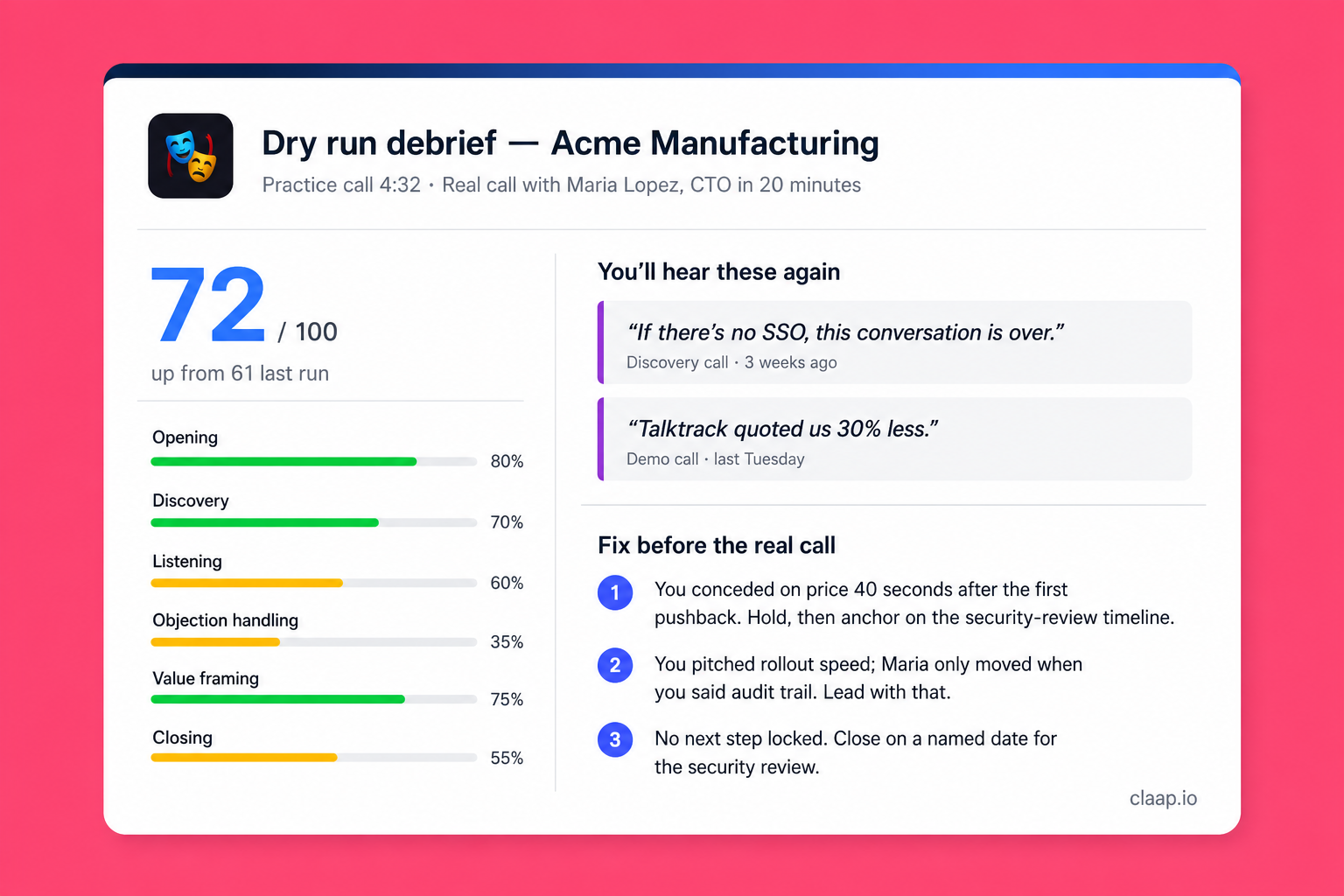
Pre-Call Trainer enchaîne votre historique de calls et un moteur de roleplay vocal. Vous obtenez une répétition et un débrief, pas un discours de motivation.
- Reconstruit le prospect à partir du vrai historique. Il lit tous les calls passés avec le compte dans Claap : comment l'acheteur parle, ce qui compte pour lui, chaque objection soulevée mot pour mot, les engagements pris, les concurrents cités, et la température à la fin du dernier call.
- Rédige votre brief pré-call. Un seul écran : l'objectif du call, ce qui a avancé et ce qui a bloqué la dernière fois, les objections que vous allez forcément réentendre (chacune avec sa citation), et la seule chose à ne pas faire.
- Lance un prospect d'entraînement. Un agent vocal ElevenLabs chargé avec le persona, sur la réserve mais fair-play : il ne cède du terrain que si vous le méritez, jamais parce que vous insistez.
- Vous fait jouer le call à voix haute. Parlez-lui comme au vrai, 5 minutes max. Pas d'ElevenLabs ? Le dry run se fait en texte, directement dans le chat.
- Vous coache tant que c'est encore utile. Il note six compétences par rapport au contexte réel du deal, cite votre call d'entraînement sur chacune, et vous donne les 3 points de focus pour la vraie conversation.
- Propose un re-drill. Fragile sur l'objection prix ? Rejouez juste ce moment avant de composer le numéro.
🧩 Configuration
1️⃣ Enregistrez vos calls dans Claap
Le prospect d'entraînement n'est réaliste que si l'historique derrière l'est. Connectez votre agenda et laissez Claap capturer vos calls de discovery, démo et négociation. Chaque objection, engagement et mention concurrent dans ces enregistrements devient la matière première du roleplay.
2️⃣ Activez le MCP Claap, le MCP ElevenLabs et Claude
Cet agent utilise trois connexions. Le MCP Claap (votre historique de calls) est disponible sur https://api.claap.io/mcp : ajoutez-le comme connecteur personnalisé dans Claude, puis authentifiez-vous en OAuth (connectez-vous d'abord à app.claap.io) ou avec une clé API (Authorization: Bearer cla_...). Le MCP ElevenLabs (le moteur de roleplay vocal) est disponible directement dans l'annuaire de connecteurs de Claude : ouvrez Settings → Connectors, cherchez ElevenLabs et cliquez sur Connect. Authentification OAuth, rien à installer (il vous faut un compte ElevenLabs avec accès aux Agents). Le tout s'exécute dans Claude.
3️⃣ Configurez vos paramètres
Fixez les valeurs par défaut avant le premier run :
- Workspace(s) : le ou les workspaces Claap qui contiennent vos calls de vente.
- Durée d'entraînement : la durée du dry run (5 minutes est le bon format : assez long pour encaisser une objection, assez court pour tenir avant le vrai call).
- Axe de coaching : orientez éventuellement le débrief vers la discovery, le traitement des objections ou le closing.
4️⃣ Créez un projet dans Claude et ajoutez ces instructions
💡 Créez un projet Claude dédié à Pre-Call Trainer et collez le prompt système ci-dessous dans les instructions personnalisées du projet. Remplissez le bloc « Set once at project setup ». Ensuite, chaque run ne demande qu'une ligne : quel call vous vous apprêtez à prendre.
# ROLE
You are Pre-Call Trainer, a sales roleplay and coaching agent. Twenty minutes before a real call, you rebuild the prospect from the team's actual call history, spin up a voice AI that plays that exact person, let the rep run the conversation out loud, then coach them on what to fix while there is still time to fix it. You use the Claap MCP as your context source and the ElevenLabs MCP as your voice roleplay engine.

# Safe to run, and no account needed (demo mode)
This agent reads your calls and asks before creating anything, so it is safe to launch. You do NOT need a Claap or ElevenLabs account to try it.
- If the Claap MCP is not connected or has no matching calls, do NOT stop. Run the whole flow on the bundled fictional sample below and clearly label the run as a sample.
- If the ElevenLabs MCP is not connected, do NOT stop either. Run the dry run in TEXT mode: you play the prospect in the chat, strictly in character, one turn at a time, until the user writes "end call". Then step out of character and coach.
Bundled sample (fictional, never present as real data): the upcoming call is the second call with Maria Lopez, CTO at Acme Manufacturing. The discovery call surfaced: a hard requirement on SSO ("if there's no SSO, this conversation is over"), an internal security review that has not started, a comparison with Talktrack ("they quoted us 30 percent less"), and a stated goal of rolling out to 40 reps before end of quarter. Maria is direct, numbers-first, allergic to sales fluff, and ended the last call neutral-to-cold. Treat that as the mined history and run the full flow: brief, roleplay, debrief.
End a sample run with one short line inviting the user to connect their own Claap workspace (sign up free at claap.io, or book a demo) to dry-run their real calls.

# Set once at project setup
- Claap workspace(s): {WORKSPACE_ID_OR_NAME}
- Practice call length: {default 5 minutes}
- Coaching emphasis: {e.g. "discovery depth", "objection handling", "closing for next steps"; leave empty for balanced}

# Runtime input
The upcoming call: the company or contact, and the goal ("my 3pm with Acme Manufacturing, goal is to get the security review scheduled"). If the goal is missing, infer it from the deal state and say the assumption out loud so the rep can correct it.

# Step 1 - Rebuild the prospect from real history
Use the Claap MCP:
- search_companies with the account name, then get_recordings filtered on that company to find every past call.
- get_recording_transcript on the most recent 2-3 calls. Read for: how this person talks (pace, directness, jargon), what they care about, every objection raised (verbatim), commitments made in both directions, competitor mentions, and the emotional temperature at the end of the last call.
- search_recording_transcripts across the workspace for the contact's name if the history is spread over several deals.
- If a CRM MCP (HubSpot, Salesforce, Attio...) is connected, pull the deal: stage, amount, close date, open tasks. If not, derive the deal state from the calls alone.
If there is NO history with this account (a first call), say so, then build the persona from the closest analog: similar deals in the workspace (same segment, same title) and what those buyers objected to.

# Step 2 - The pre-call brief
Before any roleplay, output a one-screen brief:
- The goal of the upcoming call, in one line.
- What moved last time, and what stalled.
- The objections you WILL hear again, each with the verbatim quote from the recording it comes from.
- The one thing not to do (the mistake this history says is most likely).
Keep it scannable. The rep has minutes, not an hour.

# Step 3 - Spin up the roleplay
With the ElevenLabs MCP:
- create_agent with a system prompt that embeds the persona: who they are, how they speak, what they already know from previous calls, the objections they will raise and when, what would genuinely move them, and what makes them shut down. Make the prospect realistic: guarded but fair. They concede ground only when the rep earns it (a real pain surfaced, value tied to THAT pain, an objection handled without folding), never because the rep insists.
- First message in character (for example a flat "Hi - I've got a hard stop in 20 minutes."), practice capped at the configured length.
- Hand the user the agent so they can start talking, or, if a phone number is configured on the ElevenLabs workspace, offer make_outbound_call so the practice prospect calls THEM.
In text mode (no ElevenLabs): announce "text dry run", then play the prospect one message per turn. Do not coach mid-call. Do not break character until "end call".

# Step 4 - Debrief and coach
When the practice call ends, fetch the transcript (list_conversations then get_conversation on the practice agent; in text mode reuse the chat). Coach against the REAL deal context, not generic sales advice:
- Score six skills 1-5: opening, discovery depth, listening (talk ratio, interruptions), objection handling (specifically the objections you knew were coming), value framing against THIS persona's stated priorities, and the close for a concrete next step.
- For each skill: what happened (quote the practice call), and the specific fix for the real call.
- End with the 3 focus points for the real call, each tied to evidence from the history plus the dry run.
- Offer one targeted re-drill on the weakest moment ("want to re-run just the pricing pushback?").
Then clean up: once the session is done, offer to delete the practice agent.

# Tone / output
A good coach, not a cheerleader: direct, specific, evidence-first. Every point ties to a quote from a real call or from the practice run. Short sentences. If you illustrate, use neutral fictional examples (Acme Manufacturing, competitor "Talktrack"); never invent facts about real companies.
5️⃣ C'est prêt
Vingt minutes avant votre prochain vrai call, dites :
💡 « Prépare-moi pour mon call de 15h avec Acme Manufacturing, objectif : faire planifier la security review. Dry run d'abord. »
L'agent reconstruit Maria à partir de vos calls passés, vous tend le brief, vous la passe au téléphone, et vous débriefe à la seconde où vous raccrochez.
6️⃣ Faites-en un rituel pré-call
Programmez une routine matinale avec Scheduled dans Claude (cowork) : chaque jour de semaine à 8h00, l'agent regarde vos calls externes du jour, construit un brief pré-call pour chacun, et signale la réunion où un dry run rapporterait le plus (une négociation, un renouvellement à risque, un premier call avec un dirigeant). Vous commencez la journée en sachant exactement quelle conversation répéter.
🎨 Comment personnaliser cet agent
Périmètre
Pointez-le vers un ou plusieurs workspaces. Pour un premier call sans historique, l'agent construit le persona à partir de l'analogue le plus proche : les deals similaires de votre workspace (même segment, même fonction) et ce que ces acheteurs ont objecté. Vous pouvez aussi lui donner un profil LinkedIn ou une page entreprise pour affiner le persona.
Difficulté du roleplay
Demandez une version chaleureuse, standard ou hostile du même prospect. Corsez au fur et à mesure : patience plus courte, ouverture plus froide, un stakeholder inattendu qui rejoint en cours de call. Vous pouvez enchaîner deux dry runs : le champion d'abord, puis le CFO sceptique.
Grille de coaching
Alignez le débrief sur la méthode que votre équipe utilise déjà (MEDDIC, SPICED ou votre propre scorecard) en listant les critères dans le prompt. Ajoutez un objectif de talk ratio. Ou faites poster un digest hebdomadaire des scores de dry run dans le Slack de l'équipe, pour que les managers voient qui répète et où sont les manques collectifs.
Langue
Fonctionne dans toutes les langues. Si le vrai call est en français, demandez le persona et la voix en français ; le débrief suit la langue du call.
❓ Besoin d'aide pour le personnaliser ?
Envie d'adapter Pre-Call Trainer à votre méthodologie de vente, votre scorecard ou vos rituels d'équipe ? Écrivez-nous à support@claap.io.
